
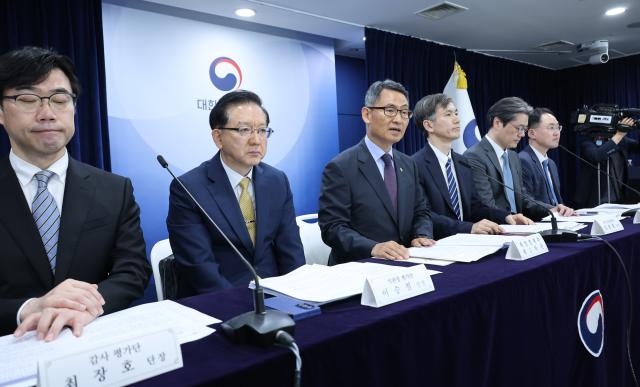
Heo Jang, Deputy Minister of Finance, announces the results of the 2025 public institution management evaluation at the Government Seoul Complex in Jongno, Seoul, on June 19. [Photo=Yonhap]
Among major public institutions under the Ministry of Agriculture, Food and Rural Affairs, only the Korea Racing Authority improved its management evaluation this year. In contrast, the Korea Rural Community Corporation received a warning for its leadership following a fatal incident last year.
The Ministry of Finance held its seventh Public Institution Operation Committee meeting on June 19, chaired by Deputy Prime Minister and Minister of Finance Koo Yun-cheol, to review and approve the '2025 Public Institution Management Performance Evaluation Results and Follow-up Measures.'
The Korea Racing Authority was the only institution to achieve a higher rating among major public institutions under the Ministry of Agriculture. It improved from a C rating last year to a B rating this year. However, it received a standard rating for its leadership contract performance evaluation.
The Korea Agro-Fisheries & Food Trade Corporation (aT) was also classified as a B rating, maintaining the same rating as last year. aT received a standard rating for its leadership contract performance evaluation as well.
The Korea Rural Community Corporation faced a warning for its leadership after a fatal incident occurred during the tenure of its head last year. While it received an excellent rating for its leadership contract performance evaluation, its overall management evaluation was classified as a C rating.
Kim Chang-wan, head of the Public Institution Management Evaluation Committee, stated, "Among quasi-government institutions where serious accidents occurred, five institutions, including the Korea National Park Service, Korea Rural Community Corporation, Korea Asset Management Corporation, Korea Electric Safety Corporation, and Korea Environmental Corporation, were evaluated at the lowest grade for their industrial accident-related indicators after reviewing their accident prevention systems and measures to prevent recurrence."
The Livestock Quality Assessment Agency received a C rating for the second consecutive year, with its leadership contract performance also classified as standard. No institutions under the Ministry of Agriculture received ratings of D or E.
The government plans to provide performance bonuses to institutions that received a rating of C or higher, differentiated by institution type and rating. Conversely, institutions rated D or lower will be required to submit management improvement plans and undergo management consulting.
This evaluation covered the management performance of 88 public institutions, including 31 public enterprises and 57 quasi-government institutions, for the previous year. The government placed significant emphasis on evaluating the performance of major projects and national agenda initiatives, while also considering social responsibilities such as safety and environmental sustainability, financial soundness, and efforts to enhance operational efficiency. Additionally, the evaluation included the institutions' efforts for management innovation using artificial intelligence (AI).
The overall evaluation results showed that 15 institutions received an excellent (A) rating, 29 received a good (B) rating, 28 received a standard (C) rating, 13 received a poor (D) rating, and 3 received a very poor (E) rating. Compared to last year, the number of excellent institutions remained the same, but the number of institutions rated poor or lower increased from 13 to 16.
The Ministry of Finance held its seventh Public Institution Operation Committee meeting on June 19, chaired by Deputy Prime Minister and Minister of Finance Koo Yun-cheol, to review and approve the '2025 Public Institution Management Performance Evaluation Results and Follow-up Measures.'
The Korea Racing Authority was the only institution to achieve a higher rating among major public institutions under the Ministry of Agriculture. It improved from a C rating last year to a B rating this year. However, it received a standard rating for its leadership contract performance evaluation.
The Korea Agro-Fisheries & Food Trade Corporation (aT) was also classified as a B rating, maintaining the same rating as last year. aT received a standard rating for its leadership contract performance evaluation as well.
The Korea Rural Community Corporation faced a warning for its leadership after a fatal incident occurred during the tenure of its head last year. While it received an excellent rating for its leadership contract performance evaluation, its overall management evaluation was classified as a C rating.
Kim Chang-wan, head of the Public Institution Management Evaluation Committee, stated, "Among quasi-government institutions where serious accidents occurred, five institutions, including the Korea National Park Service, Korea Rural Community Corporation, Korea Asset Management Corporation, Korea Electric Safety Corporation, and Korea Environmental Corporation, were evaluated at the lowest grade for their industrial accident-related indicators after reviewing their accident prevention systems and measures to prevent recurrence."
The Livestock Quality Assessment Agency received a C rating for the second consecutive year, with its leadership contract performance also classified as standard. No institutions under the Ministry of Agriculture received ratings of D or E.
The government plans to provide performance bonuses to institutions that received a rating of C or higher, differentiated by institution type and rating. Conversely, institutions rated D or lower will be required to submit management improvement plans and undergo management consulting.
This evaluation covered the management performance of 88 public institutions, including 31 public enterprises and 57 quasi-government institutions, for the previous year. The government placed significant emphasis on evaluating the performance of major projects and national agenda initiatives, while also considering social responsibilities such as safety and environmental sustainability, financial soundness, and efforts to enhance operational efficiency. Additionally, the evaluation included the institutions' efforts for management innovation using artificial intelligence (AI).
The overall evaluation results showed that 15 institutions received an excellent (A) rating, 29 received a good (B) rating, 28 received a standard (C) rating, 13 received a poor (D) rating, and 3 received a very poor (E) rating. Compared to last year, the number of excellent institutions remained the same, but the number of institutions rated poor or lower increased from 13 to 16.
* This article has been translated by AI.
Copyright ⓒ Aju Press All rights reserved.