
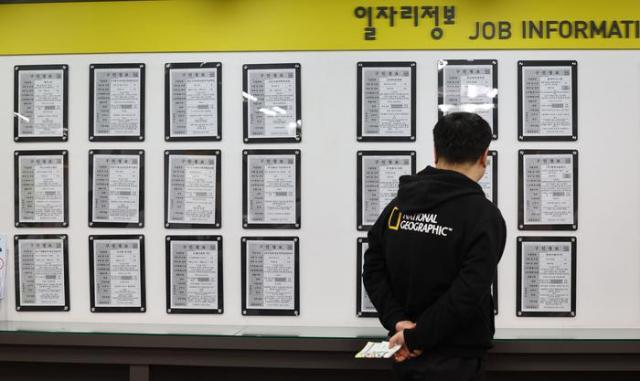
The proposal to extend the retirement age to 65 has become a central issue in South Korean politics, while the youth job market continues to freeze. As the need for continued employment among older workers grows, the youth unemployment crisis deepens, presenting the country with a 'new equation' in its labor market that has never been experienced before.
According to the National Data Agency's employment trends report for May, the number of employed individuals aged 15 to 29 decreased by 255,000 compared to a year ago, marking the largest decline since the peak of the COVID-19 pandemic in 2021. The youth employment rate fell to 43.8%, while the unemployment rate rose to 7.2%. Notably, the number of wage workers with permanent positions dropped to 16.74 million, a decrease of 7,000 from the previous year, marking the first decline since December 1999.
In response to the aging population and the high elderly poverty rate, which is among the highest in OECD countries, the ruling party is actively pursuing legislation to extend the legal retirement age. This move is seen as necessary to accommodate the increasing life expectancy.
However, concerns are rising that extending the retirement age may encroach on youth job opportunities. Business leaders worry that if the retirement age is extended while maintaining the seniority-based wage system, companies may face increased labor costs and reduced capacity for new hires. There is a particular fear that the decline in youth hiring will be pronounced in the manufacturing sector and among large corporations.
The Korea Development Institute (KDI) reported in 2023 that since the mandatory retirement age of 60 was implemented in 2016, employment among older workers has increased, while youth employment has decreased in some companies. The report noted that the substitution effect was particularly significant in large corporations and the manufacturing sector, with a trend showing that for every additional older worker, youth employment decreased by 0.2 positions.
Nevertheless, some argue that the relationship between retirement age extension and youth employment cannot be viewed as a simple 'zero-sum game.' Institutions like the Korea Labor Institute and the OECD emphasize that jobs for youth and older workers do not necessarily compete with each other. They point out that retaining skilled workers can enhance productivity and lead to job creation through increased consumption.
Critics also highlight that the issue may lie more with the seniority-based wage system than with the retirement age itself. Under the current wage structure, longer tenures lead to significantly higher labor costs, which may incentivize companies to reduce new hiring. This has led to calls for discussions that encompass retirement age extension, wage system reform, and continued employment strategies.
Countries around the world have already adopted various approaches to address aging populations. Japan has expanded continued employment through reemployment systems after retirement, while Germany has established a job-based wage system to alleviate corporate burdens. In contrast, South Korea's strong adherence to seniority-based pay raises the potential for generational conflict over retirement age discussions. While extending the retirement age seems inevitable, the challenge of simultaneously addressing youth employment and the livelihoods of older workers makes South Korea's situation more complex than that of other nations.
* This article has been translated by AI.
Copyright ⓒ Aju Press All rights reserved.