
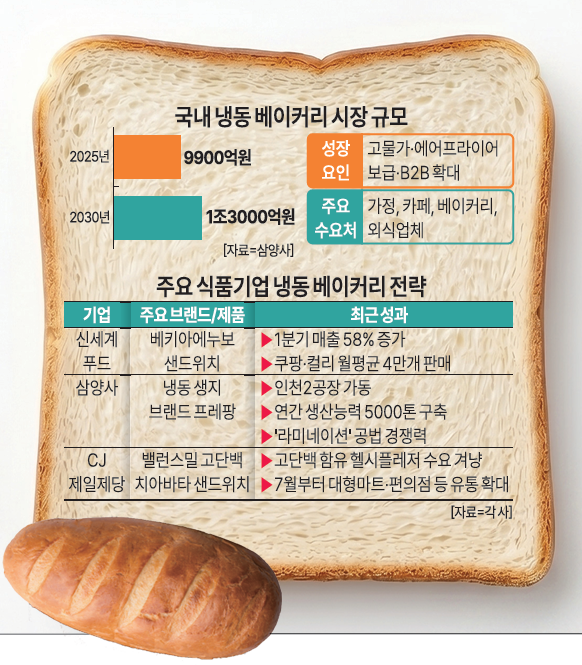
The frozen bakery market is experiencing rapid growth, driven by prolonged high prices and the increased adoption of air fryers. Once primarily used by large franchises, hotels, and cafes, frozen dough is now making its way into households, prompting food companies to accelerate investments in production facilities and expand their product lines.
According to the food industry on June 22, the frozen bakery market is witnessing robust growth due to rising demand from both households and business-to-business (B2B) sectors. Samyang estimates that the domestic frozen bakery market, valued at approximately 990 billion won last year, could grow to 1.3 trillion won by 2030.
The growth is attributed to high prices and the convenience of preparation. Frozen bakery products are baked to about 80-90% and then rapidly frozen, allowing consumers to enjoy bread with a freshly baked texture and flavor after reheating. This pre-prepared process simplifies production for restaurants, enabling them to maintain consistent quality without specialized staff. Additionally, the recent rise of air fryers and home ovens as essential appliances has increased demand in households.
With significant growth potential, competition among major companies is intensifying. Samyang recently completed an expansion of its frozen dough production line at its Incheon Plant 2, investing a total of 52 billion won. The plant's annual production capacity has increased to 5,000 tons, more than quadrupling that of the previous pilot plant. Leveraging this increased capacity, Samyang has launched its own frozen dough brand, 'Prepan,' aiming to capture a market share of around 15% by focusing on its competitive edge in the lamination process, which involves repeatedly folding dough and butter to create layers.
Shinsegae Food is enhancing its presence with its frozen sandwich brand 'Beckia Enuvo.' In the first quarter of this year, Shinsegae Food's frozen sandwich sales surged by 58% compared to the same period last year. Buoyed by this strong performance, the company has set its annual sales target at 61 billion won, an 11% increase from the previous year. Shinsegae Food plans to accelerate its efforts in both business-to-consumer (B2C) online channels and the B2B market targeting franchise cafes, as well as its original design manufacturing (ODM) business.
Samlip reported a 16% increase in sales in its frozen bakery segment, which includes buns and desserts, in the first quarter compared to the previous year. The company aims for a 30% growth in its frozen dough business this year. Hyundai Green Food is also selling frozen bakery products through its premium brand 'Bezzly,' with first-quarter sales rising by 73% year-on-year. The company plans to broaden its distribution channels while diversifying its product offerings.
New entrants are also joining the market. CJ CheilJedang recently launched two high-protein ciabatta sandwiches under its 'Balance Meal' brand, targeting the health-conscious consumer segment that seeks both nutrition and culinary enjoyment. The company plans to test market reactions through its official online store before expanding sales channels to large supermarkets, convenience stores, and online platforms next month.
Industry experts believe that frozen bakery products have established themselves as a distinct and substantial food category. A food industry representative stated, "In the past, frozen dough was often perceived as a low-cost product, but quality has significantly improved, leading to its active use in professional bakeries and cafes. Given the ongoing high prices and labor shortages, we expect steady growth in demand from both households and cafes and restaurants."
* This article has been translated by AI.
Copyright ⓒ Aju Press All rights reserved.