
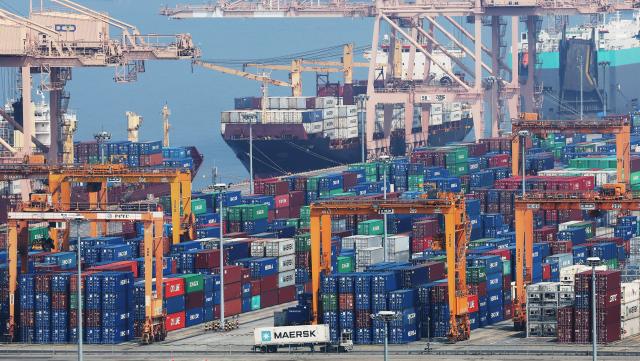
On June 23, the government held the "2026 12th Joint Government Briefing on EU CBAM Response" at the Busan Chamber of Commerce and Industry, in collaboration with the Korea Customs Service, the Ministry of Trade, Industry and Energy, the Ministry of Climate, Energy and Environment, and the Ministry of SMEs and Startups.
Implemented to prevent carbon leakage in EU industries, the CBAM requires that specific imported goods report their carbon emissions generated during production and bear future carbon costs.
Since December of last year, the EU has been releasing detailed regulations, including guidelines for calculating emissions. As a result, domestic companies must understand these new regulations and incorporate them into their export practices.
The CBAM could directly impact the export competitiveness of carbon-intensive sectors such as steel and aluminum. Not only major corporations but also small and medium-sized enterprises supplying raw materials, components, and parts will be required to submit emissions data, highlighting the importance of managing carbon data across the supply chain. In the current global trade environment, which is rapidly shifting towards carbon and environmental regulations, the CBAM is viewed as a significant "green trade barrier."
During the briefing, the government will provide practical guidelines on EU emissions verification trends and methods for calculating embedded emissions. Additionally, one-on-one customized consultations will be available for companies that apply in advance.
The challenges of responding to the CBAM extend beyond merely calculating carbon emissions. Exporters must verify whether their products fall under the CBAM and align the product numbers and emissions data required by EU importers. The need to pass verification by designated agencies adds to the burden on small exporters.
To assist exporters in determining whether their products are subject to the CBAM, the Korea Customs Service will distribute a "EU Product Classification Pre-Assessment Guidebook." There may be discrepancies between product numbers on domestic export declarations and EU import declarations, even for the same items. Furthermore, to help small businesses struggling with emissions calculations, the government will enhance and distribute the "CBAM-PASS" carbon emissions calculation program for free.
The Ministry of Trade, Industry and Energy is providing tailored consultations through a dedicated CBAM help desk and has published case-based explanatory materials on the confirmed emissions calculation methods. The Ministry of Climate, Energy and Environment is conducting customized consulting for companies subject to the CBAM and is revising and distributing explanatory materials on emissions calculations by industry.
The government plans to collaborate with relevant agencies to develop support measures that will help South Korean exporters maintain their competitiveness amid tightening EU environmental regulations and will continue discussions with related authorities.
Han Min, Director of the International Customs Cooperation Bureau at the Korea Customs Service, stated, "This year is crucial for small and medium-sized enterprises exporting to the EU to thoroughly prepare for the full implementation of the CBAM. We hope this briefing will help companies accurately understand the system and establish effective response strategies."
* This article has been translated by AI.
Copyright ⓒ Aju Press All rights reserved.