
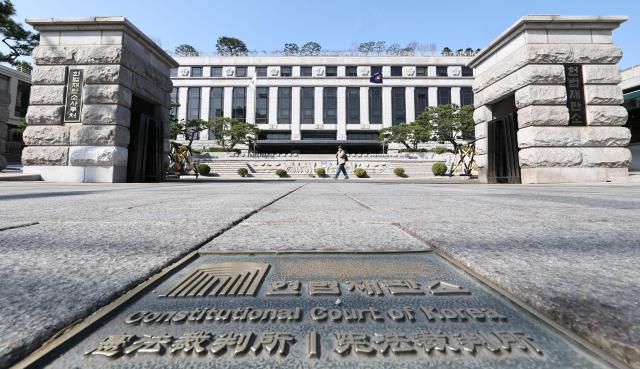
KBS journalists facing civil liability for defamation related to a report on Han Joo-hee, chairman of Han & Brothers, have had their case accepted for review by the Constitutional Court. The court announced on June 23 that it has decided to refer the journalists' constitutional complaint (2026헌마1776) to the full bench after a preliminary review by a designated panel.
The designated panel typically dismisses cases that are clearly inadmissible, indicating that the Constitutional Court found significant constitutional value in this case to warrant further examination.
The KBS journalists reported anonymously on allegations that Han Joo-hee engaged in inappropriate lobbying and embezzlement of large sums of money from public officials between June 8 and 17, 2023. The report also included details of Han's previous criminal record for fraud.
The journalists did not stop at the initial report; they further aired a documentary on September 12 of the same year, reiterating the allegations anonymously.
In response, Han's legal team claimed that KBS's reporting constituted defamation through the dissemination of false information and invasion of privacy, filing a civil lawsuit seeking 1.2 billion won (approximately $1 million) in damages. However, they did not pursue criminal charges.
During the trial, the initial court's decisions varied, but in January of this year, the Seoul High Court partially upheld the defamation claims against the journalists, ordering them to pay 10 million won (about $7,500) each. The court's concern was not about the allegations of falsehood or lobbying but rather the reporting of Han's past criminal record.
The court noted, "By reporting both the current fraud allegations and Han's past criminal record while detailing the alleged crimes, the journalists left the impression that the plaintiff was guilty of current charges in the eyes of viewers."
The court further stated, "It is difficult to conclude that the reporting of past criminal records falls within the legitimate scope of press activities aimed at monitoring and criticizing public officials," thus holding the journalists liable for defamation. In April, the Supreme Court dismissed the journalists' appeal, finalizing the ruling.
Following the confirmation of the ruling, the journalists filed a constitutional complaint on June 2, arguing that the court's decision threatens the exercise of press and publishing freedoms and violates the principle of proportionality. They contend that the anonymous disclosure of past convictions in a documentary is a matter of public interest regarding trust in public officials, thus exempting them from civil liability.
This case is expected to be a significant example since the introduction of a system allowing constitutional complaints against court rulings on March 12. Public opinion may vary regarding whether this incident constitutes an infringement on press freedom or if the protection of personal rights is paramount.
Since the implementation of this system, a total of 1,075 constitutional complaint cases have been filed, with only nine cases passing the threshold for full bench review, while the remaining 916 were dismissed.
The Constitutional Court is set to closely examine the extent to which public interest can be recognized as a justification for civil liability in cases of factual defamation. A court official stated, "The full bench will thoroughly review various issues, including specific criteria for balancing press freedom and individual personality rights concerning the anonymous disclosure of past convictions."
* This article has been translated by AI.
Copyright ⓒ Aju Press All rights reserved.