
The Korea Institute for Industrial Economics and Trade reported on June 24 in its study titled "Quantitative Analysis of South Korea's Industrial Policy and Policy Implications."
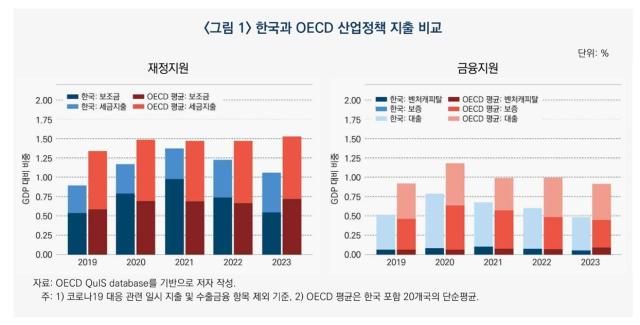
According to the analysis of data from the OECD's Quantification of Industrial Strategies (QuIS) project, as of 2023, the financial support for industrial policy among 20 member countries averaged 1.55% of their GDP, an increase of 0.21 percentage points from 1.34% in 2019.
In contrast, South Korea's industrial policy financial support stood at 1.06% in 2023, below the average. This marks a decline from a peak of 1.37% in 2021.
Financial support through loans and guarantees is also at a low level. While the OECD average for financial support is about 0.92% of GDP, South Korea's figure is approximately 0.49%. However, in terms of export financing, South Korea's support is about twice the OECD average, reflecting the country's export-oriented industrial characteristics, which tend to focus on short-term assistance.
The Herfindahl-Hirschman Index (HHI), which assesses concentration based on financial expenditures by project, indicates that South Korea ranks among the lowest, just above Chile. This suggests that while there are many government initiatives, the budget for each individual project is relatively small.
In terms of expenditure structure, horizontal policies that apply universally across all industries account for 65.0%, while vertical policies targeting specific industries or companies make up 35.0%. The report notes that vertical policies are increasingly concentrated in manufacturing sectors such as materials and research and development (R&D).
The Korea Institute for Industrial Economics and Trade warns that fragmented support could lead to inefficiencies in industrial policy. They recommend a shift towards a policy framework that clearly defines goals and significantly increases concentration of resources in critical areas.
Specifically, the report emphasizes the need to enhance support for advanced strategic industries and non-manufacturing sectors, including new industries. It calls for strengthening targeted support for advanced strategic industries while broadening the scope to include non-manufacturing areas such as artificial intelligence (AI) and information and communication technology.
The institute stated, "South Korea exhibits a relatively high number of policies with small individual support amounts, reflecting a small-scale and decentralized structure. This could lead to inefficiencies compared to the more aggressive support expansion seen in major global economies."
It also highlighted the necessity to expand policies for non-manufacturing sectors in line with the global trend of vertical shifts in industrial policy, and to develop a comprehensive evaluation system that assesses the achievement of policy objectives and efficiency relative to inputs, moving away from evaluations focused solely on individual company performance.
* This article has been translated by AI.
Copyright ⓒ Aju Press All rights reserved.