
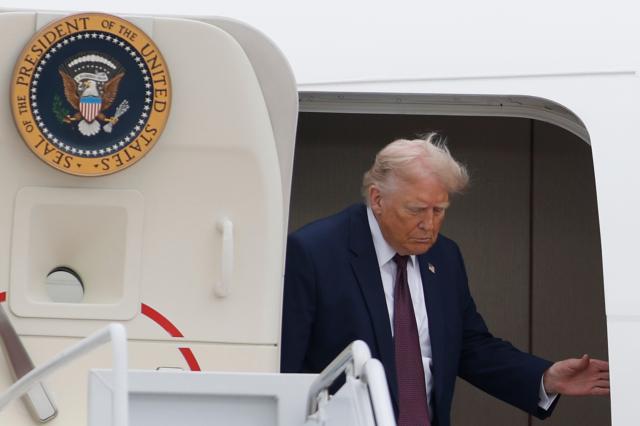
President Donald Trump, who initiated the Iran War, has finally signed a memorandum of understanding (MOU) for a ceasefire with Iran. However, there are no cheers of victory or sighs of relief. The political landscape in the United States is marked by a peculiar scene where both the war and the ceasefire are subjects of criticism.
Recently, the U.S. Senate passed a resolution aimed at preventing Trump from resuming military action in Iran, with a vote of 50 in favor and 48 against, marking the first successful attempt after ten tries. Four Republican senators—Susan Collins, Lisa Murkowski, Rand Paul, and Bill Cassidy—broke ranks to vote against the president. Even members of the ruling party are now questioning the president's war powers. Senate Democratic Leader Chuck Schumer stated, "This war will go down in history as one of the worst diplomatic blunders committed by the United States."
However, the context behind the passage of this resolution is not solely driven by anti-war sentiment. Hardline Republicans are expressing their dissatisfaction from the opposite end, arguing that the agreement is too weak. There is significant backlash regarding the inclusion of a $300 billion fund for Iran's reconstruction in the agreement. Texas Republican Senator Ted Cruz publicly criticized Trump, stating, "The president is receiving very misguided advice on the Iran issue." This creates a scenario where both factions—those advocating for more military action and those claiming the war ended too cheaply—are pressuring Trump.
The financial implications of the war are also a concern. An estimated $11.3 billion was spent in the first week alone, with total costs nearing $100 billion. Defense Secretary Pete Hegseth is seeking an additional $80 billion budget from Congress to replenish military supplies post-war. This request is unwelcome news for Americans already struggling with high gas prices and rising living costs. The passage of this resolution has raised doubts about the Defense Department's plan to secure the $80 billion war budget.
Public opinion is even harsher. A recent Reuters-Ipsos poll of 1,262 American adults found that only 24% believed the Iran War was worth fighting. Just 23% felt the U.S. is stronger now than before the war, while 35% believe the country is weaker. Only 18% expressed confidence that the agreement signed by Trump would lead to lasting peace. This indicates widespread dissatisfaction with both the conflict and the manner in which it has been halted.
Trump's approval rating is at a record low of 34%. Ahead of the midterm elections in November, only 17% of independent voters indicated they would support a Republican candidate, compared to 34% for Democrats. The legal effectiveness of the resolution remains uncertain, and it is unlikely that Trump will comply willingly. His true intention appears to be to secure a final agreement through a two-step follow-up negotiation. However, politics is driven by public sentiment rather than legalities. The outcomes of the two-step negotiations could potentially alter these evaluations. Yet, at this moment, Trump's Iran War is recorded as a conflict that has drawn criticism whether fought or paused—satisfying no one.
* This article has been translated by AI.
Copyright ⓒ Aju Press All rights reserved.