
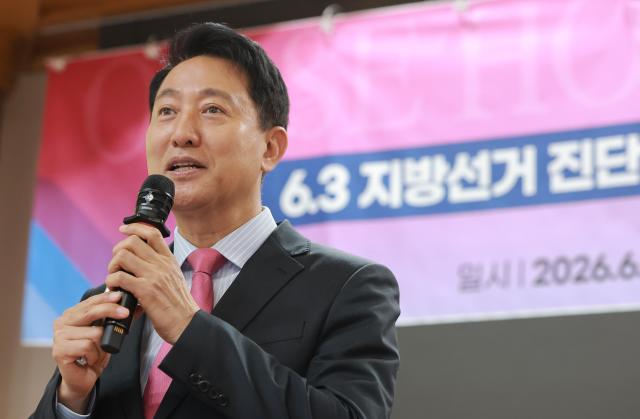
In his first comprehensive assessment following the June 3 local election victory, Seoul Mayor Oh Se-hoon delivered a surprisingly straightforward message on June 24 at the Korea Future Innovation Forum seminar held at the National Assembly.
Oh did not attribute his electoral success to polling techniques, campaign strategies, or political engineering. Instead, he explained his five-year administration by stating, "I conveyed the values of conservatism sincerely."
However, there is another interpretation of this election. If the 'sincerity' mentioned by Mayor Oh was the reason for his victory, it was ultimately recognized by the citizens of Seoul. Despite ongoing controversies over government influence, media framing, and various negative campaigns during the election period, voters chose policies and achievements in the end. In this sense, the election can be seen as a victory for both Oh Se-hoon personally and the 'intelligence of the citizens of Seoul.'
“Complete the Change That Has Begun”... A Message from Seoul Citizens
Oh did not view the election results as merely a local election victory.
During the campaign, he appealed, "Please leave at least one platform to check the government," and introduced the so-called 'magpie rice theory,' which stirred sentiments against the ruling party's dominance at the time.
Oh interpreted the votes given to him by the citizens of Seoul as a combination of a desire to check the runaway power and a call to continue the change that has begun.
Reasons for Young Voter Turnout... Housing and Jobs
Oh first addressed the youth demographic.
He cited housing policies such as the 'Miril House' initiative, expansion of youth housing, and job creation programs like the 'Youth Employment Academy' and 'Young Careers' as representative examples. Notably, the Youth Employment Academy was highlighted as a program providing digital and AI education to liberal arts and arts students, achieving high employment rates.
He confidently analyzed, "What mattered more than the policies themselves was sincerity." Although similar policies were proposed by opposing candidates, citizens trusted Oh Se-hoon's policies more. He attributed this to a difference in trust stemming from consistent policy execution and reliability.
A Time When Loneliness Became Policy
One notable aspect of his lecture was the concept of 'loneliness policy.'
Oh mentioned initiatives like 'Seoul Without Loneliness,' 'Comfort Convenience Store,' and 'Goodbye Loneliness 120,' stating, "Modern individuals are all lonely."
He emphasized that local governments can approach the issue of loneliness more intricately than the central government, highlighting that Seoul was the first city in the country to institutionalize this issue. He explained that the city's policies extend beyond economics and welfare to include psychological and relational aspects.
Policies Opposed by the Democratic Party Yield Results
Throughout his lecture, Oh repeatedly mentioned the word "(Democratic Party) opposition."
He noted that many of Seoul's flagship projects, such as the 'Thank You Garden,' 'Han River Bus,' 'Seoul Run,' 'Design Seoul,' 'Han River Renaissance,' and 'Nodeul Island Art Island Project,' were pursued amid opposition from the Democratic Party and civic groups.
In particular, he described 'Seoul Run' as a policy that restores the ladder of social mobility, claiming it resonated most with the younger generation.
Oh also stated that attacks labeling him as "inept" and "doing nothing" provided him with opportunities to explain his policy achievements to the public.
Reevaluation of Tourism and Attractive City Strategies
Another pillar of Oh Se-hoon's administration is tourism and urban branding.
He argued that policies previously criticized as "showy administration" and "superficial administration" have now become key assets in enhancing Seoul's competitiveness. He explained that initiatives like the DDP, Han River Renaissance, Fun City Strategy, nighttime economy activation, and Nodeul Island Art Island all stem from the same philosophy.
He emphasized that as we enter the AI era, the importance of the tourism industry will only increase, reiterating its role as a future growth engine for Seoul.
“Walking with the Vulnerable” Changes the Image of Conservatism
Oh identified 'walking with the vulnerable' as a key factor in his election victory.
He evaluated that through welfare policies like 'Safe Income,' 'Companion Restaurant,' and 'Warmth Warehouse,' he successfully shattered the image of conservatism as a 'party of the wealthy.'
He cited increased support in areas densely populated by single-person households, youth, and small business owners as evidence, asserting that "the sincerity of policies translated into votes."
Global Top 3 City... Oh Se-hoon's Ultimate Goal
Oh revisited his vision of making Seoul a 'Global Top 3 City,' which he emphasized during the final stages of his campaign.
He noted that various international competitiveness indicators for Seoul have been steadily rising, and he views this as a feasible goal rather than just a slogan. He explained that even when polls showed him trailing, he remained confident, believing that "policy achievements and international evaluations would ultimately be the criteria for citizens' judgments."
Oh Se-hoon's Victory or the Victory of Seoul Citizens?
In his lecture, Mayor Oh Se-hoon sought the source of his victory in 'sincerity.'
However, politically, there was a more crucial element than that sincerity: the citizens of Seoul who recognized it.
Despite the barrage of framing, negativity, and political attacks during the election, the citizens of Seoul ultimately judged based on policies and achievements that changed their lives. If Oh's 'sincerity' won, it was the 'intelligence of the citizens of Seoul' that recognized it.
Thus, the June 3 mayoral election is likely to be recorded as an election where 'policy triumphed' and 'voters emerged victorious.'
* This article has been translated by AI.
Copyright ⓒ Aju Press All rights reserved.