
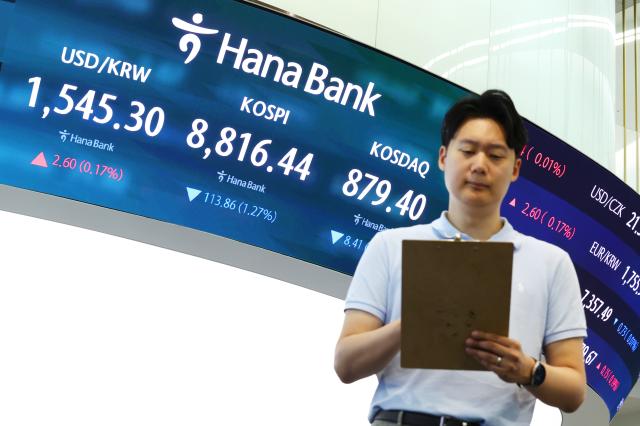
The KOSPI experienced a sharp decline of over 8% on June 26, triggering a circuit breaker (CB). Analysts attribute this drop to weak U.S. tech stocks affecting investor sentiment, alongside profit-taking in semiconductors following a recent surge and adjustments in supply and demand at the end of the quarter. The decline has been linked to concerns surrounding companies like Apple and OpenAI. Apple raised product prices due to "chipflation," which is interpreted as a sign of weakening semiconductor demand. OpenAI is reportedly considering postponing its initial public offering (IPO) until next year.
According to the Korea Exchange, at 12:10 p.m., the KOSPI fell more than 8%, prompting the activation of a first-stage circuit breaker. Early in the trading session, a sell-side car was also triggered, increasing volatility.
Market observers noted that the previous day's weakness in U.S. tech stocks contributed to the negative sentiment. Notably, Apple’s stock dropped 6.15% after announcing price increases, raising concerns about cost burdens from expanded AI investments and slowing final demand.
Han Ji-young, a researcher at Kiwoom Securities, stated, "The 6% drop in Apple’s stock was driven by concerns over weakened final set demand due to rising memory prices and product price increases. This creates noise that could hinder capital expenditure (CAPEX) willingness not only for consumer goods like Apple but also for hyperscaler companies facing similar memory price pressures."
However, Han interpreted the decline as primarily driven by supply and demand factors rather than fundamental damage.
Another analyst noted, "In the recent two trading days, the KOSPI surged, with semiconductors leading the way. Today, profit-taking from these leading semiconductor stocks contributed to the decline. At the same time, passive supply related to semiconductors also exited, creating selling pressure across most sectors."
He added, "Concerns over decreased memory demand may be overstated, and the actual volatility today is largely explained by the concentration phenomenon and related supply-demand fluctuations."
Some market participants also pointed to OpenAI's IPO delay consideration and renewed Middle East risks as factors dampening investor sentiment. U.S. media reported that OpenAI is considering postponing its planned IPO, originally set for this year, to next year. This has raised caution regarding valuations of AI companies and increased volatility in tech stocks.
Nevertheless, analysts do not view these factors as the primary causes of the domestic market's decline. One researcher remarked, "The speculation about OpenAI's IPO delay or the renewed uncertainty regarding the Strait of Hormuz has minimal impact on today’s drop."
Another contributing factor identified is portfolio adjustments at the end of the quarter.
Hwang Soo-wook, a researcher at Meritz Securities, explained, "The background for today’s decline is likely related to portfolio rebalancing based on the June settlement. Since Korean stocks operate on a T+2 settlement structure, June 26 is effectively the last valid trading day to reflect sell orders in the June 30 settlement balance."
He continued, "Given the recent surge, accounts with significantly increased exposure to Korean and semiconductor stocks began to see foreign basket selling from the pre-market session. This is more about end-of-quarter position adjustments rather than a structural exit from the Korean market."
Hwang concluded, "If this adjustment is indeed due to rebalancing, it should be resolved within a day, likely by June 30. Concerns about decreased AI demand or Apple’s product price increase affecting memory demand are secondary explanatory variables, not indicative of a fundamental trend change."
* This article has been translated by AI.
Copyright ⓒ Aju Press All rights reserved.