
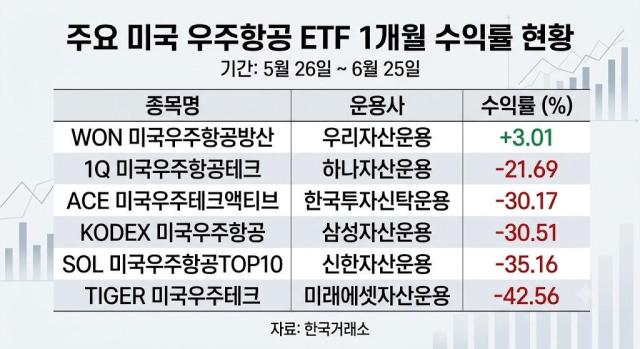
According to the Korea Exchange, from May 26 to June 25, the only domestic U.S. aerospace ETF to record a positive return was the WON U.S. Aerospace and Defense ETF, which gained 3.01%. In contrast, several other ETFs, including 1Q U.S. Aerospace Tech (-21.69%), ACE U.S. Aerospace Tech Active (-30.17%), KODEX U.S. Aerospace (-30.51%), SOL U.S. Aerospace TOP10 (-35.16%), and TIGER U.S. Aerospace Tech (-42.56%), all experienced double-digit losses.
The key differentiator was whether or not the ETFs included SpaceX. The WON U.S. Aerospace and Defense ETF, which achieved the highest return, did not include SpaceX and instead diversified its investments across companies in the aerospace and defense value chain, such as VSEC, Woodward, FTAI Aviation, Howmet Aerospace, TransDigm Group, and Boeing. The 1Q U.S. Aerospace Tech ETF also had not included SpaceX at that time.
Conversely, ETFs that prominently featured SpaceX as a core investment point struggled significantly. Asset management firms failed to secure allocations through Mirae Asset Securities for the public offering, forcing them to buy shares at inflated prices in the market to meet their target allocations. This chase for shares at high prices after the listing ultimately dragged down ETF returns.
For instance, the TIGER U.S. Aerospace Tech ETF, which purchased shares near their peak just two trading days after the listing, recorded a decline of 42.56% over the past month, marking the worst performance among its peers.
SpaceX's stock price initially surged after its listing but quickly faced corrections. On its first day of trading on June 12, the stock rose by 19.22%, followed by increases of 19.60% and 4.83% on June 15 and 16, respectively, surpassing $200 during intraday trading on the 15th. However, the stock turned bearish starting June 17, plummeting by 16.43% on June 22. By June 25, the closing price was $153, lower than the initial closing price of $160.95 on its first day.
Other major aerospace stocks also experienced declines. Over the past month, Rocket Lab fell by 43.65%, AST SpaceMobile by 45.18%, Planet Labs by 45.14%, and Intuitive Machines by 46.36%, contributing to a broader correction in the aerospace sector.
This situation has raised concerns about the aggressive competition among asset management firms to include SpaceX. Samsung Asset Management is currently under investigation by the Financial Supervisory Service for potentially violating index methodology after including SpaceX on its listing day using special inclusion rules. Mirae Asset Management also attempted to include SpaceX on the listing day through a 'Fast Entry' method but faced intervention from the Financial Supervisory Service.
Industry insiders suggest that these outcomes were foreseeable. It is common for volatility to increase significantly in the month following an IPO of a global giant. However, as investor interest in SpaceX intensified, asset management firms focused on market capture and fundraising, leading to reckless competition for inclusion. Consequently, many investors are now facing losses due to buying at peak prices.
Financial authorities are closely monitoring the heated competition in the ETF market. As the ETF market rapidly expands and marketing competition among firms intensifies, the Financial Supervisory Service and the Korea Financial Investment Association launched a task force on April 23 to improve advertising practices and address misleading promotional activities that could confuse investors.
* This article has been translated by AI.
Copyright ⓒ Aju Press All rights reserved.