
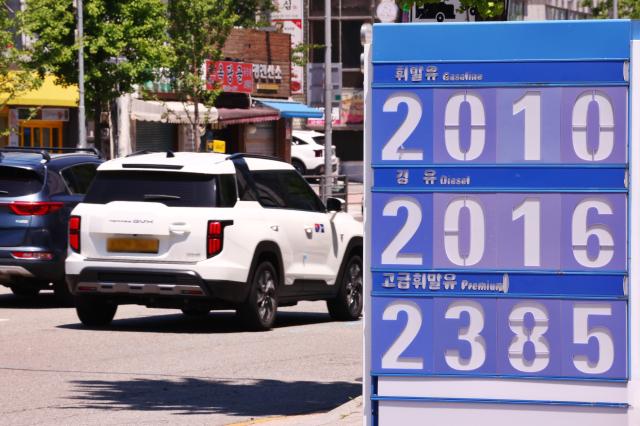
The Ministry of Trade, Industry and Energy announced on June 26 that the seventh adjustment to the oil price cap will take effect at midnight on June 27, marking the first decrease in 106 days since the price cap system was implemented on March 13.
The reduction applies equally to gasoline, diesel, and kerosene. The maximum supply prices for refiners will be adjusted to 1784 won per liter for gasoline, 1773 won for diesel, and 1380 won for kerosene.
This measure aims to quickly reflect the recent decline in international oil prices in domestic fuel costs, alleviating the financial burden on consumers.
Previously, on March 27, during the second adjustment, the government raised the maximum prices for different fuel types by 210 won per liter. Since then, the maximum supply prices have remained at 1934 won for gasoline, 1923 won for diesel, and 1530 won for kerosene for nearly three months.
A ministry official explained, "Following the signing of a memorandum of understanding (MOU) for peace between the U.S. and Iran, the increase in tanker traffic through the Strait of Hormuz has reduced geopolitical uncertainties in the Middle East, leading to stabilization in international oil prices."
As of June 25, the international prices were reported at $75 per barrel for Brent crude, $72 for West Texas Intermediate (WTI), and $64 for Dubai crude. Additionally, international product prices have significantly decreased since early June, with gasoline at $97 per barrel, diesel at $112, and kerosene at $111.
However, despite the rapid stabilization of international oil prices, domestic consumers have not yet seen a corresponding drop in gas prices. According to the Korea National Oil Corporation's Opinet, the average gasoline price as of 4 p.m. on June 26 was 2005.97 won per liter, while diesel was at 1997.18 won, still hovering around the 2000 won mark.
The ministry stated that this reduction is a proactive measure to reflect the decline in international prices. However, it noted that there may be a delay in the actual decrease in gas station prices due to the time needed to deplete existing high-cost inventory.
To ensure the price reduction is quickly realized at the consumer level, the government plans to strengthen management and oversight. It will conduct focused inspections of gas stations that intentionally delay price reductions citing leftover inventory, and will monitor the prices and stock levels at over 10,000 gas stations nationwide in collaboration with consumer groups and public institutions.
Furthermore, the government will enhance on-site inspections through a multi-agency market monitoring team and will take strict action against any illegal activities detected.
The seventh oil price cap will remain in effect for the next four weeks. However, the government plans to flexibly adjust the price cap review cycle based on ongoing assessments of the Middle Eastern situation and fluctuations in international oil prices.
* This article has been translated by AI.
Copyright ⓒ Aju Press All rights reserved.