
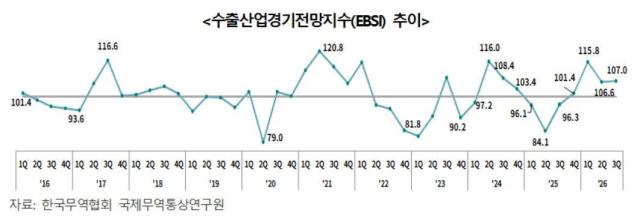
Exports are expected to continue improving in the third quarter of this year, driven primarily by semiconductors and wireless communication devices and components. While there are growing expectations for recovery in the supply of raw materials and operational conditions due to the situation in the Middle East, rising raw material prices and logistics costs remain significant challenges.
According to the '2026 Q3 Export Industry Outlook Survey (EBSI)' released on June 28 by the Korea International Trade Association's International Trade and Commerce Research Institute, the EBSI for the third quarter is recorded at 107.0. An EBSI above 100 indicates that more companies view the export conditions for the next quarter positively compared to the previous quarter.
The overall index has exceeded the baseline of 100 for four consecutive quarters. Although many sectors fell below the baseline, key industries such as semiconductors and shipbuilding have been credited with lifting the overall export outlook.
By item, four out of the top 15 categories, including semiconductors, are expected to see improved export conditions. The EBSI for semiconductors is the highest at 142.6, driven by steady demand for server DRAM and an increase in high-performance SSD demand due to a shortage of HDD supply.
Wireless communication devices and components recorded an EBSI of 120.3, with strong expectations for exports as major smartphone new product launches are scheduled for the second half of the year.
Industry experts note that increased investment in AI servers is simultaneously boosting demand for memory and storage devices, indicating that the recovery in semiconductor exports is moving beyond mere price rebounds to focus on high-value server products.
In contrast, the electrical and electronic products sector scored only 74.1, hindered by intensified price competition with Chinese secondary battery manufacturers and rising prices for OLED components. The plastics, rubber, and leather products sector is also expected to perform poorly, with a score of 76.0, due to high raw material prices, including a surge in naphtha following the Middle East crisis.
Among the ten survey items, nine are expected to improve, excluding 'manufacturing costs of export products.' The facility utilization rate is recorded at 114.3, and export consultations and contracts at 111.9.
Notably, the index for raw material supply and procurement jumped 41.6 points from the previous quarter to 111.4, reflecting the easing of tensions in the Middle East and a base effect from the previous quarter's low, marking the highest level since the fourth quarter of 2017.
Export companies identified rising raw material prices and logistics costs as the main challenges for the third quarter, with response rates of 24.7% and 17.9%, respectively. Rising raw material prices were cited as the most significant burden across all categories.
* This article has been translated by AI.
Copyright ⓒ Aju Press All rights reserved.