
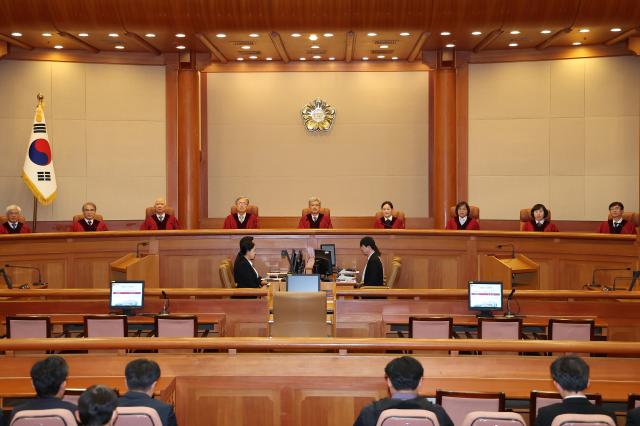
The Constitutional Court has ruled that a provision in the Youth Protection Act, which mandates a minimum five-year prison sentence for the sale of virtual child and adolescent sexual exploitation materials for profit, does not violate the constitution.
On June 28, legal sources reported that the court issued a unanimous decision on June 24 regarding the constitutionality of Sections 2 and 5 of Article 11 of the Youth Protection Act.
Previously, an individual identified as A was charged with distributing 82 online comic files depicting sexual acts involving child and adolescent characters for profit between July 16 and August 21, 2020. A was accused of uploading these files to an online site to exchange points earned for financial gain.
On November 30, 2021, while the trial was ongoing, A requested a constitutional review of the applicable sections of the Youth Protection Act. The court accepted A's request and referred the case for constitutional review on February 25, 2022.
The case centered on whether the provision in Section 2 regarding the distribution of child and adolescent sexual exploitation materials for profit and the provision in Section 5 concerning the possession of such materials with knowledge constituted a violation of the constitution. The court examined whether the materials could be clearly recognized as depicting children or adolescents through various media.
Section 2 of the Youth Protection Act states that anyone who sells, rents, distributes, or provides child and adolescent sexual exploitation materials for profit, or possesses, transports, advertises, introduces, or publicly displays or screens such materials, shall be punished with imprisonment for five years or more. Section 5 stipulates that anyone who purchases or possesses such materials, knowing they are child and adolescent sexual exploitation materials, shall face imprisonment for one year or more.
The Constitutional Court noted, "With advancements in technology, it has become possible to depict images of children and adolescents so realistically that they are difficult to distinguish from reality. Virtual child and adolescent sexual exploitation materials contain explicit sexual acts that can provoke abnormal sexual impulses towards children and adolescents, fostering distorted perceptions of sexuality and abnormal values among viewers. Continued exposure to such materials can lead to sexual crimes against children and adolescents."
The court further explained, "Even in the case of comics or animations, exaggerated or unrealistic physical representations can be easily depicted, and the lack of restrictions on expression allows for extreme situations to be portrayed. Therefore, it is difficult to clearly distinguish the degree of risk involved."
Additionally, the court highlighted the need to prevent the significant negative repercussions associated with the distribution of virtual child and adolescent sexual exploitation materials, emphasizing the necessity of measures to achieve general preventive objectives. It also noted that possession cannot be simply classified as a minor offense, and that mitigating circumstances or legal reductions could allow for probation in specific cases, concluding that the principle of proportionality between responsibility and punishment was not violated.
* This article has been translated by AI.
Copyright ⓒ Aju Press All rights reserved.