
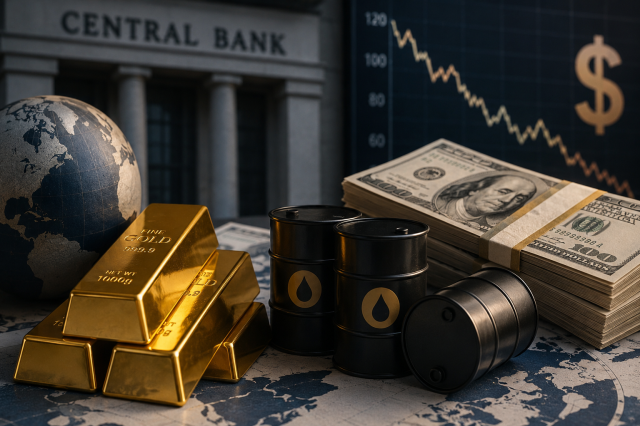
According to a survey by global investment firm Invesco, which included 90 sovereign funds and 54 central banks managing a total of $29 trillion (approximately 44,600 trillion won), there is a rising apprehension regarding the dollar and U.S. financial infrastructure among these institutions.
The survey revealed that 61% of participating central banks believe that the current level of U.S. debt negatively impacts the dollar's long-term status as a reserve currency. This figure marks a significant increase from 20% in 2024. Additionally, 29% of respondents anticipate a weakening of the dollar's status as the world's primary reserve currency within the next five years, up from 12% in 2022.
However, due to the lack of a reliable alternative currency, any shift away from the dollar is likely to occur gradually rather than abruptly, as reported by Reuters.
Some institutions are also reevaluating their dependence on U.S. financial infrastructure. Invesco noted that several institutions are exploring ways to reduce reliance on U.S.-based custodians, trading partners, and clearing systems due to geopolitical tensions. One European central bank has already replaced its U.S. custodian, while a central bank in Latin America is establishing custodial relationships outside the U.S. in preparation for worst-case scenarios.
In this context, sovereign funds and central banks are turning their attention to energy assets and gold. About 80% of respondents indicated that energy security and energy transition infrastructure are the most reliable investment avenues for enhancing portfolio resilience. Ongoing geopolitical shocks, including trade tariffs, disruptions in maritime transport, and conflicts in Ukraine and the Middle East, have underscored the importance of asset composition that can withstand such shocks.
There is also a growing trend to increase gold holdings. One-third of survey respondents plan to expand their gold reserves as part of their portfolio diversification strategies.
The competition to build AI infrastructure has also contributed to the preference for energy assets. Large data centers and AI computing facilities require substantial power, highlighting the strategic value of energy-related infrastructure. Invesco reported that in 2026, infrastructure accounted for 9% of sovereign fund assets.
Benjamin Jones, head of research at Invesco, stated, "In a world marked by inflation shocks, geopolitical divisions, and increased market concentration, investors are rethinking their assumptions about diversification and redesigning their portfolios to withstand a wider range of outcomes. Resilience is no longer just a nice-to-have; it has become a necessity."
* This article has been translated by AI.
Copyright ⓒ Aju Press All rights reserved.