
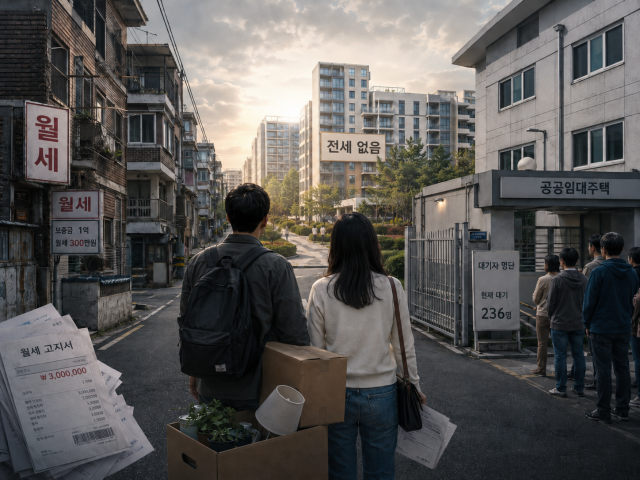
The real estate market is difficult to read, and buying a home is equally challenging. Government policies are similarly complex. Understanding the 'difficult' real estate landscape is where we must begin.
President Lee Jae-myung described jeonse as "a form of private financing" during a press conference marking his first year in office. He noted that jeonse loans have contributed to rising home prices and created fertile ground for jeonse fraud. He also predicted that jeonse would "gradually disappear."
The common belief that jeonse is unique to South Korea is somewhat misleading. Similar deposit-based rental agreements exist in Bolivia, India, and some European countries. However, South Korea is nearly the only country where jeonse has become a nationwide rental method. Just because it is a rare system does not mean it should disappear immediately. The pressing question is not whether jeonse will vanish, but where tenants who relied on it will go next.
The Stability Provided by Jeonse and the Risks It Transfers
For many, jeonse has been a way to save on monthly rent. Households without homes could reduce their monthly housing costs by paying a large deposit instead. For those with higher incomes who do not qualify for public housing but have not saved enough to buy a home, jeonse has been the most realistic option.
Thus, jeonse has long been viewed as a ladder to housing stability. However, describing its positive functions solely as a housing ladder is insufficient. Its more practical role has been to provide residential stability and cushion income gaps. Although the initial deposit was high, once tenants secured it, they could escape the burden of monthly rent. Even if their income temporarily ceased, the risk of eviction due to unpaid rent was low.
Yet, jeonse is not a one-dimensional system. While it served as a cost-saving mechanism for tenants, it also acted as a funding source that supported rising home prices across the market. Landlords could receive interest-free jeonse deposits to purchase homes or invest elsewhere. As home prices increased, they could also expect capital gains. For tenants, jeonse was a safety net, but for landlords, it was an investment ladder.
This structure relies on the assumption that home prices will continue to rise. If prices are not expected to increase as they once did, landlords' calculations change. They may prefer monthly rent, which provides consistent income, over jeonse, which requires a large deposit. The recent trend of decreasing jeonse availability and increasing monthly rents is not unrelated to this shift.
The jeonse ratio illustrates this instability. A high jeonse ratio indicates a small difference between home prices and deposits, making it easier to invest with less money. However, if the jeonse ratio becomes excessively high, even a slight decrease in home prices can make it difficult to return deposits. Jeonse fraud exploited this structure, where landlords collected deposits close to home prices while shifting the risk of loss onto tenants.
Conversely, when the jeonse ratio decreases, landlords have less incentive to offer jeonse, leading to a reduction in its availability. When there are many jeonse options, the risk of deposit loss increases; when jeonse options decrease, tenants have fewer choices. In either scenario, the ultimate burden falls on the tenants.
For individuals, jeonse has been a rational choice, allowing them to lower monthly housing costs without purchasing a home. However, when this choice is repeated across the market, it creates a structure reliant on expectations of rising home prices. If those expectations falter, the costs revert to the tenants.
Where to Go After Jeonse: Cheap or Expensive Options
Where should tenants go after jeonse? The current market offers two main choices: cheap or expensive. The middle ground is largely absent.
The spaces left by the reduction in jeonse will ultimately be filled by public and private rentals. Public rentals are lower in cost but often struggle to shed the perception of being merely "welfare housing" in terms of quality and image. The Korea Land and Housing Corporation (LH), which manages these properties, faces significant burdens, with its debt projected to reach 160 trillion won by the end of 2024, compounded by ongoing losses due to low rental rates. This is why the public sector cannot fully absorb the gap left by jeonse.
We must also consider whether public rentals are sufficient. While it can be argued that South Korea does not have a significant overall shortage, the perception changes when looking specifically at long-term rental options. There is a discrepancy between statistical figures and the actual sense of scarcity in the market. Public rentals cannot immediately keep pace with the rapid decline in jeonse.
Private rentals face a different set of challenges. A significant portion of the rental market relies on individual landlords, who often manage properties inconsistently. The proportion of monthly rents has already approached 70%. When including monthly rents with deposits, the space for jeonse is rapidly shrinking. The impact of jeonse fraud still lingers in the market.
The shortcomings of private rentals as an alternative to jeonse extend beyond high costs. Monthly rent and maintenance fees are ongoing expenses, and price instability recurs with each lease renewal. High monthly rents do not necessarily correlate with good management. Individual landlords of villas, studios, and officetels often have inconsistent standards for repairs and maintenance. Tenants struggle to control housing quality while incurring costs.
The impact of the shift to monthly rents hits younger generations hardest. While accumulating a jeonse deposit is challenging, the monthly rent quickly erodes savings. For young people and newlyweds, rising monthly rents are not just a burden; they delay the timeline for moving to the next home and make homeownership feel more distant. Although jeonse deposits carried risks, there was at least the expectation of recovering the principal. Monthly rent diminishes that expectation.
Ultimately, low-rent homes carry a stigma of welfare, while homes worth living in are expensive. The middle class, who exceed public rental standards but cannot afford to buy homes, find themselves in a precarious position. Jeonse has filled this gap until now. The first question after jeonse is straightforward: where can tenants live, at what cost, and for how long?
Long-Term Rental Housing
To prepare for life after jeonse, we need long-term rental options for middle-class tenants. Rent must be affordable, contracts should be stable, and homes should not fall into disrepair over time. Simply building more public rentals is insufficient. We must move beyond the perception that these homes are only for the poor.
Homeownership alone cannot solve housing issues. Even if land prices are lowered, the costs of building homes remain, which can still be substantial for young professionals and newlyweds. Someone must build first, buy first, and then rent out for an extended period. The key is determining who will take on this role and under what conditions.
South Korean society tends to oversimplify housing into two categories: owning a home or renting. Alternatives after jeonse must focus on expanding this spectrum. Instead of requiring full ownership from the start, we could consider options that allow gradual accumulation of home equity or public support to lower land costs and interest burdens, enabling longer stays. The name of the program is not what matters; the structure must ensure that tenants can save while paying housing costs without taking on excessive debt that risks home price declines.
The social housing model in Vienna, Austria, is noteworthy for this reason. A significant portion of the population lives in social housing, which is not viewed solely as housing for low-income individuals. Cooperatives or corporations build and manage homes on public land with low-interest financing. Profits are capped, and any surplus is reinvested into repairs or new construction. The criteria for residency are broad, allowing middle-class individuals to live there without stigma.
Denmark follows a similar model. A portion of rental income and surplus from housing is pooled to renovate old homes and construct new ones. Importantly, this is not a one-time effort; rental income, management, repairs, and reinvestment operate within a cohesive structure.
This is not a call to replicate these models exactly. The essence lies in not dividing rental housing into just two categories: affordable but stigmatized homes or expensive rental products. Between these two, we can create homes where the middle class can live long-term. If we add options that combine partial ownership with long-term rentals, tenants can move beyond the simplistic choice of "if I can't buy a home, I must rent."
South Korea has seen attempts at social housing, publicly supported private rentals, and youth-friendly housing. However, these efforts have been small in scale and lacked diversity. Most importantly, the entities managing these programs have struggled to sustain them. They must lower rents while maintaining properties over the long term, but the financial structure to support this is weak.
The public sector cannot shoulder all the burdens, nor can it leave everything to the private sector. The public must support land and financing, while private or non-profit entities manage operations, capping profits while allowing for sustainable operations. Regardless of the name, the core principles are simple: rents must be manageable, contracts must be long-term, and maintenance must not be neglected. The structure must ensure that homes last while being affordable for tenants and sustainable for operators.
There Must Be a Sequence to Reducing Jeonse
Policies aimed at reducing jeonse quickly impact the market. Tightening jeonse loans and reducing guarantees will immediately shift landlords' calculations toward monthly rent. The critical issue is what comes next. The speed at which jeonse decreases does not match the speed at which new housing options for tenants will emerge.
Building homes takes time. Creating policies, gathering stakeholders, securing land, and moving from construction to occupancy can take years. In contrast, changes in loan regulations and tax policies can immediately affect the market. Even if the direction is correct, the sequence matters; tenants will bear the consequences if it is incorrect. If we aim to reduce jeonse, we must first create housing options for people to move into.
In the meantime, financing must be designed with tenants in mind. The South Korean housing market has long relied on pre-sales and jeonse deposits to supply homes rather than long-term low-interest funds. To reduce jeonse, we need financial alternatives to fill that gap. This way, reducing reliance on jeonse deposits does not directly lead to increased monthly rent burdens for tenants. Financing should focus on reducing tenants' deposit risks and monthly rent burdens rather than preserving landlords' profits.
During this process, tenants may face higher monthly rents and experience anxiety over the return of their deposits. It is essential to distinguish between demand for new homes with jeonse and existing tenants renewing or relocating. Measures to curb speculative demand cannot be the same as those that reduce the moving costs for actual residents.
We must also reassess rental functions. This does not mean ignoring landlords with multiple properties. We should tax rental income and reduce excessive gap investments using deposits. However, we must differentiate between reducing the number of landlords and decreasing the availability of homes for tenants. The policy should focus not only on how many properties landlords own but also on how securely tenants can live.
The homes available after jeonse must be affordable for tenants, suitable for long-term living, and well-maintained over time. Ideally, there should be pathways for asset formation while paying housing costs. The middle class, who have relied on jeonse, are precisely those who exceed public rental standards but cannot afford to buy homes. We must ensure they have viable options beyond jeonse, supplying homes in line with the pace of jeonse reduction.
The direction of reducing the excessive reliance on the jeonse structure is valid. The key is the sequence. Not everyone needs to own a home. If rents are manageable and allow for long-term living, renting can be a normal way of life. Expanding choices between ownership and renting can help more people avoid the pitfalls of excessive debt and unstable monthly rents. There is no need to fear the trend of reducing jeonse. The real danger lies in dismantling the existing structure without providing alternative solutions, which would only shift the burden rather than normalize the system.
* This article has been translated by AI.
Copyright ⓒ Aju Press All rights reserved.