
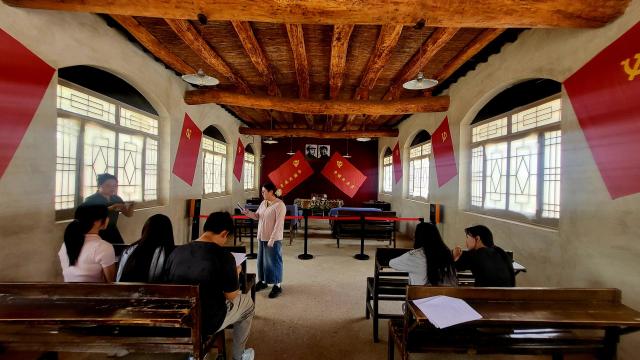
"The spirit of 'Two Musts' left by Mao Zedong continues today as 'Three Musts' in the Xi Jinping era."
The site of the 2nd Plenary Session of the 7th Central Committee of the Chinese Communist Party, located in Shibai Po, is a significant revolutionary site. A small meeting room, converted from a 33-square-meter cafeteria, contains ten long wooden benches. Here, about six students from Shijiazhuang Vocational School were engaged in political education field studies.
Zheng, a student from the 2025 class at Shijiazhuang Vocational School, stated, "With the 105th anniversary of the founding of the Chinese Communist Party approaching on July 1, our task is to visit Shibai Po to study the spirit of past revolutionary generations and discuss the path forward for new-era Communist Party members."
On June 23, the reporter visited Shibai Po, located approximately 90 kilometers northwest of Shijiazhuang in Hebei Province. In May 1948, the Chinese Communist Party leadership relocated from Yan'an in Shaanxi Province to Shibai Po, just over 400 kilometers from Beijing, to prepare for the final victory in the Chinese Civil War and the entry into Beijing.
The site of the Central Committee of the Chinese Communist Party in Shibai Po preserves traces of the modest lives of key leaders at the time, including Mao Zedong, Zhou Enlai, Zhu De, and Liu Shaoqi, in addition to the meeting hall of the 2nd Plenary Session. Despite it being a weekday, many 'red pilgrims' visited the site in anticipation of the party's founding day.
Upon entering the square in front of the Shibai Po Memorial Hall, visitors are greeted by statues of five top leaders of the Chinese Communist Party—Mao Zedong, Zhu De, Liu Shaoqi, Zhou Enlai, and Ren Bishi—along with the inscription, 'Shibai Po, the starting point of New China.'
In fact, Mao Zedong held the 2nd Plenary Session here in March 1949, before entering Beijing, to discuss the blueprint for establishing New China. This meeting laid out the fundamental policies for political, diplomatic, economic, and social governance that would later lead to the founding of the People's Republic of China.
At this meeting, as victory in the Civil War was imminent, Mao emphasized the 'Two Musts' and the 'Six Regulations' to caution against party members' arrogance and to restore discipline. The 'Two Musts' stressed maintaining a humble and cautious attitude while fighting against adversity, while the 'Six Regulations' outlined the virtues and principles required of party members. This is why Shibai Po is regarded as a 'sacred site of political education' where the Communist Party reflects on its founding intentions and discipline. Following Jiang Zemin and Hu Jintao, President Xi Jinping has also visited Shibai Po after taking office.
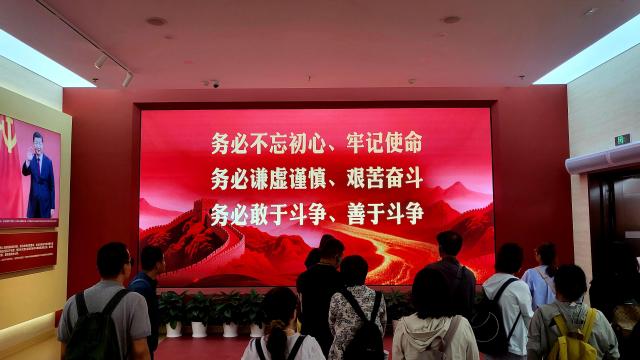
Notably, President Xi has inherited and developed Mao's 'Two Musts' into 'Three Musts' by adding the principles of 'never forget your original intention' and 'be adept at struggle.' At the Shibai Po Memorial Hall, a red screen filled with the content of the 'Three Musts' is displayed alongside a photo of President Xi.
Even on a weekday, the footsteps of red pilgrims visiting Shibai Po continued, reflecting the heightened atmosphere of 'red education' ahead of the 105th anniversary of the Communist Party's founding.
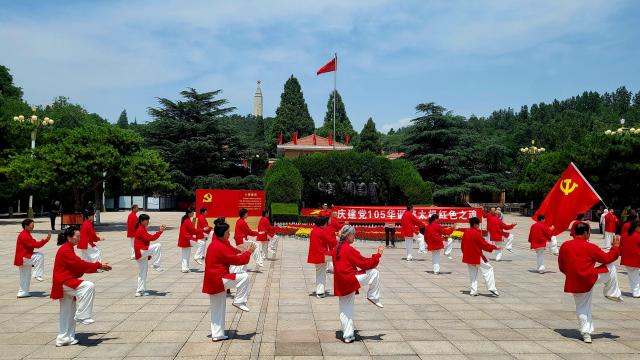
As the reporter left the Shibai Po Memorial Hall, about 50 Tai Chi practitioners in red uniforms gathered in the square, waving the Communist Party flag while performing Tai Chi to the song 'I Love China.' The group, consisting of middle-aged and elderly men and women from Zibo in Shandong Province, came to commemorate the 105th anniversary of the Communist Party. After their training, they concluded with a chorus of 'Without the Communist Party, there is no New China.' A middle-aged woman with gray hair expressed pride, saying, "As a Communist Party member, I am proud to train in Tai Chi, a traditional Chinese martial art, at the revolutionary site of Shibai Po."
Indeed, Shibai Po has evolved beyond a mere revolutionary site; it serves as a living educational venue where the Chinese Communist Party passes on its revolutionary traditions and founding intentions to the next generation.
On June 24, China Central Television remarked, ahead of the 105th anniversary, that "Shibai Po is a symbolic place that adorns a page of Chinese revolutionary history, where the great journey of building New China began," adding that "the spirit of Shibai Po is the driving force for the Chinese Communist Party to advance courageously in the new era."
* This article has been translated by AI.
Copyright ⓒ Aju Press All rights reserved.