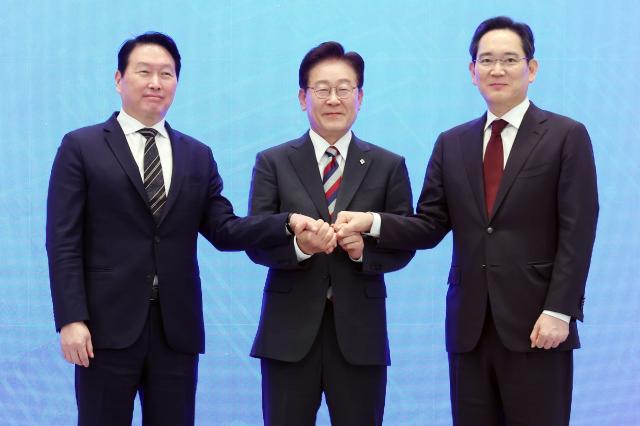
SEOUL, June 29 (AJP) - Samsung Electronics and SK hynix are joining forces to build a second memory semiconductor hub along South Korea's southwestern coast, committing more than 1,000 trillion won ($650 billion) in what would become one of the world's largest semiconductor expansion projects as the country races to preserve its leadership in AI-era memory chips.
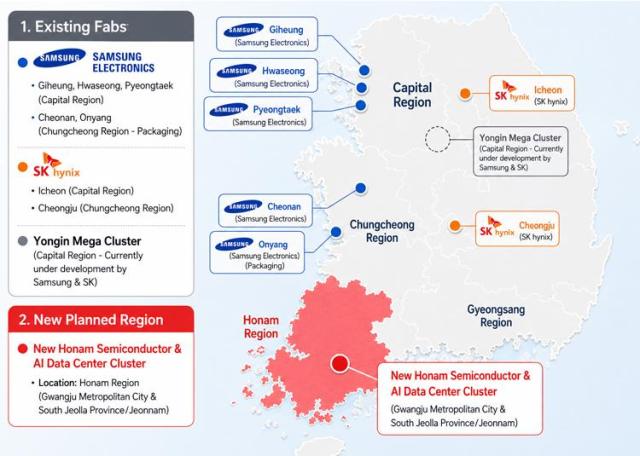
The initiative, unveiled during President Lee Jae Myung's "Three Mega Projects" briefing at the presidential office, signals a strategic shift in South Korea's semiconductor policy: expanding beyond the Seoul metropolitan area as existing production centers around Pyeongtaek and Yongin approach practical limits in land, electricity and industrial water.
Calling artificial intelligence the defining industrial battleground of the coming decades, Lee pledged to personally oversee the project while directing government ministries to accelerate approvals for electricity, industrial water and transport infrastructure needed to support the new semiconductor corridor.
"The government will leave no innovation undone to ensure these projects are completed," Lee said.
Samsung Electronics Executive Chairman Jay Y. Lee unveiled a new 625 trillion won investment roadmap, including 425 trillion won earmarked for the Honam region on top of more than 2,000 trillion won already committed to the company's Pyeongtaek campus and Yongin semiconductor cluster.
Lee said Gwangju has emerged as the leading candidate for Samsung's next fabrication complex because of its abundant electricity, industrial water, skilled workforce and government support.
"The investment schedule for Yongin has already been accelerated, and preparations for another semiconductor complex need to begin sooner than originally planned," he said.
Samsung also plans to concentrate high-bandwidth memory (HBM) production in Cheonan and Onyang, where it is expanding advanced chip stacking and packaging technologies essential for AI memory.
"HBM, which powers AI training and inference, requires cutting-edge stacking technology and manufacturing processes comparable to front-end fabrication plants," Lee said.
Beyond semiconductors, Samsung outlined a nationwide investment blueprint that includes a digital twin innovation hub in Gwangju, Physical AI projects in Gumi, next-generation battery production in Ulsan, advanced shipbuilding in Geoje, semiconductor package substrates in Busan and biotechnology in Songdo.
SK Group Chairman Chey Tae-won presented an equally ambitious vision centered on AI infrastructure, arguing that South Korea should move beyond manufacturing semiconductors to exporting intelligence itself.
"The question is not why Korea should pursue AI, but what Korea wants AI to accomplish," Chey said.
He pledged to build AI data centers totaling 15 gigawatts by 2035, beginning with an initial 5-GW phase before expanding nationwide.
"We should become a country that manufactures and exports intelligence," he said, describing hyperscale data centers as "AI factories."
To support the surge in AI computing demand, SK hynix will accelerate construction of its previously announced 600 trillion won Yongin semiconductor complex and a separate 100 trillion won expansion in Cheongju, advancing completion by roughly 12 years to 2033.
SK will also invest 400 trillion won to establish a new semiconductor production base in Honam, arguing that the country's existing manufacturing belt can no longer accommodate future AI demand.
"Even after these investments, demand will continue to outstrip supply," Chey said. "That is why we need an entirely new production base."
Industry specialists welcomed the strategy of expanding semiconductor manufacturing beyond the capital region but cautioned that execution—not investment size—will ultimately determine its success.
"The critical question is not where the cluster is built but whether Korea can expand semiconductor production quickly enough to keep pace with exploding AI demand," Lee Jong-hwan, professor of system semiconductor engineering at Sangmyung University, told AJP.
He said Honam's abundant renewable energy resources and proximity to the Hanbit Nuclear Power Plant provide a favorable combination of stable baseload electricity and clean energy—two increasingly valuable assets for semiconductor manufacturing.
"The bigger challenge may ultimately be talent," Lee said.
"Samsung Electronics and SK hynix will probably have little difficulty attracting engineers. The real challenge will be persuading smaller materials, parts and equipment suppliers to relocate."
He urged regional universities to establish semiconductor-focused contract departments and strengthen partnerships with industry before large-scale production begins.
Power specialists likewise stressed that electricity infrastructure could become the project's defining constraint.
"Locating electricity-intensive industries where surplus renewable generation already exists is a positive direction," Park Woo-young, head of power policy research at the Korea Energy Economics Institute, told AJP.
"But success will ultimately depend on reinforcing the transmission grid, deploying sufficient energy storage systems and implementing detailed power infrastructure plans."
Park said it remains too early to judge whether the planned electricity network will be sufficient because detailed demand projections have yet to be released.
If completed as envisioned, the Honam development would create South Korea's second semiconductor belt alongside the existing Gyeonggi-based K-Chip Belt, fundamentally reshaping the country's industrial geography after decades of concentrating advanced manufacturing around the capital region.

Copyright ⓒ Aju Press All rights reserved.