
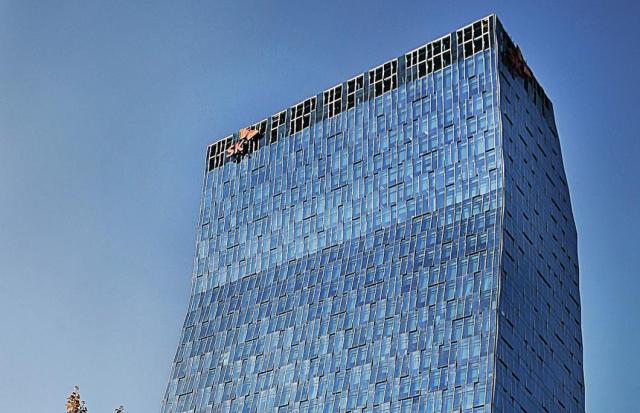
SK Group announced on June 29 its roadmap to establish a 15-gigawatt (GW) AI data center, marking its entry into the global AI infrastructure competition. Led by SK Telecom, the plan includes a phased rollout of 5GW by 2029, with a total of 15GW to be constructed by 2035. The initiative is part of a strategy to attract global AI demand to Korea, positioning the country as a "Northeast Asia AI Hub."
In a Q&A session, SK Telecom addressed several key points regarding the project:
- What is the significance of 15GW?
"This is a long-term expansion goal and roadmap in a global AI infrastructure competition that is already unfolding at the GW level. According to McKinsey & Company, global data center demand is expected to grow by 19-22% annually, but supply is lagging, leading to a projected 15GW shortfall in the U.S. by 2030. SK Group aims to seize this demand."
- Where will the data centers be located?
"We have not confirmed specific locations yet; decisions will be made in conjunction with government and local authorities' regional development projects and power supply plans. Site selection will consider power supply, site availability, and securing anchor tenants. We are currently constructing a hyperscale data center in Ulsan and are in discussions with partners like AWS and NVIDIA."
- How will funding be secured?
"We will utilize a combination of SK's own investments, strategic partner investments, long-term contracts with global clients, and project financing. Investments will be executed in phases based on secured demand, power supply, site availability, and permitting conditions. Specific investment amounts will be determined as partnerships, equity structures, and contract terms are finalized."
- What is the revenue model?
"Our model consists of two main pillars: AI-specialized co-location services and AI computing cloud services. Co-location will provide AI infrastructure to global tech giants and domestic users, while the AI computing cloud will offer resources like GPUs as a service (GPUaaS). We aim to achieve economies of scale based on long-term, high-volume demand to enhance total cost of ownership (TCO) competitiveness."
- Is power supply feasible?
"In the short term, we will maximize the use of available power resources, and in the medium to long term, we will utilize a variety of power sources, including renewable energy, battery energy storage systems (BESS), LNG, and small modular reactors (SMR). We are reviewing business opportunities centered around feasible power supply locations and are in close consultation with the government and power authorities."
- How will this differ from existing data centers?
"While existing data centers serve as general-purpose infrastructure for data storage, AI data centers are designed to produce 'AI intelligence' with immense computational power. They require significantly higher power density than conventional data centers and necessitate next-generation immersion cooling solutions and technology to connect thousands of GPUs as a single unit."
- Isn't rapid technological change a risk?
"We are adopting a modular design that is not fixed to specific GPU generations, allowing us to respond to heterogeneous AI chips, replace cooling and network modules, and implement strategies for GPU generation reallocation and resale to minimize asset obsolescence. Our strategy involves collaborating with global tech giants from the design phase of next-generation AI semiconductors, leveraging SK Hynix's memory competitiveness."
- What is the expected impact on the domestic industry?
"SK Group emphasizes that this project will be a turning point for Korea to transition from an 'AI consumer country' to an 'AI computing exporter.' It will drive the growth of the entire domestic value chain, from AI chips and memory to energy, next-generation cooling systems, and networks, while providing stable computational resources to software companies and startups, effectively serving as an 'AI highway.'"
* This article has been translated by AI.
Copyright ⓒ Aju Press All rights reserved.