
The June mock exam for the 2027 college entrance exam has revealed a record shift toward social studies and subjects perceived as easier. With an increase in repeat test takers coinciding with discussions around regional medical programs, the complexity of test-takers' strategies has intensified, especially as the English section, which is graded on a pass/fail basis, was notably difficult this year.
The Korea Institute for Curriculum and Evaluation announced on June 30 that it will notify students of the grading results from the nationwide mock exam conducted on June 4 on July 1.
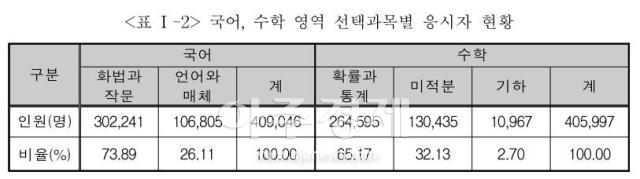
According to the institute, a total of 411,302 students participated in the June mock exam, with 328,242 being current students and 83,060 (20.2%) being graduates or those who passed the high school equivalency exam. In terms of subject selection, 73.89% of students chose the Korean language section focusing on speech and writing, while 26.11% opted for language and media. In mathematics, 65.17% selected probability and statistics, 32.13% chose calculus, and only 2.70% opted for geometry.
The Korea Institute for Curriculum and Evaluation announced on June 30 that it will notify students of the grading results from the nationwide mock exam conducted on June 4 on July 1.
According to the institute, a total of 411,302 students participated in the June mock exam, with 328,242 being current students and 83,060 (20.2%) being graduates or those who passed the high school equivalency exam. In terms of subject selection, 73.89% of students chose the Korean language section focusing on speech and writing, while 26.11% opted for language and media. In mathematics, 65.17% selected probability and statistics, 32.13% chose calculus, and only 2.70% opted for geometry.
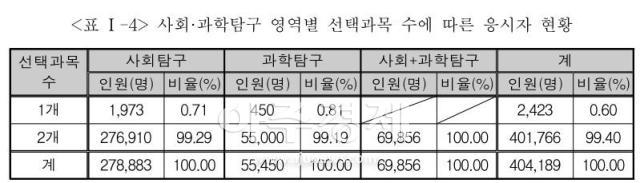
The trend toward social studies was even more pronounced. Among those taking the inquiry section, 278,883 students focused solely on social studies, while only 55,450 took only science. A total of 69,856 students combined both areas. The percentage of students achieving the highest grade in the English section was 4.13% (16,979 students).
Admissions experts highlighted the extreme shift toward social studies and the preference for easier subjects, noting that even high-achieving students found the English section challenging. With major universities lifting restrictions on subject selection, students taking the last current version of the exam before the 2028 admissions reform are strategically shifting to reduce their academic burden.
Im Seong-ho, head of Jongno Academy, stated, "The number of students taking only science has halved compared to last June, with a decrease of 46,533 students (45.6%). The number of students scoring within the top two grades in science has also dropped by 34.2%. The 2027 college entrance exam, being the last year of the integrated exam, will see score predictions become increasingly difficult due to changes in the number of test-takers." He added that the acceleration of the social studies shift could lead to further movements among students, increasing anxiety among high-achieving science students.
Lee Man-ki, director of the Education Evaluation Research Institute at Yuhwa, remarked, "The trend of shifting to social studies has penetrated even among high-achieving students who maintain calculus while switching to social studies. The combined percentage of students scoring in the top two grades in English is 17.53%, similar to last year's challenging exam (17.46%), indicating that English has become a difficult subject for high achievers." He advised students to carefully consider the advantages of science and calculus points and the scoring conversion methods before making any shifts.
Woo Yeon-cheol, head of the Admissions Strategy Research Institute at JinHakSa, noted, "Despite the decline in the school-age population, the increase in repeat test takers has resulted in 7,874 more graduates participating. The percentage of students taking two science subjects has dropped to 13.7%, which is only one-third of the 48.5% seen three years ago in 2024." He further explained that the shift to social studies has reached a peak, with record-high selection rates for Korean's 'speech and writing' (73.9%) and mathematics' 'probability and statistics' (65.2%), indicating a trend of prioritizing easier subjects over career paths.
Kim Byeong-jin, head of the Education Evaluation Research Institute at Etoos, stated, "There is a clear tendency to choose subjects with a higher likelihood of success relative to effort, not just in the inquiry section but also in Korean and mathematics. While the composition of test-takers has emerged as a major variable for the college entrance exam, students should focus on reviewing incorrect answers based on their score reports and enhancing their mastery of the subjects they have chosen."
Im Seong-ho, head of Jongno Academy, stated, "The number of students taking only science has halved compared to last June, with a decrease of 46,533 students (45.6%). The number of students scoring within the top two grades in science has also dropped by 34.2%. The 2027 college entrance exam, being the last year of the integrated exam, will see score predictions become increasingly difficult due to changes in the number of test-takers." He added that the acceleration of the social studies shift could lead to further movements among students, increasing anxiety among high-achieving science students.
Lee Man-ki, director of the Education Evaluation Research Institute at Yuhwa, remarked, "The trend of shifting to social studies has penetrated even among high-achieving students who maintain calculus while switching to social studies. The combined percentage of students scoring in the top two grades in English is 17.53%, similar to last year's challenging exam (17.46%), indicating that English has become a difficult subject for high achievers." He advised students to carefully consider the advantages of science and calculus points and the scoring conversion methods before making any shifts.
Woo Yeon-cheol, head of the Admissions Strategy Research Institute at JinHakSa, noted, "Despite the decline in the school-age population, the increase in repeat test takers has resulted in 7,874 more graduates participating. The percentage of students taking two science subjects has dropped to 13.7%, which is only one-third of the 48.5% seen three years ago in 2024." He further explained that the shift to social studies has reached a peak, with record-high selection rates for Korean's 'speech and writing' (73.9%) and mathematics' 'probability and statistics' (65.2%), indicating a trend of prioritizing easier subjects over career paths.
Kim Byeong-jin, head of the Education Evaluation Research Institute at Etoos, stated, "There is a clear tendency to choose subjects with a higher likelihood of success relative to effort, not just in the inquiry section but also in Korean and mathematics. While the composition of test-takers has emerged as a major variable for the college entrance exam, students should focus on reviewing incorrect answers based on their score reports and enhancing their mastery of the subjects they have chosen."
* This article has been translated by AI.
Copyright ⓒ Aju Press All rights reserved.