
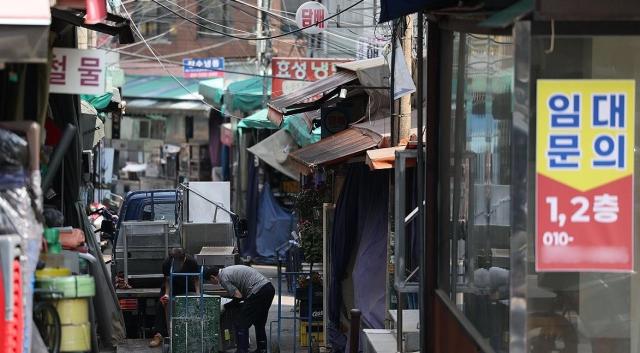
As profitability declines and minimum wage increases, small business owners are increasingly forced to close their shops. This drastic measure is often a last resort to avoid crippling debt, but many small business owners find themselves in a dilemma where they cannot afford the costs associated with shutting down, leading to a deterioration in their quality of life.
According to the Ministry of SMEs and Startups, the number of closed businesses in the six major sectors closely tied to the economy—manufacturing, wholesale, retail, accommodation, food, and service—is projected to reach 756,000 in 2023, 784,000 in 2024, and 751,000 in 2025. This indicates that more than 750,000 small businesses are closing each year, with the closure rate exceeding 11% annually (11.64% in 2023, 11.74% in 2024, and 11.08% in 2025).
Small business owners facing closure report that the costs of dismantling their shops, which can range from millions to tens of millions of won, are a significant barrier. The average closure cost is 12.86 million won, including 5.59 million won for shop dismantling, 2.21 million won for raw materials, and 2.05 million won for employee severance pay. Additionally, loans taken out during the COVID-19 pandemic become due upon closure, creating a situation where owners are left with only the shell of their business while struggling under debt.
In response, the Ministry of SMEs and Startups announced a "Small Business Recovery and Restart Support Plan" in October 2025, which includes a support system for businesses before and after closure, from crisis diagnosis to rapid closure and connections to re-employment and re-starting businesses. Notably, through the "Hope Return Package," the government has increased the support limit for shop dismantling costs from 4 million won to a maximum of 6 million won (200,000 won per 3.3 square meters), covering a portion of the average closure cost for small businesses.
In a recent survey, the government support programs utilized by closing small business owners included the Hope Return Package (75.5%), the Yellow Umbrella Fund (18.2%), and local credit guarantee programs (11%). The support programs that need expansion include "closure cost support" (47.3%), "restarting and employment support" (38.8%), and "repayment deferral and interest reduction" (32.1%).
Kim Hee-jung, head of the Economic Policy Division at the Korea Federation of SMEs, stated, "There seems to be a disparity between those who utilize the Hope Return Package and those who do not. To bridge this gap, the government must enhance information accessibility for small business owners."
Concerns have also been raised about potential fraud, as rising labor and material costs have led to increased support rates for shop dismantling, prompting some to engage in false dismantling or inflate costs to misappropriate government subsidies.
A significant issue is that the loan repayment support system for small business owners after closure has been inadequate. To address this, the government plans to introduce practical financial support for re-employment of closed small business owners in the second half of the year. Under the new system, the repayment period for policy loans will be extended up to seven years for those who successfully find employment. Additionally, if they remain employed for more than a year, they will receive a 0.5 percentage point interest reduction on their loan balance. This initiative aims to alleviate the debt burden on small business owners and prevent them from falling into severe credit delinquency.
Ryu Pil-seon, a specialist at the Small Business Association, noted, "In the current prolonged economic downturn, most small business owners are burdened with unprecedented levels of debt when deciding to close. For the government policies, including the Hope Return Package, to be effective in preparing for re-employment, collaboration with organizations like the Small Business Association is essential."
* This article has been translated by AI.
Copyright ⓒ Aju Press All rights reserved.