
SEOUL, July 01 (AJP) - "A man is responsible for his ignorance," Milan Kundera once wrote. Young Koreans are now learning that lesson the hard way.
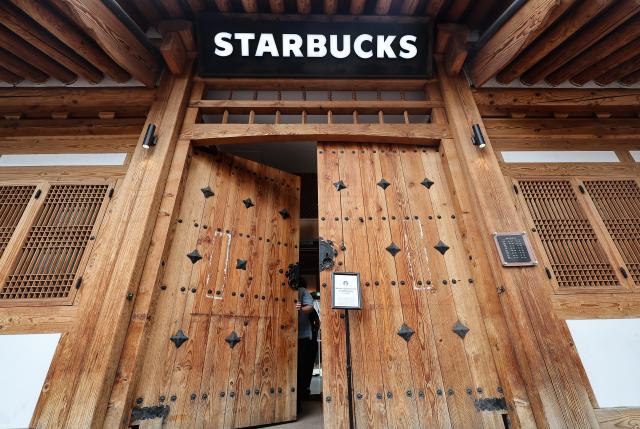
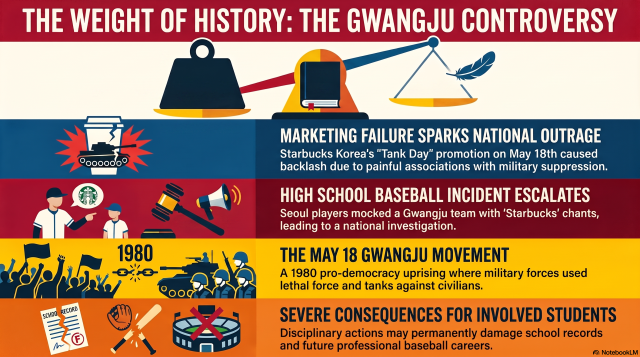
Just last week, Starbucks Korea was forced to close stores early nationwide for employee history lessons, absorbing an estimated 2 billion won ($12.8 million) in losses after a promotional campaign on May 18 sparked outrage in Gwangju.
Its "Tank Day" promotion of 5/18 tumbler sparked social outrage for its painful associations with the May 18, 1980 Gwangju Democratization Movement, when military forces used tanks and lethal force to suppress a pro-democracy uprising, killing hundreds of civilians.
The controversy was reignited during a high school baseball championship game between teams from Seoul and Gwangju last Monday.
What may have begun as teenage taunting quickly escalated into a serious national issue, drawing investigations by education authorities and the Korea Baseball Softball Association.
For the students involved, the consequences could be severe.
Disciplinary action could affect not only their school records but also their future baseball careers.
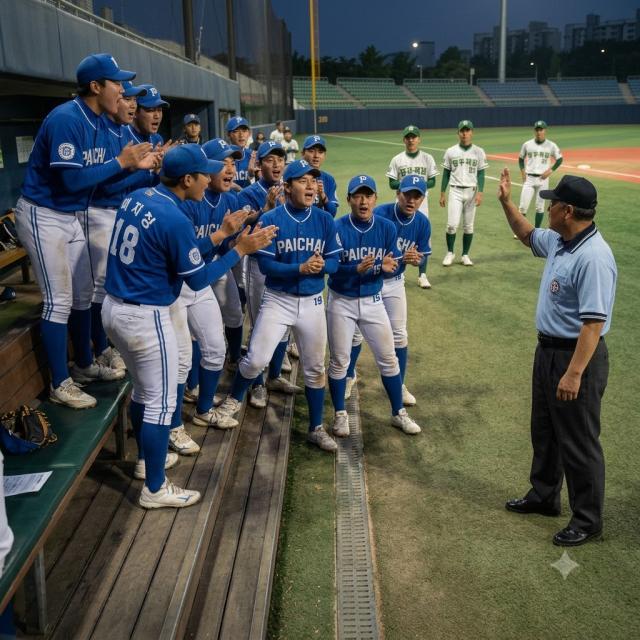
The controversy erupted during a game between Paichai High School of Seoul and Gwangju Jeil High School in the 81st Blue Dragon National High School Baseball Championship at Mokdong Baseball Stadium.
Video footage circulating online showed multiple Paichai players repeatedly chanting, "Let's go, let's go, let's go to Starbucks," from the dugout during the top of the eighth inning as their team led 6-2.
The baseball incident suggested that the lessons from the Starbucks controversy had not been fully learned. Critics accused the students of trivializing the May 18 Gwangju Democratization Movement as it remains one of the darkest chapters in modern Korean history.
According to witnesses and game footage, the chanting continued until coaches from Gwangju Jeil protested. Paichai's coaches intervened only after the complaint was raised, and umpires stepped in to calm the situation.
The Korea Baseball Softball Association has launched an investigation after Gwangju Jeil formally requested disciplinary action against those involved.
The Seoul Metropolitan Office of Education also announced Tuesday that it would conduct its own investigation.
"The office takes this matter extremely seriously," it said in a statement. "Expressions that can be interpreted as ridiculing historical suffering or mocking a particular region are educationally unacceptable and have no place in school sports."
Education officials said they would visit Paichai High School to determine how the incident unfolded, whether coaches responded appropriately, how student athletes were supervised, and what measures the school plans to take to prevent similar incidents.
The school's apology also came under criticism.
Paichai High initially stated that it would discipline "the student athlete involved" under school regulations, wording many online critics said portrayed the incident as the actions of a single individual despite video footage showing numerous players chanting together.
The apology sparked further controversy after internet users noticed that the first version carried a visible watermark indicating it had been generated using Google's Gemini artificial intelligence model. The watermark was later removed.
The Korean Teachers and Education Workers Union criticized not only the students but also the adults responsible for supervising them.
"The fact that no one stopped the students immediately demonstrates educational neglect," the union said in a statement Tuesday. "Society's failure to respond firmly to historical distortion and hate speech has ultimately influenced the language and behavior of adolescents."
Residents of Gwangju told AJP the episode reflected what they described as deeply rooted prejudice and hostility toward the city, adding that such incidents occur with troubling frequency.
Lee Dong-yoon, a physical education student at Chonnam National University, said that when he travels outside the region, it is "very common" for people to discriminate against those from Gwangju or disparage the May 18 Gwangju Democratization Movement.
"I think almost everyone from Gwangju has had that kind of experience," he said.
"I experienced a great deal of prejudice and discrimination, especially during my mandatory military service in Seoul."
"Many senior soldiers referred to people from Gwangju as hongeo (ray fish), a derogatory slur, or repeated distorted claims about the May 18 Gwangju Democratization Movement."
Having witnessed the chanting during the game, Lee said he was "deeply shocked that such young high school students were saying those things."
"I'm worried because, after I graduate, I may have to teach students like them," he said.
"It made me think that regional hatred is spreading like an internet meme," said Yun Young-jun, a business administration student at Chonnam National University.
"The players targeted the opposing team simply because it represented Gwangju. It's unfortunate that even teenage athletes seem to consume and reproduce these expressions as casual jokes."
Kim Ki-beom, a history education student at Chonnam National University, said he was particularly disturbed by the coordinated nature of the chants.
"I was shocked to see the students chanting while performing choreographed gestures in the dugout," he said.

"I believe this incident reflects how hostility toward Gwangju has become normalized in everyday life. Watching it was heartbreaking."
The incident has reignited a longstanding debate in South Korea over regional discrimination and how younger generations perceive one of the country's darkest historical tragedies.
The May 18 Gwangju Democratization Movement began after military strongman Chun Doo-hwan expanded martial law following the assassination of President Park Chung-hee. As students and citizens protested military rule in the southwestern city of Gwangju, paratroopers were deployed to suppress the demonstrations.
Security forces used live ammunition, beat civilians and arrested thousands. Historians estimate that between 600 and 2,300 civilians were killed. The uprising has since become a defining symbol of South Korea's democratization movement and is officially commemorated each year on May 18.
Seon Hee-ju, a history education student and baseball fan who watched the game live, said the incident reflected broader social prejudice rather than the actions of a few individuals.
"One of my friends even had a man disparage the May 18 Gwangju Democratization Movement during a blind date," she said.

"Derogatory remarks about the Honam region occur frequently, and it seems the number of people who view someone negatively simply because they are from Gwangju has actually increased."
Yang Jae-hyuk was standing with his mother in front of the former South Jeolla Provincial Government building when soldiers attacked civilians during the 1980 crackdown.
"The soldiers repeatedly beat my mother and me, then a middle school student, with clubs," he recalled.
"Although 46 years have passed, I still frequently have nightmares in which soldiers beat my mother and me until we were covered in blood."
His older brother, Yang Jae-young, fought against martial law troops as a member of the citizen militia.
A high school senior at the time, Yang Jae-young suffered severe head injuries after being captured. He lived with the lasting effects of those injuries until his death in 2009 in his mid-40s.
Yang said he hopes history education will be strengthened and that the May 18 Gwangju Democratization Movement will eventually be included in the preamble to South Korea's Constitution.
Rep. Seo Young-kyo, chair of the National Assembly's Legislation and Judiciary Committee, said the controversy should become an opportunity to correct distorted perceptions of the uprising.
"We must make it clear that regional discrimination and disparaging the democratization movement are unacceptable," she said.
Park Ha-sung, who joined the citizen militia as a high school student during the uprising, said witnessing today's students mock the movement reinforced the need for stronger history education.
"Watching today's high school students ridicule the Gwangju Democratization Movement convinced me that history education must be strengthened and that those who distort the history of May 18 should face tougher consequences."
Copyright ⓒ Aju Press All rights reserved.
