This is the twenty-seventh installment of AJP's Spiritual Asia series, which explores the religious traditions, philosophical ideas and moral foundations that have shaped Asia's civilizations. In this concluding chapter of our three-part journey through Japanese Shinto, we examine how a faith rooted in reverence for nature was transformed into an instrument of the modern state, and how it later returned to everyday life.
A religion does not survive for centuries because it builds grand temples. Having a large following does not automatically mean a religion shapes civilization either. The great religions of humanity become forces of civilization only when they change how people live, establish order in society, and plant new ethics into economic and cultural life. In that sense, Jainism was never large in scale, but its influence was never small.
Jainism, systematized by Mahavira in the sixth century BCE, has left a deep imprint across Indian society for more than two thousand five hundred years. It never founded a dynasty or built an empire, and unlike many other religions, it never pursued large-scale missionary campaigns. Instead, Jainism answered the question of how human beings ought to live through rigorous practice, and that practice became a driving force that reshaped India's economy, culture, and social ethics.
Jainism held that a person's greatest asset was not wealth but trust. Money can be earned and lost, but trust, once broken, is difficult to rebuild. For this reason, Jain believers treated honesty as their highest form of competitive advantage. Avoiding deception in business dealings, keeping promises without fail, and guarding against unfair gain were all considered spiritual practice in themselves. This ethic naturally translated into a strong reputation for Jain communities in commerce, finance, jewelry, textiles, and trade.
Even today, no discussion of the Indian economy is complete without mentioning the Jain community. Jains make up a small share of India's population, yet they are disproportionately represented among entrepreneurs, merchants, financiers, and jewelers. This is not simply a matter of economic skill. It reflects trust and ethical discipline accumulated over centuries. A culture of honoring contracts, dealing honestly, and giving back to society became one of the community's greatest competitive strengths.
Jainism never treated wealth itself as sinful. What mattered was how wealth was earned and how it was used. Property accumulated through greed ultimately enslaves a person, the tradition taught, while wealth earned honestly and shared with the community builds good karma. This is why Jain communities developed a long tradition of funding schools, hospitals, scholarships, and relief work. The idea that using wealth rightly matters more than accumulating it closely parallels what companies today call corporate social responsibility.
One of the most talked about concepts in the global economy in recent years, Environmental, Social, and Governance standards, brings the Jain tradition to mind almost immediately. The environmental piece connects to a Jain worldview that sees nature not as something humans own but as a community of life shared with all beings. The social piece resembles the Jain ethic of protecting the vulnerable, respecting all forms of life, and preserving trust within the community. And the governance piece shares deep common ground with a Jain economic philosophy that places honesty, accountability, and transparency above all else.
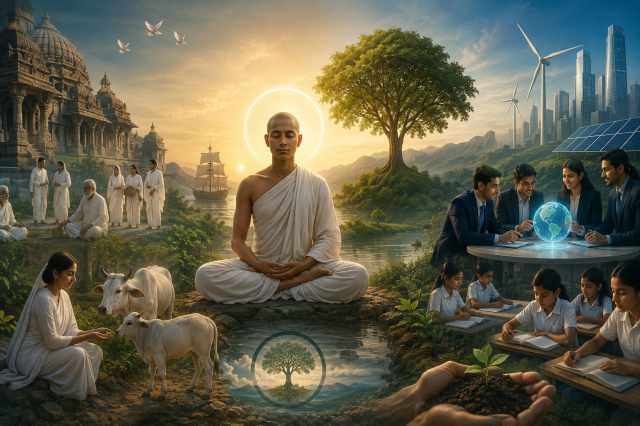
Many companies now adopt Environmental, Social, and Governance (ESG) principles as a new management strategy, but it is not an exaggeration to say Jainism had already been living out these principles two thousand five hundred years earlier. The idea that a company is not simply an organization built for profit, but a community that shares responsibility for society and nature, is an old piece of Jain wisdom.
The climate crisis is another reason the world is looking back at Jainism. Since the Industrial Revolution, humanity has achieved remarkable economic growth, but the planet's ecosystems have paid a steep price for it. Extreme weather, declining biodiversity, deforestation, and ocean pollution are, in part, the result of unchecked human desire. Jainism has long viewed nature not as something to conquer but as something to live alongside. Human beings are part of nature, the tradition holds, and harming nature ultimately means harming ourselves.
This reverence for life is also visible in Jainism's strict vegetarianism. Abstaining from meat is not simply a dietary choice. It is a practice of nonviolence and compassion. The effort to minimize harm to other living beings wherever possible connects naturally to what people today call environmental protection, animal welfare, and healthy eating. What modern society is only now rediscovering as sustainable living was, in Jainism, simply a daily practice.
As economies grow, ethics matter more, not less. As technology advances, human conscience faces bigger tests, not smaller ones. Jainism does not reject progress itself. It insists that progress should not feed human greed, but instead protect life and enrich communities. This is the old wisdom the world is rediscovering today under the banner of sustainable development.
The level of a civilization depends less on how much it produces and more on how much restraint it practices. Nations, companies, and individuals that chase endless growth without limit eventually exhaust both nature and themselves. Growth built on restraint, on the other hand, can last. This is why Jainism is still regarded as a forward looking tradition today. It has been teaching, for two thousand five hundred years, that a civilization which values dignity over abundance, sustainability over speed, and coexistence over competition is the one that will endure.
The freedom of the soul, as told in scripture: Jain wisdom meets the age of artificial intelligence
Jainism places enormous weight on spiritual practice, but that practice was never passed down through experience alone. Teachings handed from master to student, and from that student to the next generation, were carried orally for centuries before being organized into written scripture. These texts were never simple doctrinal manuals. They served as guides for how to live, how to master desire, and how to set the soul free.
The oldest scriptural tradition in Jainism is known as the Agamas, a body of texts built on Mahavira's sermons and the teachings of the early monastic community. The Agamas cover the conduct expected of practitioners, the principles governing community life, meditation, ethics, and the path to liberation. The Svetambara sect, one of Jainism's two major branches, regards the Agamas as its most authoritative scripture and continues to follow them today. The Digambara sect, the other major branch, holds that the original Agamas were lost over the course of transmission and developed a separate body of texts instead. Despite this difference, both branches agree on Mahavira's core teachings, nonviolence, non-possession, and self-restraint, as the heart of the faith.
The most systematic classical text in Jain philosophy is the Tattvartha Sutra. It is a rare work respected as authoritative by both major branches of Jainism. The text lays out, in careful logical order, the principles of soul, non-soul matter, karma, rebirth, and liberation, known as moksha. Its central idea, that correctly understanding true reality is the beginning of liberation, runs through the entire work. Before a person can change the world, the text teaches, that person must first understand themselves. Only by overcoming one's own greed, anger, and attachment can a person become truly free.
Another widely read text, the Kalpa Sutra, records the life and spiritual journey of Mahavira, along with the early history of the monastic order and the rules governing its community. It documents, in considerable detail, Mahavira's birth, his renunciation of worldly life, his enlightenment, his years of teaching, and his eventual passing into nirvana. It is one of the texts most familiar to ordinary Jain believers, and its emphasis on compassion, restraint, and a life lived for the community continues to resonate widely today.
These texts differ in character, but they share one message. A person's greatest enemy is not an outside rival but the greed, anger, and pride within. Overcoming oneself, the teaching holds, is harder and more admirable than defeating another, and the soul becomes free not by ruling over others but by governing itself.
On this point, Jainism offers a striking perspective for the age of artificial intelligence. Generative AI is expanding human capability at a remarkable pace, but it is also raising new ethical questions. How far can technology stand in for human judgment. When efficiency and respect for life come into conflict, which should win. Can an algorithm substitute for human conscience.
Jainism offers a clear standard for these questions. Technology should exist for the sake of life, and it should be used in ways that raise human dignity. No matter how advanced a technology is, if it amplifies greed and violence or erodes what makes us human, it cannot be called genuine progress. Progress should be judged by its direction, not its speed, and a civilization is completed by responsibility, not by power. That has been Jainism's consistent philosophy.
The world today faces a tangle of challenges: the climate crisis, resource scarcity, social division, and an erosion of ethical standards. In times like these, Jainism's old teachings read almost like a language built for the future. Choosing sustainable living over unchecked consumption, coexistence over endless competition, and shared benefit over domination, the tradition suggests, is the direction humanity needs to move.
A company should not exist only to chase profit. It should be a community that carries responsibility toward society and nature. Politics should not be a contest for power but a form of service to the public. Journalists should prioritize fact and truth over the race to publish first, and education should build character and conscience alongside knowledge. Science should serve humanity, and artificial intelligence, too, should develop on a foundation of respect for life.
People today own more than any generation before them, yet they are quick to feel anxious. They are more connected than ever, yet they often feel profoundly alone. To this moment, Jainism delivers a quiet but firm message. Happiness does not come from having more, but from being attached to less, and freedom does not come from gaining more power, but from freeing oneself from desire.
Nonviolence, in this tradition, is not the choice of the weak but the greatest form of courage. Non-possession does not romanticize poverty. It represents an independence of spirit that refuses to be ruled by any desire. Restraint is not an obstacle that halts growth. It is the starting point for a future that can actually last.
The biggest challenge facing humanity today is not a shortage of technology but a shortage of wisdom. Artificial intelligence can take the place of human hands, but it cannot take the place of human conscience. A machine can calculate, but it cannot practice compassion, and an algorithm can produce an answer, but it cannot choose between good and evil on its own. In the end, the level of the civilization we build will be decided not by the speed of our technology, but by the character of the people who use it.
Mahavira taught, some two thousand five hundred years ago, that anyone who wishes to change the world must first conquer himself, a teaching handed down through translation. That single line still stands as a living standard for civilization today. Only those who respect life, restrain their desires, and practice truth can become genuinely free.
Jainism, then, is not simply an old religion. It is the oldest lamp still lighting the path toward a future where humanity, nature, technology, and ethics must find a way to coexist. As humanity stands at a major turning point in the age of artificial intelligence, the spirit Jainism has carried for so long asks us the same question once more. Should we possess more, or should we live more rightly. The answer to that question will ultimately decide the direction civilization takes from here.
*The author is a senior columnist of AJP.
Copyright ⓒ Aju Press All rights reserved.