
SEOUL, July 02 (AJP) - China is on pace to export nearly ten million vehicle units this year, according to global consulting firm AlixPartners' 23rd annual Global Automotive Outlook, released June 25. The expected export volume would be a jump from 7.1 million units in 2025, marking the fastest expansion yet for the Chinese automobile industry that, for most of its history, built cars almost entirely for its own drivers.
For decades, exports were an afterthought in China's car industry. As recently as 2018, only about three percent of the passenger cars made in the country ever left it, and vehicle exports accounted for less than one percent of China's total export value that year. Throughout the late 2010s, annual exports hovered around one million units, most of them bound for Russia and a handful of other emerging markets. Chinese industry researchers have described the 2009 to 2020 period as a time when carmakers turned inward, not outward, as a fast-growing domestic middle class bought vehicles faster than factories could find buyers abroad.
That market trend changed quickly. Exports climbed from roughly one million to two million between 2020 and 2021, then kept accelerating to 3.1 million in 2022, to nearly 5 million in 2023, the year China passed Japan to become the world's largest car exporter, 6.4 million in 2024, and 7.1 million in 2025. If the AlixPartners forecast holds, 2026 would push that trajectory into territory no country has reached before in a single year.
Two forces are driving the shift, and both point away from China's home market rather than toward it. The first is domestic overcrowding. China Association of Automobile Manufacturers (CAAM) data show total vehicle sales inside China fell 2.1 percent in May compared with a year earlier, even as new energy vehicle sales, a category covering both battery-electric and plug-in hybrid cars, rose 14.4 percent. Automakers have been cutting prices to hold onto market share in a pattern the industry itself calls involution, a term for competition so intense that companies exhaust themselves fighting over the same customers without growing the overall market. Industry margins in China have been squeezed to around 3.2 percent as a result.
The second force is a global one. Oil prices have spiked amid the conflict between the United States and Iran, and the resulting rise in fuel costs has made electric vehicles a more attractive purchase for buyers outside China, particularly in Europe. Morgan Stanley recently raised its 2026 forecast for Chinese EV export growth by 50 percentage points, to 88 percent, citing the energy shock as an offset to soft demand at home.
"China's intense local competition and ongoing involution are also expected to drive Chinese automakers to seek growth in new markets," AlixPartners said in its June 25 report.
Europe has become the main battleground for that growth. Chinese EV maker BYD's first-quarter sales in Europe more than doubled from a year earlier, Leapmotor's surged more than 800 percent, and a Chery model topped Britain's monthly sales chart for the first time. A pricing agreement between the European Union and China on minimum EV prices, reached in January, has removed some of the uncertainty that had clouded the region for Chinese brands.
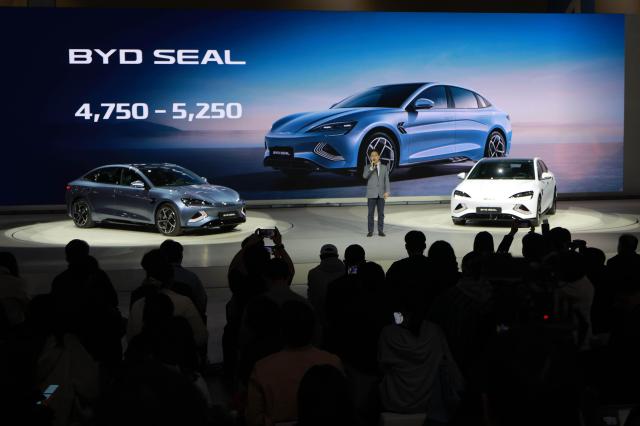
The export boom has been closely tied to a separate contest playing out between BYD and American EV maker Tesla for the title of the world's top seller of EVs. BYD delivered 557,090 battery-electric vehicles in the second quarter of 2026, according to figures compiled by Bloomberg, while Tesla is expected to report around 396,500 for the same period once it releases official numbers. That reverses the first quarter, when Tesla narrowly reclaimed the lead with 358,023 deliveries against BYD's 310,389, a gap driven mainly by a drop in BYD's domestic sales after Beijing scrapped its EV purchase tax exemption earlier this year. BYD has told analysts it expects overseas sales to reach 1.5 million vehicles in 2026, above its earlier official target of 1.3 million.
Chinese automakers are increasingly moving beyond shipping finished cars and building factories overseas instead. AlixPartners forecasts that Chinese brands will boost overseas production to 3.4 million vehicles by 2030, up from 1.2 million last year, with new plants planned in at least sixteen countries. BYD's passenger car plant in Hungary is scheduled to begin mass production in the current quarter, joining existing factories in Thailand and Brazil, with sites in Indonesia and a second European location expected online by April 2026.
"It's clear that Chinese automakers and suppliers have even bigger plans in store, starting with more local production," said Andrew Bergbaum, global co-leader of the automotive and industrial practice at AlixPartners.
That localization push is already reshaping how global parts suppliers operate. Stephen Dyer, AlixPartners' Asia-Pacific leader for its automotive and industrial practice, said Chinese automakers building or buying capacity abroad tend to bring their own supply base with them.
"These Chinese automakers' preference is for their existing supply base, and internal suppliers, to join them abroad," Dyer said, adding that the pattern makes it difficult for traditional suppliers already established in those markets to win new contracts with Chinese customers.
BYD's plant in Hungary, once operational, will give the company its fourth overseas manufacturing base after Thailand, Brazil, and a facility already under construction in Indonesia.

Copyright ⓒ Aju Press All rights reserved.
