
Meta's announcement regarding its artificial intelligence (AI) cloud services has sent shockwaves through the global semiconductor market. Following news that Meta plans to sell excess AI computing resources, the Philadelphia Semiconductor Index plummeted by over 6% in just one day. On July 2, shares of major semiconductor companies in South Korea, including Samsung Electronics and SK Hynix, fell by 9.06% and 14.57%, respectively. The core concern stemming from the Meta shock is the potential for a semiconductor "peak-out," indicating a slowdown after a period of growth. There are growing fears that demand from hyperscalers—companies operating large data centers—may be waning.
Reactions in the financial sector regarding the AI investment cycle following the Meta shock are mixed. Some analysts suggest it signals an oversupply of AI infrastructure, while others view it as a short-term correction due to profit-taking after a recent surge in semiconductor stocks.
Kiwoom Securities assessed that Meta's announcement does not indicate a real decline in AI demand but rather a temporary "noise" in the AI investment narrative. They argue that the recent sharp rise in semiconductor stocks made Meta's issue a trigger for profit-taking, and considering the growth in South Korean semiconductor exports and positive earnings forecasts for major companies, it is premature to conclude that the AI investment cycle has been damaged.
Conversely, BNK Investment & Securities suggested that Meta's plan to sell excess AI computing resources could hint at potential oversupply in AI infrastructure. They noted that efforts to monetize surplus computing resources might lead to a slowdown in capital expenditures (CapEx) among big tech companies, warranting a closer look at their investment plans for the second half of the year.
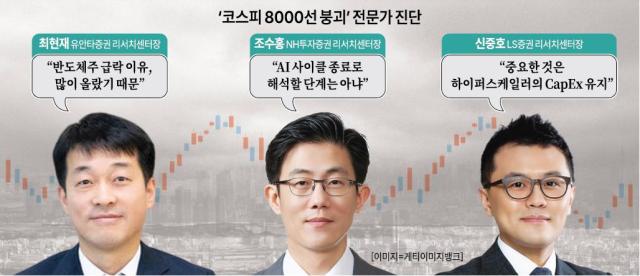
Experts believe that the Meta issue itself is less significant than the accumulated desire for profit-taking and changes in the macroeconomic environment. Choi Hyun-jae, head of research at Yuanta Securities, stated, "The main reason for the sharp drop in semiconductor stocks is that they had already risen significantly. The earnings outlook for Samsung Electronics and SK Hynix remains strong, and the preliminary results for Samsung Electronics expected next week are likely to be positive." He added that recent strong U.S. employment data has diminished expectations for interest rate cuts, while supply and demand pressures from leverage regulations and pension fund rebalancing have increased. He described the Meta issue as a trigger that unleashed existing burdens all at once.
Jo Soo-hong, head of research at NH Investment & Securities, also noted that while rapid price increases could lead to greater volatility, it is too early to interpret this as the end of the AI cycle. He emphasized that this year marks the beginning of corporate AI adoption, suggesting that AI utilization will continue to expand. He predicted that as AI agents and multimodal services proliferate beyond text-based applications, computing demand will continue to grow. He further stated, "It is difficult to view AI demand as a temporary trend, and we expect steady growth in AI demand until 2028."
The nature of this correction is expected to become clearer with the second-quarter earnings reports from major U.S. tech companies at the end of this month. The key variable will be whether Meta, Microsoft, Amazon, and Alphabet, among others, maintain their AI investment and data center expansion plans.
Shin Chung-ho, head of research at LS Securities, noted, "Meta's cloud business announcement has raised concerns that the rise in memory prices may slow down somewhat. Ultimately, what matters is demonstrating continued confidence that hyperscalers will maintain their capital expenditures (CapEx)." He added that if the AI investment trend and CapEx maintenance policies are confirmed in the big tech earnings reports at the end of July, the market may view this correction as an overreaction.
Choi also predicted that high volatility is likely to continue in the short term. He stated, "Until the third quarter, the market may fluctuate up and down due to interest rate and inflation pressures, and the supply and demand focus that has been concentrated on semiconductors may begin to diversify into other sectors." He concluded that if inflation stabilizes by the end of the third quarter and interest rate forecasts shift toward a freeze in the fourth quarter, a rally in the KOSPI could reemerge.
* This article has been translated by AI.
Copyright ⓒ Aju Press All rights reserved.