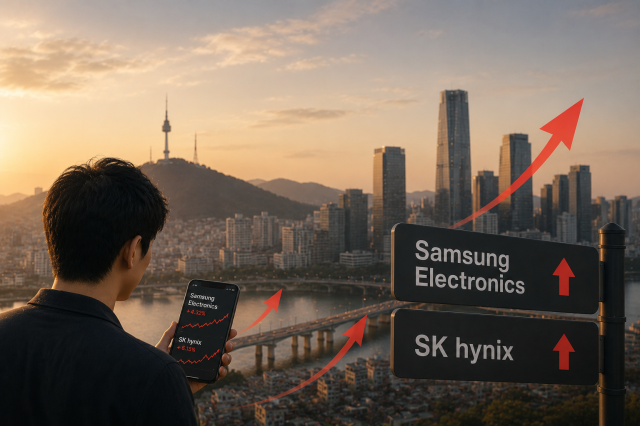
SEOUL, July 03 (AJP) — The hotter South Korea's stock market becomes, the narrower it grows. Investing in Korean equities is now synonymous with owning Samsung Electronics or SK hynix.
"People don't ask whether you own stocks anymore. They ask whether you own Samjeonnix," insurance planner Lee Min-joo said, referring to the Korean investor shorthand combining Samjeon (Samsung Electronics) and SK hynix. "Those two stocks dominate almost every conversation I have with clients."
The country's two semiconductor giants now account for roughly half of the KOSPI's market capitalization, which stood at 6,504 trillion won ($4.18 trillion) on Friday. Their recent wild swings have dictated not only the direction of Seoul's benchmark index but also rippled through semiconductor-heavy markets from Tokyo and Taipei to Wall Street.
The concentration reflects the AI-driven rally that has propelled Korean equities this year, drawing both first-time investors and seasoned traders into an increasingly crowded trade.
By the end of last year, about one-quarter of South Korea's 50 million people owned stocks. With the KOSPI and its two largest constituents nearly doubling this year, market participants believe many more have since joined the rally.
The enthusiasm has been even more pronounced in exchange-traded funds.
According to ETF Check, a platform operated by financial market technology provider Koscom, the KODEX SK hynix Single Stock Leverage ETF attracted the largest retail inflows over the past month, with net purchases totaling 2.37 trillion won ($1.52 billion).
It was followed by the KODEX Samsung Electronics Single Stock Leverage ETF, which drew 1.89 trillion won, the TIGER SK hynix Single Stock Leverage ETF with 1.45 trillion won, and the TIGER Samsung Electronics Single Stock Leverage ETF with 1.12 trillion won.
The fifth most-purchased fund was the SOL AI Semiconductor TOP2 Plus ETF, an unleveraged product heavily weighted toward Samsung Electronics and SK hynix alongside several other major semiconductor stocks. It attracted 744.8 billion won in net inflows.
Together, the five funds drew 7.57 trillion won in retail money over the past month, underscoring how heavily individual investors have concentrated their bets on the country's two dominant memory chipmakers.
Yoon Jae-hong, an analyst at Mirae Asset Securities, said the trend reflects investors' growing preference for owning the industry's clear winners rather than diversified semiconductor portfolios.
"As semiconductor stocks became increasingly driven by Samsung Electronics and SK hynix, investors began asking why they should own a broader semiconductor ETF when they could invest directly in the two market leaders," Yoon said.
He added that investors seeking lower-risk exposure, particularly through retirement pension and tax-advantaged accounts where leveraged products are unavailable or less suitable, have increasingly turned to the SOL AI Semiconductor TOP2 Plus ETF.
The shift is also evident in what investors are selling.
The TIGER Semiconductor TOP10 Leverage ETF, which tracks a broader basket of Korean semiconductor companies with leverage, posted the largest retail outflow over the past month at 404.2 billion won. Its unleveraged counterpart, the TIGER Semiconductor TOP10 ETF, followed with net outflows of 204.4 billion won.
Academics say the pattern also reflects the distinctive characteristics of Korean retail investors.
Lee Jeong-hwan, a professor of economics and finance at Hanyang University, said leveraged ETFs naturally attract investors seeking short-term gains, contributing to higher trading turnover and greater market volatility.
"The investment strategy itself is different," Lee said. "Many investors aim to make quick profits. They sell into rallies, cut losses quickly when prices fall and move in and out of positions much more actively."
He added that Korean retail investors have long exhibited a stronger appetite for risk than their counterparts in many overseas markets.
"Korean retail investors tend to have a stronger appetite for risk," Lee said, noting that the absence of a capital gains tax on most domestic stock trading lowers the cost of frequent transactions and encourages rapid-fire trading.
That strategy has become increasingly painful as AI-related semiconductor stocks have entered a period of violent swings.
Over the past month, the KODEX SK hynix Single Stock Leverage ETF has plunged 29.15 percent, from 31,100 won to 22,035 won. The KODEX Samsung Electronics Single Stock Leverage ETF has tumbled 40.03 percent, from 29,350 won to 17,600 won. Even the unleveraged SOL AI Semiconductor TOP2 Plus ETF has fallen 8.74 percent over the same period.
The selloff has reignited debate over whether the AI-driven semiconductor rally is merely entering a period of consolidation or approaching the end of its explosive run.
Some analysts argue the latest correction resembles earlier episodes triggered by concerns over China's DeepSeek AI model and this year's "Turbo Quant" rotation, in which quantitative funds rapidly unwound crowded AI trades before the sector eventually rebounded.
The next major test may come within days.
Investors are now awaiting Samsung Electronics' preliminary earnings on July 7, followed later this month by SK hynix's quarterly results, which are expected to offer the clearest indication yet of whether record AI memory demand remains strong enough to justify a market where investing in Korean stocks has become increasingly synonymous with betting on two chip giants.

Copyright ⓒ Aju Press All rights reserved.