
SEOUL, July 03 (AJP) - A research team at the Korea Advanced Institute of Science and Technology has built a system that adjusts the flow of air around an electric vehicle in real time, adapting to how the car is being driven to improve speed, braking and cornering. The work, developed with support from Hyundai Motor Company, won the top student paper prize at one of the world's leading conferences on intelligent vehicles, a result that signals South Korea's growing reach in the technology shaping the next generation of high-performance cars.
According to the Korea Advanced Institute of Science and Technology (KAIST) on Friday, its team, led by Professor Shim Hyun-chul in the Department of Electrical and Electronic Engineering at KAIST, received the First Prize Best Student Paper Award at the IEEE Intelligent Vehicles Symposium (IV 2026), held in Detroit, Michigan, in June this year. KAIST said the paper was one of only about eight and a half percent of accepted submissions chosen for an oral presentation, a session reserved for papers the conference organizers judge strongest, before going on to win the top prize among those presented.
The research centers on what engineers call active aerodynamics, technology that automatically adjusts a vehicle's airflow depending on how it is being driven. In fast, high-performance cars, air moving around the body of the vehicle generates downforce, a pressing force that helps tires grip the road and keeps the car stable through turns. But the same shapes that generate downforce also increase drag, which slows a car down and hurts acceleration. Active aerodynamics is designed to resolve that trade-off by changing shape on the fly, cutting drag on straightaways to boost top speed and increasing downforce under braking or cornering to improve grip and stability. Variants of the technology are already used in Formula One racing and in some production supercars, including adjustable wings and spoilers and the overtaking aid known as the Drag Reduction System, or DRS.
Most previous research into active aerodynamics has been confined to wind tunnel testing, computer modeling or scaled-down prototypes, KAIST said, with few public studies validating a fully integrated system on an actual production vehicle at a professional racetrack. The KAIST team said its work was different because it moved beyond simulation and tested a complete system on a real car under racing conditions.
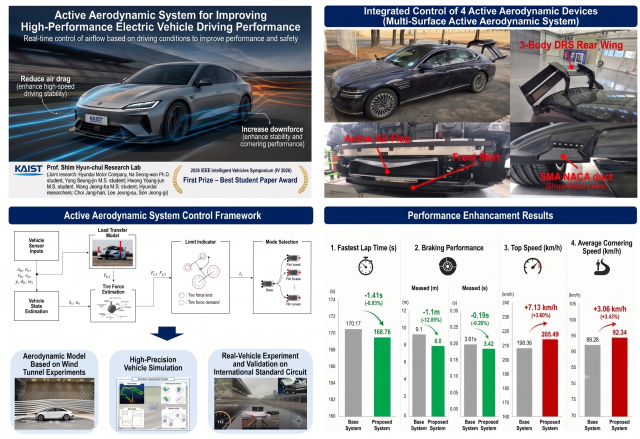
The system developed by Na Seong-won, a PhD student who served as first author on the paper, combines four separate aerodynamic components into one integrated setup. These include an active air flap and front skirt at the front of the car, a rear wing split into three independently controlled sections functioning as a DRS, and ducts built from shape memory alloy, a material that changes form in response to temperature or electrical signals. Each part can shift the balance of drag, downforce, and side-to-side load distribution depending on driving conditions.
To make the system respond automatically, the researchers built a control algorithm that reads a car's speed, steering angle, acceleration, and other real-time data, then selects the aerodynamic setup best suited to the moment, whether that is a straightaway, a hard brake, or a tight corner. The team first modeled the system using wind tunnel data and simulation software, including CarSim, MATLAB, and Simulink, then mounted it on a Genesis G80 Electrified and tested it on the track using a dSPACE MicroAutoBox III real-time control unit and RT3000 GNSS and INS sensors, which track a vehicle's position and motion with high precision.
The physical testing took place at the Korea International Circuit in Yeongam, a track built to FIA Grade 1 specification, the highest certification level a circuit can hold and the standard required to host Formula One races. KAIST said testing on a track of that caliber, rather than relying solely on simulation, was central to demonstrating that the technology works under real racing conditions. The results showed the active system outperformed a fixed aerodynamic setup on lap times, braking distance, cornering performance and overall vehicle stability, with the simulation and real-world results lining up consistently.
Na has experience with high-speed vehicle control that predates this project. Since 2021, Professor Shim's lab has taken part in the Indy Autonomous Challenge, an international competition for self-driving race cars, and Na has served as team leader of KAIST's entry, called EURECAR, which has driven autonomously at speeds up to 290 kilometers per hour. KAIST said that the background in extreme-speed vehicle control fed directly into the aerodynamic control work.
Shim said the recognition reflected years of accumulated experience from high-speed autonomous racing. "I think it is very meaningful that active aerodynamic control technology based on an actual vehicle, drawing on the experience our lab has gained through high-speed autonomous racing competitions such as the Indy Autonomous Challenge, was selected as the best student paper at a top-tier international conference," Shim said, according to KAIST. He added that he expects the research to develop into a core technology that improves both performance and safety in future vehicles, not just high-performance electric cars.
The paper, titled "Development of an Active Aerodynamic System for Improving Circuit Driving Performance of High-Performance Electric Vehicles," lists Na as first author, with master's students Yang Seung-jin, Hwang Young-jun and Wang Jeong-ha as co-authors. Three Hyundai researchers, principal researchers Choi Jang-han, Lee Jeong-su and Son Jeong-gi, also contributed to the work.
(Reference Information)
Journal/Source: IEEE Intelligent Vehicles Symposium (IV 2026)
Title: Development of an Active Aerodynamic System for Improving Circuit Driving Performance of High-Performance Electric Vehicles
Link: https://drive.google.com/file/d/1H68vDCwL9LJT-aONUHOOTmePxC14phC8/view

Copyright ⓒ Aju Press All rights reserved.
