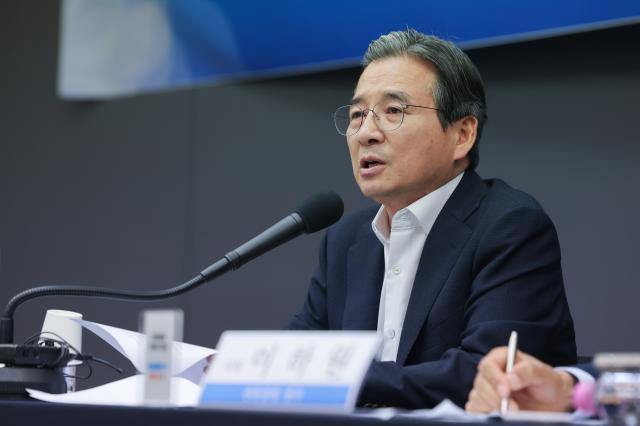
SEOUL, July 05 (AJP) - Kim Yong-beom, director of the Blue House policy office, said Sunday that artificial intelligence represents a production revolution rather than a technology one, and that national power in the AI era will be decided by a country's ability to organize production systems rather than by technological strength alone.
Kim made the remarks in a Facebook post on July 5, giving the clearest articulation yet of the governing philosophy behind South Korea's most ambitious industrial push in a generation. His statement comes less than a week after President Lee Jae Myung unveiled the Three Mega Projects at a June 29 briefing at the Blue House, a sweeping program covering semiconductors, AI data centers, and physical AI, anchored by a pledge of 800 trillion won ($522.8 billion) in corporate investment over the coming decade. Kim leads the policy office responsible for designing that program.
"If the internet was a revolution of information, AI is a revolution of production," Kim wrote in the post. "If the winners of the internet era were companies that owned platforms, the winners of the AI era are likely to be nations that own production systems." He argued that what is scarce in the age of AI is not technology but productive capacity, and that competition has moved beyond companies to become a contest between states.
The Three Mega Projects are the most concrete expression of that contest South Korea has mounted. For semiconductors, Samsung Electronics and SK hynix have each pledged 400 trillion won to build new fabrication facilities in southwestern Jeolla Province, creating what the government describes as a second major chip cluster alongside the existing base in the Seoul metropolitan area. Samsung will invest 56 trillion won in high-bandwidth memory fabs in Cheonan and Onyang. SK hynix will complete its fourth Yongin fab by 2033, twelve years earlier than its previous 2045 target. The Chungcheong region is set to receive an 81 trillion won advanced packaging hub.
The announcement marked the government's answer to what industry and policymakers have long identified as a strategic vulnerability. South Korea's semiconductor base, home to more than 40 percent of global memory chip output, has been concentrated in the capital region, leaving it exposed to power and water constraints that could limit further expansion. Spreading production to the southwest also addressed a political calculation. The Jeolla and Gyeongsang regions have historically competed for industrial investment, and the announcement was calibrated to signal that the Lee administration intended to benefit.
Kim's Facebook post supplied the ideological frame that the June 29 briefing left largely implicit. He described three roles the state must now play -- connecting the fruits of production back into production, building production infrastructure, and reproducing productive capacity across generations. Data centers cannot operate without power grids, he wrote. Semiconductors cannot be produced without water. Physical AI cannot function in the real world without manufacturing, logistics, and urban infrastructure. "Companies can build AI," he said in the post, "but building power grids, developing industrial sites, and organizing supply chains is the work of the state."
He also addressed the distributional question that critics of large-scale industrial policy tend to raise first. "Welfare is not an institution on the opposite side of production," he wrote. "Welfare is an investment that connects the surplus profit created by the production revolution to the productive capacity and social trust of the next generation. Production is the precondition for distribution, and good distribution makes greater production possible again. The state is the entity that designs that virtuous cycle."
The framing is directed as much outward as inward. South Korea's semiconductor companies are simultaneously navigating pressure from Washington to expand their American manufacturing footprint, a tension the Jeolla announcement has sharpened. Samsung has committed $37 billion to a foundry complex in Taylor, Texas, scheduled to begin production in the second half of 2026, and SK hynix has committed $3.87 billion to an advanced packaging facility in West Lafayette, Indiana. Both companies are weighing whether those commitments will be enough to satisfy the Trump administration, which has threatened 100 percent tariffs on chips made outside the United States.
Kim made no direct reference to that pressure. His post closed by returning to the historical register he opened with. "The AI production revolution will make the nation that has organized the best production system the center of the next era," he wrote. "South Korea is now standing on that historical turning point."
Copyright ⓒ Aju Press All rights reserved.