
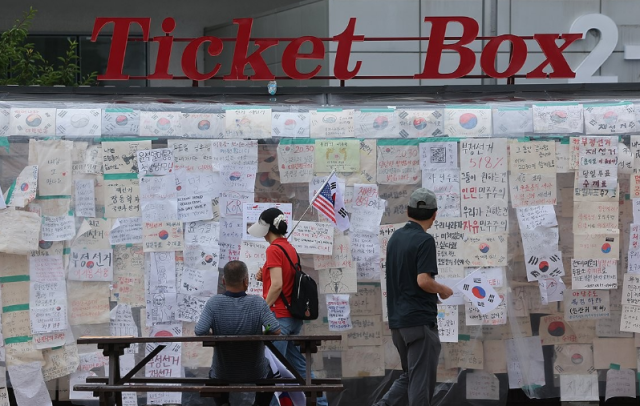
The protest at the handball stadium in Olympic Park, Seoul, against the blockade of the ballot counting center triggered by a ballot paper shortage from the June 3 local elections has now entered its second month. Attempts by the National Assembly's special investigation committee to remove ballot boxes have failed twice, while police are taking a cautious approach to forced dispersal. Political leaders are focusing on institutional responses, such as reforms to the special investigation committee and the Election Commission, rather than deploying public force, leading to a prolonged situation.
According to legal sources on July 5, the special investigation committee attempted to remove ballot boxes stored at the Olympic Park handball stadium on June 16 and again on July 2, but both attempts were unsuccessful. On July 2, they managed to enter the stadium with police cooperation but only confirmed the storage conditions and seals of the ballot boxes.
While maintaining order at the scene and investigating individual illegal acts, police are cautious about forcibly dispersing the protest. This caution is attributed to the potential for physical clashes, safety concerns, and a lack of legal grounds for such actions.
Park Jeong-bo, chief of the Seoul Metropolitan Police Agency, explained on July 1 during a special investigation committee meeting that while it is easy to remove one person, the presence of many others raised concerns about possible clashes. He also noted the difficulty in determining whom to negotiate with, as this protest differs from typical gatherings with designated organizers.
Legal experts also suggest that forced dispersal is challenging. The participants are not gathered under a specific organizer but have come together individually, making it difficult to issue a dispersal order solely based on their assembly. There is a cautious view that without clear illegal acts such as violence or property damage, applying charges of obstructing official duties is also problematic.
However, police are maintaining a strict stance against individual illegal acts, such as assaults. A man in his sixties was arrested on July 2 for allegedly pushing a police officer during the special investigation committee's on-site investigation, and a woman in her forties was also arrested for allegedly spitting at and assaulting police officers. Police are continuing investigations into participants suspected of obstruction of duties and assault based on recorded evidence from the scene.
Political leaders are struggling to propose clear solutions. Some members of the Democratic Party have suggested a need for a strong response, but there are significant concerns that deploying public force could lead to a 'suppression narrative.' The Democratic Party is focusing on institutional responses through the special investigation committee and a task force for Election Commission reform, as well as pursuing a special investigation. Meanwhile, the People Power Party is emphasizing issues related to poor election management and government accountability, opposing the use of public force.
The Election Commission is identified as the agency responsible for the situation, but it has limited authority and means to directly resolve the blockade. While the ballot paper shortage has raised concerns about the Commission's management, the ongoing protests and ballot box removal issues involve multiple stakeholders, including police, the National Assembly, and sports organizations.
The prolonged blockade is also causing secondary damages. Sports organizations with offices inside the handball stadium have faced disruptions to their normal operations for a month. Some sports organizations are reportedly struggling with administrative tasks such as athlete support, salary payments, and event management. The Korean Sports Council is also considering legal action against the Election Commission.
Experts, including sociology professors, emphasize that addressing the root causes and responsibilities of the ballot paper shortage should take precedence over relying on physical force. They argue that as the blockade continues, the burden on police and the impact on citizens will increase, necessitating a swift investigation by the special investigation committee and discussions on reforming the Election Commission.
* This article has been translated by AI.
Copyright ⓒ Aju Press All rights reserved.