
As artificial intelligence (AI) has become a key investment theme driving global stock markets, expectations are high for continued performance improvements among related companies in the second half of the year. However, with rapid changes in leading stocks within the AI sector, experts advise that investors should adopt flexible strategies that align with these evolving trends rather than simply investing in AI.
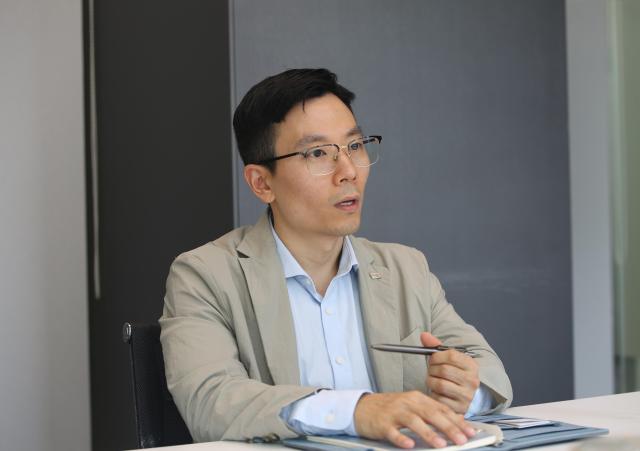
Oh Jun-hyuk, head of the Active ETF team at Mirae Asset Asset Management, stated in a recent interview with Aju Economy, "Investment flows within AI are continuously changing. If general investors find it difficult to keep up, active ETFs can be a viable alternative."
Oh manages overseas stock active ETFs at Mirae Asset and is currently overseeing the 'TIGER Global AI Active ETF,' which actively adjusts its portfolio in response to changes in the global AI industry.
He attributed recent performance improvements to a shift in management strategy. "Previously, we were heavily influenced by benchmarks, but now we are boldly increasing our positions in stocks we are confident about," he explained. "Active ETFs can hold individual stock weights of up to 25%, so we are increasing the weight of strong momentum stocks to 15-20%."
Indeed, the TIGER Global AI Active ETF has seen its net assets grow from approximately 400 billion won at the beginning of the year to nearly 800 billion won recently. Oh noted, "The one-month, three-month, and one-year returns are all outperforming competing products," indicating that the strategic changes have led to improved performance.
Oh highlighted the 'rapid responsiveness' of active ETFs as their greatest competitive advantage. He remarked, "While passive ETFs require investors to decide when to buy and sell, active ETFs allow the management company to adjust stocks and weights according to market changes. This difference can lead to better performance, especially in fast-changing markets like AI."
He assessed that the era of holding a single AI stock for an extended period has passed. "In the early days of AI, graphics processing units (GPUs) led the market, but now the focus is shifting to central processing units (CPUs), memory semiconductors, semiconductor equipment, and power semiconductors," he said. "Since it is challenging for general investors to keep up with these trends, active ETFs that adjust portfolios according to market conditions can be advantageous."
He specifically pointed to CPUs and memory semiconductors as the most favored sectors. "As AI CPU performance increases, the amount of memory also rises," he noted. "With the expansion of semiconductor investments, equipment companies are expected to benefit, and subsequently, the power semiconductor market is likely to grow significantly alongside increased investments in data centers."
Despite increased volatility due to concentrated investments in AI-related stocks, Oh predicts that the upward trend will continue, supported by strong earnings.
"Recent corrections have raised concerns about AI concentration, but the industry with increasing earnings remains solely AI," he stated. "Memory semiconductors are also seeing a much faster growth rate in operating profit compared to stock prices, so the likelihood of continued AI strength through the second half is high."
He added, "While volatility may occur more frequently, it could actually present buying opportunities. Historically, memory semiconductors have been viewed as a cyclical industry, but in the AI era, structural demand is increasing."
Oh also maintains a positive outlook for the domestic stock market. "As long as Samsung Electronics and SK Hynix continue to exceed market expectations, the KOSPI is likely to remain strong," he said. "Conversely, the KOSDAQ may struggle to show relative strength as funds continue to concentrate on large semiconductor stocks."
Oh expressed a high assessment of the growth potential of the ETF market. He stated, "ETFs are much more transparent than traditional public funds because their constituent stocks are disclosed in real-time, allowing investors to verify management details directly. Additionally, the ability to compare investment strategies across products means the ETF market is structurally poised for growth."
He emphasized the necessity of investing in overseas ETFs. "While the Korean stock market is centered on memory semiconductors, the U.S. market offers a much wider array of AI-related investment opportunities, including CPUs and power semiconductors," he advised. "Utilizing retirement pensions or ISA accounts to hold overseas assets can be beneficial for long-term asset allocation."
Oh urged individual investors to adhere to investment principles that resist short-term fluctuations. "In a highly volatile market like today, reacting to daily stock price changes can actually reduce returns," he cautioned. "Initially, it is advisable to invest small amounts in various ETFs to understand one's investment style and to adopt a long-term perspective in investing."
* This article has been translated by AI.
Copyright ⓒ Aju Press All rights reserved.