
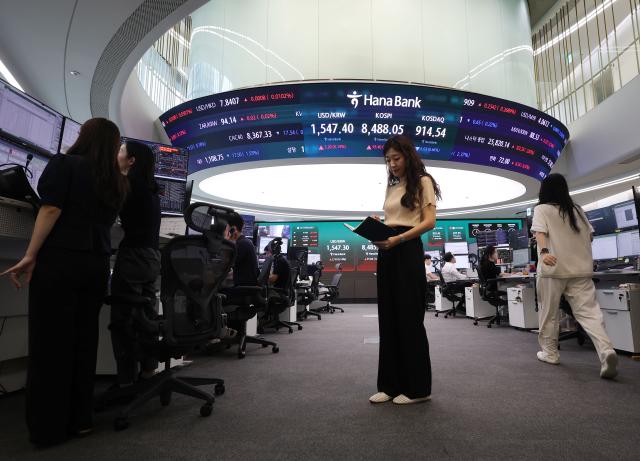
Employees work in the dealing room of Hana Bank in Jung-gu, Seoul, on June 30, ahead of the official transition to 24-hour trading on July 6. [Photo: Yonhap News]
In the first half of this year, the won-dollar exchange rate reached its highest level since the 1997 financial crisis, prompting a sustained trend of high exchange rates. Starting July 6, the foreign exchange market will transition to a 24-hour trading system, marking a new phase of currency volatility.
According to the Bank of Korea's economic statistics system, the average weekly closing price of the won-dollar exchange rate in the first half of this year was 1484.56 won. This figure is the second highest on record, following the 1493.08 won average during the first half of the 1998 financial crisis.
Beginning the year at 1441.8 won, the exchange rate surpassed 1500 won for the first time since the global financial crisis in March, driven by concerns over prolonged U.S. tightening and conflicts in the Middle East. Although it fell back to the 1400 won range, it climbed back above 1500 won in mid-May and remained above that level for 34 consecutive trading days until July 3. This marks the longest stretch since the 1998 crisis, which saw 47 consecutive days above 1500 won.
There are concerns that high exchange rates may persist. Park Hae-sik, a senior researcher at the Korea Financial Research Institute, stated in a report on the "Structural Upward Movement Possibility of the Won-Dollar Exchange Rate" that "unless there are additional shocks, it is likely that the average won-dollar exchange rate will not return to past levels in the short term and will remain around the current level."
This year, geopolitical risks from the Middle East and the strength of the U.S. dollar, combined with significant foreign selling of domestic stocks, have exacerbated the depreciation of the won. Notably, foreign investors have sold approximately 156.56 trillion won worth of domestic stocks this year, far exceeding the annual net selling of about 34.58 trillion won during the 2008 global financial crisis. With the likelihood of continued rebalancing by global institutional investors, expectations are that the exchange rate will remain elevated for the foreseeable future.
In this context, the foreign exchange market will officially transition to a 24-hour trading system starting July 6. Previously, trading was only available from 9 a.m. to 2 a.m. the following day. Now, trading will occur from 6 a.m. on Monday to 6 a.m. on Saturday, excluding weekends and January 1.
The move to 24-hour trading is a key initiative in the government's efforts to modernize the foreign exchange market. Historically, external factors such as U.S. economic indicators, Federal Reserve monetary policy, and international oil prices have often been reflected in the exchange rate all at once after the domestic market opened. Going forward, movements in overseas financial markets will be reflected in the won-dollar exchange rate in real time, enhancing convenience for foreign investors.
However, market analysts believe that extending trading hours will not immediately stabilize the exchange rate. While the phenomenon of external shocks being reflected all at once at market opening may ease, the real-time reflection of fluctuations in U.S. stock markets and global financial markets could actually increase short-term volatility.
Jung Yong-taek, a researcher at IBK Investment & Securities, noted, "Even if there are changes in domestic investors' preferences for U.S. investments and foreign investors' selling trends, it seems unlikely that the exchange rate will drop quickly. While fluctuations will occur, the overall trend is likely to continue upward, raising the lows."
According to the Bank of Korea's economic statistics system, the average weekly closing price of the won-dollar exchange rate in the first half of this year was 1484.56 won. This figure is the second highest on record, following the 1493.08 won average during the first half of the 1998 financial crisis.
Beginning the year at 1441.8 won, the exchange rate surpassed 1500 won for the first time since the global financial crisis in March, driven by concerns over prolonged U.S. tightening and conflicts in the Middle East. Although it fell back to the 1400 won range, it climbed back above 1500 won in mid-May and remained above that level for 34 consecutive trading days until July 3. This marks the longest stretch since the 1998 crisis, which saw 47 consecutive days above 1500 won.
There are concerns that high exchange rates may persist. Park Hae-sik, a senior researcher at the Korea Financial Research Institute, stated in a report on the "Structural Upward Movement Possibility of the Won-Dollar Exchange Rate" that "unless there are additional shocks, it is likely that the average won-dollar exchange rate will not return to past levels in the short term and will remain around the current level."
This year, geopolitical risks from the Middle East and the strength of the U.S. dollar, combined with significant foreign selling of domestic stocks, have exacerbated the depreciation of the won. Notably, foreign investors have sold approximately 156.56 trillion won worth of domestic stocks this year, far exceeding the annual net selling of about 34.58 trillion won during the 2008 global financial crisis. With the likelihood of continued rebalancing by global institutional investors, expectations are that the exchange rate will remain elevated for the foreseeable future.
In this context, the foreign exchange market will officially transition to a 24-hour trading system starting July 6. Previously, trading was only available from 9 a.m. to 2 a.m. the following day. Now, trading will occur from 6 a.m. on Monday to 6 a.m. on Saturday, excluding weekends and January 1.
The move to 24-hour trading is a key initiative in the government's efforts to modernize the foreign exchange market. Historically, external factors such as U.S. economic indicators, Federal Reserve monetary policy, and international oil prices have often been reflected in the exchange rate all at once after the domestic market opened. Going forward, movements in overseas financial markets will be reflected in the won-dollar exchange rate in real time, enhancing convenience for foreign investors.
However, market analysts believe that extending trading hours will not immediately stabilize the exchange rate. While the phenomenon of external shocks being reflected all at once at market opening may ease, the real-time reflection of fluctuations in U.S. stock markets and global financial markets could actually increase short-term volatility.
Jung Yong-taek, a researcher at IBK Investment & Securities, noted, "Even if there are changes in domestic investors' preferences for U.S. investments and foreign investors' selling trends, it seems unlikely that the exchange rate will drop quickly. While fluctuations will occur, the overall trend is likely to continue upward, raising the lows."
* This article has been translated by AI.
Copyright ⓒ Aju Press All rights reserved.