
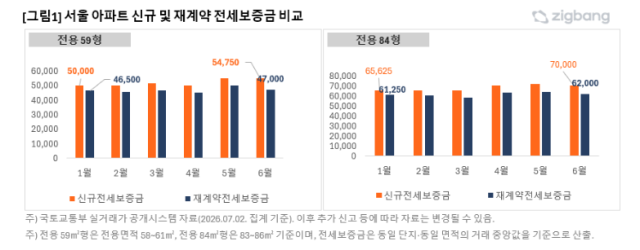
As rental prices continue to rise, tenants seeking new leases in Seoul are facing significantly higher deposit burdens, even for the same apartment and size. The gap between new and renewal lease deposits has widened to as much as 80 million won for apartments measuring 84 square meters.
According to Zigbang, an analysis of rental transactions in the metropolitan area from January to June this year shows that the disparity between new and renewal lease deposits is increasing, particularly in Seoul.
This analysis focused on cases where both new and renewal contracts were signed for the same apartment type and size, comparing deposits based on the median transaction values. The study included apartments of 59 square meters and 84 square meters, excluding monthly rental agreements.
In Seoul, the difference in lease deposits between new and renewal contracts has grown the most in the metropolitan area. For 59 square meter apartments, the deposit gap increased from 35 million won in January to 77.5 million won in June, more than doubling. During the same period, the deposit for new contracts rose from 500 million won to 547.5 million won, while renewal deposits saw a more modest increase from 465 million won to 470 million won.
The disparity for 84 square meter apartments was even greater, with the gap expanding from 43.75 million won in January to 80 million won in June. New contract deposits increased from 656.25 million won to 700 million won, whereas renewal deposits remained relatively stable, rising from 612.5 million won to 620 million won.
In Gyeonggi Province, the burden of new contracts is also on the rise. The deposit difference for 59 square meter apartments grew slightly from 20 million won to 22 million won, while for 84 square meter apartments, it surged from 10.5 million won to 51 million won. New contract deposits increased from 400 million won to 450 million won, while renewal deposits rose from 389.5 million won to 399 million won, showing a smaller increase.
In contrast, Incheon experienced a relatively smaller gap. As of June, the deposit difference for 59 square meter apartments was 9.5 million won, and for 84 square meter apartments, it was 7.12 million won, the lowest in the metropolitan area.
As the burden of rental prices increases, existing tenants are opting to renew their leases more frequently. In Seoul, the proportion of new contracts decreased from 52.6% in January to 45.0% in June, while the share of renewals rose from 47.4% to 55.0%, surpassing new contracts since April. Gyeonggi Province also saw an increase in renewal contracts, rising from 38.6% to 45.4% during the same period.
Zigbang explained that new contracts reflect current market prices immediately, while renewals are influenced by the terms of existing contracts. Particularly when the right to request a lease renewal is applied, the increase in rental prices is limited, which can further widen the deposit gap between new and renewal contracts.
The agency noted that the recent shortage of rental listings and rising prices have increased the burden of deposits required for new contracts, along with moving costs and brokerage fees, leading to a higher preference for renewals among existing tenants.
As the proportion of renewals continues to rise, particularly in Seoul and Gyeonggi Province, it is anticipated that the gap between new and renewal lease deposits will likely continue to widen as rental prices remain strong.
Additionally, renewal contracts are also on the rise. According to the Ministry of Land, Infrastructure and Transport, the proportion of renewal contracts for apartments in Seoul from January to May this year was 46.0%, an increase from 40.5% during the same period last year. Notably, the renewal contract share for leases exceeded 51.3%, with the use of the lease renewal request right surpassing 52.8%, indicating that more than half of the contracts were renewals.
* This article has been translated by AI.
Copyright ⓒ Aju Press All rights reserved.