
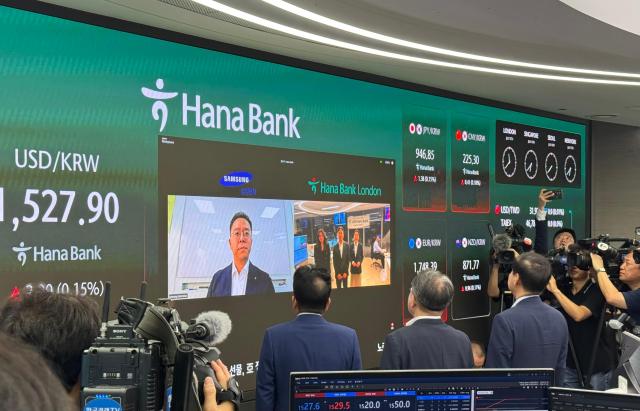
SEOUL, July 06 (AJP) -South Korea's foreign exchange market began operating on a near 24-hour basis Monday, a milestone reform aimed at making the won more accessible to global investors and strengthening the country's case for inclusion in developed-market indexes.
Under the new framework, spot trading will run continuously from 6 a.m. Monday to 6 a.m. Saturday during U.S. daylight-saving time, with the opening and closing shifting to 7 a.m. during U.S. winter time.
Deputy Prime Minister and Finance Minister Koo Yun-cheol visited Hana Bank's dealing room in central Seoul at 7:30 a.m. to inspect market conditions on the first day of the new trading regime.
Officials from the Ministry of Economy and Finance, the Bank of Korea, Hana Financial Group and Hana Bank attended alongside dealers from domestic banks, overseas branches and exporting companies.
The reform marks the final step in a gradual expansion of Korea's FX trading hours. The onshore market operated from 9 a.m. to 3 p.m. between 2005 and 2016 before the closing time was extended to 3:30 p.m. Trading hours were lengthened again in July 2024 to run until 2 a.m. the following day, overlapping with London trading.
Despite the launch, the Korean won weakened in early Monday trading, with the U.S. dollar approaching the 1,530-won level.
The finance ministry described the overhaul as more than a simple extension of trading hours, calling it a core piece of financial-market infrastructure needed to bring Korea's foreign-exchange market closer to developed-market standards.
The ministry said the reform reflects confidence in Korea's external fundamentals, including a record current-account surplus and rising foreign demand for Korean assets following the country's inclusion in the World Government Bond Index.
Koo called the launch the starting point for the won's global expansion, saying investors, exporters and importers will be able to trade the currency without being constrained by Seoul business hours.
The government expects the longer trading window to allow companies to manage currency risks in real time while creating new business opportunities for domestic financial institutions and brokers.
Bank of Korea Assistant Governor Kwon Min-soo said the broader trading session should deepen liquidity and broaden participation in the foreign-exchange market. He added that authorities would closely monitor market conditions and the impact of the new framework.
Market participants attending Monday's meeting expressed support for the reform and said banks and companies planned to make active use of the expanded trading environment.
The launch also comes as Seoul continues its long-running effort to gain admission to MSCI's developed-market index.
MSCI last month kept South Korea in its emerging-market category in its 2026 market classification review, again citing foreign-exchange accessibility as one of the main obstacles.
The index provider said the won remains a non-deliverable offshore currency and that liquidity during Korea's extended onshore trading hours has yet to reach the level needed to support execution comparable with developed markets.
Market analysts say the extended trading session could strengthen Korea's MSCI case if it enables foreign investors to exchange and hedge won positions throughout global trading hours while reducing reliance on offshore non-deliverable forwards. A deeper overnight market could also improve price discovery and transparency.
Whether the reform succeeds, however, will depend less on the official trading schedule than on the liquidity it attracts, bid-ask spreads, foreign participation and settlement efficiency during offshore hours.
Other market-access issues also remain under MSCI's review, including omnibus accounts, in-kind transfers, pre-settlement funding requirements and operational burdens related to short-selling compliance.
The impact on the bond market is expected to be indirect. Government bonds themselves will not trade around the clock, but overnight moves in the dollar-won exchange rate and swap market may be reflected more quickly when Seoul's bond market opens.
If the won becomes more stable and hedging conditions improve, the new system could support foreign demand for won-denominated government bonds as WGBI-related inflows accelerate. Conversely, sharp currency swings during relatively thin overnight trading could weigh on bond prices by raising concerns over imported inflation, financial stability and the Bank of Korea's policy outlook.
The finance ministry said maintaining market stability and ensuring smooth settlement under the expanded trading system remain the government's top priorities. Authorities plan to maintain around-the-clock market monitoring while pressing ahead with additional reforms, including a full-scale offshore won settlement system scheduled to begin operation in January 2027.

Copyright ⓒ Aju Press All rights reserved.
