
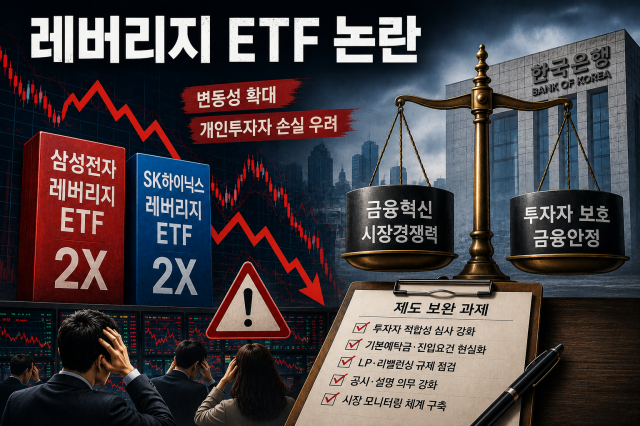
The controversy surrounding single-stock leverage ETFs is escalating rapidly. The head of the Financial Supervisory Service expressed regret, stating, "We should have prevented their introduction," while some lawmakers are even calling for a review of the possibility of delisting these products. The Bank of Korea has also weighed in, warning that leverage ETFs based on Samsung Electronics and SK Hynix could exacerbate market concentration and volatility, leading to greater losses for individual investors.
It is unusual for the central bank, financial authorities, and the National Assembly to simultaneously raise concerns about a financial product, indicating that the market's warning signals should not be taken lightly.
The basis for these concerns is clear. The South Korean stock market is already overly reliant on just two companies: Samsung Electronics and SK Hynix. Together, these firms account for more than half of the KOSPI index's market capitalization and over 60% of trading volume. In this context, a product that doubles the daily returns of these stocks could significantly skew market direction.
The structure of leverage ETFs further amplifies this issue. To maintain their target returns, these products must adjust their positions daily. This means buying more when prices rise and selling more when they fall, leading to a cycle of trading that can intensify price fluctuations, a phenomenon known as the "Wag the Dog" effect. Experts share a common concern that this structure may have contributed to the recent increase in KOSPI volatility.
The risks for individual investors are also significant. Leverage ETFs are designed based on daily returns, meaning that even if the underlying asset prices eventually stabilize, investors can still incur losses due to what is known as "volatility drag." However, many investors seem to remember only the "double returns" aspect and fail to grasp the structural characteristics that entail "double losses and slower recoveries." Following their launch, a substantial influx of individual capital occurred, leading to cases of widening discrepancies that heightened market anxiety.
However, delisting these products is not necessarily a viable solution. Removing them from the market solely because they are deemed risky could undermine the predictability and trustworthiness of the capital markets. Moreover, various single-stock leverage ETFs are already traded overseas. Simply closing the domestic market may not eliminate investor demand but could instead drive it abroad, contradicting the original policy aim of attracting foreign investment to South Korea.
This controversy prompts a reevaluation of the policy design rather than the product itself. Financial authorities must critically assess whether they adequately considered market concentration and investor behavior during the introduction of these products. The South Korean stock market does not mirror the diverse large-cap balance seen in the U.S. market; thus, applying overseas examples directly may have been a misguided judgment.
What is now required is not an extreme measure but rather thoughtful adjustments. There is a need to strengthen investor suitability assessments for high-risk products and to make the requirements for basic deposits and investment experience more realistic. Additionally, the methods used by liquidity providers (LPs) and the impact of rebalancing trades on volatility should be closely examined. Most importantly, the disclosure and explanation obligations regarding the structure and risks of these products must be significantly enhanced to ensure that investors can easily understand them. It is also time for financial authorities to evolve; reactive regulation is not the role of these institutions, which should prioritize proactive risk management.
* This article has been translated by AI.
Copyright ⓒ Aju Press All rights reserved.