
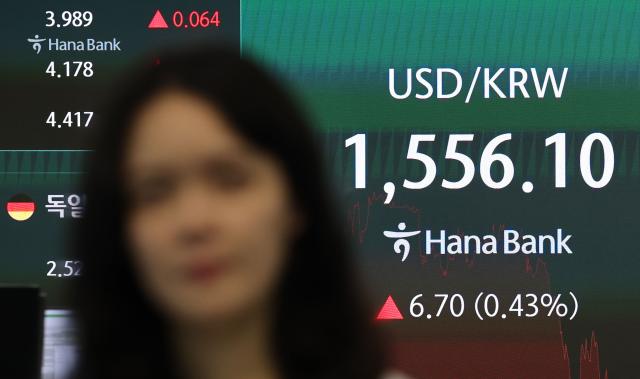
SK Hynix's plan to issue American Depositary Receipts (ADRs) on the U.S. stock market has sparked interest in its potential impact on the won-dollar exchange rate. The company aims to raise up to $30 billion, which could act as a supply factor for dollars in a foreign exchange market characterized by high exchange rates. However, analysts caution that the effect on the exchange rate may be limited due to unresolved factors contributing to its rise, as well as the timing and scale of the issuance.
As of July 6, the average exchange rate of the won against the U.S. dollar for the first half of this year was recorded at 1,484.56 won, the highest since the first half of the 1998 financial crisis. Although the exchange rate fell by over 30 won during the weekly trading on July 3, it remains above 1,500 won. This is still significantly higher than the peak of the exchange rate during the state of emergency in 2024, which was in the high 1,400s.
In this context, SK Hynix's dollar fundraising is drawing attention. The company plans to issue new shares through ADRs worth up to $30 billion, which is more than double the $13.6 billion that foreign exchange authorities sold in the first quarter to stabilize the market.
ADRs are securities that allow U.S. investors to trade shares of foreign companies on the U.S. stock market in dollars. When investors contribute funds in dollars, the company raises dollars, which can lead to increased dollar supply when the company converts these funds for domestic investments or expenditures.
Market observers are keen to see if this ADR issuance can offset some of the recent outflow of foreign capital. This year, foreign investors have sold off domestic stocks, resulting in over $100 billion leaving the South Korean stock market. While not all funds raised through the ADR issuance will be immediately converted, the large-scale dollar fundraising is viewed as a positive signal for the foreign exchange market amid ongoing foreign sell-offs.
Experts believe that while the ADR issuance itself may contribute to exchange rate stability, significant effects are not expected. The actual impact on the exchange rate will depend on when and how much of the funds enter the domestic market and how the company utilizes the dollars raised. SK Hynix has stated that it will use the funds for the construction of major domestic production facilities and equipment investments.
Another variable is the global financial market. Recently, the won has been affected not only by the strength of the U.S. dollar but also by the weakness of the yen. Key factors such as dollar supply and the direction of U.S. monetary policy continue to influence the won-dollar exchange rate, making it unlikely that the ADR issuance alone will significantly alter the exchange rate trend.
Lee Sang-hun, a researcher at iM Securities, noted, "The potential for further yen appreciation and the ongoing trend of foreign investors selling domestic stocks are variables to watch. The scale of foreign selling has not decreased this month, so the reduction in foreign stock sell-offs will be crucial for the exchange rate movement." He added that concerns over increased dollar supply from SK Hynix's ADR listing will also significantly impact the exchange rate.
Moon Da-un, a researcher at Korea Investment & Securities, stated, "The key drivers determining the level and direction of the exchange rate in the second half will be the U.S. dollar. Until a clear turning point for a weaker dollar is established, with expectations for U.S. interest rate hikes fading and monetary policy uncertainties easing, domestic supply pressures are likely to persist."
* This article has been translated by AI.
Copyright ⓒ Aju Press All rights reserved.