
SEOUL, July 08 (AJP) - South Korean researchers have developed a stretchable display platform that expands evenly in every direction when pulled, keeping text and images in their original proportions instead of squashing them, a problem that has held back screens designed to stretch like rubber.
The Korea Advanced Institute of Science and Technology (KAIST) said Wednesday that a team led by Yoo Seung-hyup, a professor in its School of Electrical Engineering, developed the platform jointly with Moon Han-ul's team at Dong-A University in Busan. The work was published in the journal Nature Communications on June 10.
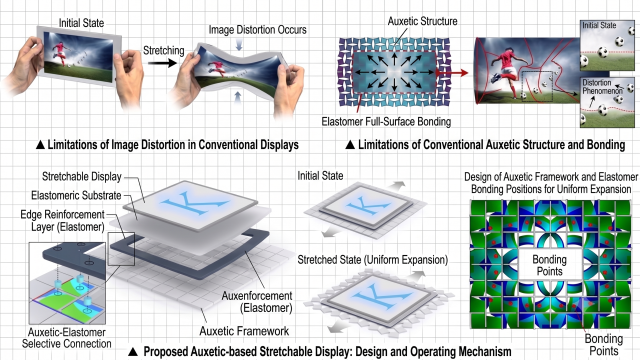
Display makers have already moved screens from flat panels to foldable and rollable forms, and stretchable displays are widely seen as the next step. Samsung Display and LG Display have both shown stretchable prototypes in recent years. The obstacle is physical. The rubbery substrates that give a screen its stretch behave like any elastic sheet, narrowing in one direction when pulled in the other, so a stretched map or photograph ends up flattened and distorted.
Engineers have tried to fix this with auxetic structures, mechanical frameworks that do the opposite of ordinary materials by growing wider as they are pulled longer. But bonding an auxetic frame across the entire surface of an elastic substrate created a new problem. The frame's individual cells rotate as they expand, and that twisting is transferred directly into the substrate, so while the screen's overall proportions are held, the letters and pictures inside it still warp.
KAIST and Dong-A team's answer was to stop gluing the two layers together everywhere. Instead, the researchers calculated the specific points where the auxetic frame should connect to the substrate and bonded only there. With the connection sites chosen correctly, every region of the screen moves outward evenly from its own position, so the display expands uniformly from the smallest patch of pixels to the full panel.

The team also introduced a way to measure the problem it was solving. Stretchable displays have typically been judged on how far they stretch and whether their circuits survive, not on how faithfully the image holds its shape. The researchers defined a statistical metric, the isotropic expansion factor, that scores how closely a stretched screen matches ideal uniform expansion, and used it to compare designs and find the least distorting configuration.
To test the platform, the researchers printed text and images on substrates and stretched them repeatedly in both directions. Patterns on conventional substrates deformed in places, while those on the new platform held their shape. The team then built a working display by mounting an array of LEDs on the platform. The screen stretched 15 percent in each direction while current kept flowing and brightness held steady, and after repeated stretching cycles, brightness dropped by less than 2 percent.
"For stretchable displays to be used as actual information display devices, they must not only stretch well but also preserve on-screen information accurately during stretching," Yoo said. "This platform enables uniform expansion from small areas of the screen to the entire display, and will serve as a key foundational technology for accelerating the commercialization of high-quality stretchable displays."
The researchers said the design could eventually reach wearable devices, electronic skin, medical biosensor patches, soft robots and curved displays for cars and aircraft, applications where a screen must deform without garbling the information it shows. Commercialization will depend less on the display elements themselves than on manufacturing, they said, including processes for producing large auxetic frames uniformly, aligning and bonding them precisely to elastic substrates, and proving the connection points survive repeated pulling and touching.
KAIST researchers Kim Su-bon and Kim Jun-ho led the study as co-first authors, with Yoo and Moon serving as co-corresponding authors.
(Reference Information)
Journal/Source: Nature Communications
Title: Hybrid auxetic metamaterial platforms enabling multiscale isotropic expansion for distortion-free stretchable displays
Link/DOI: https://bit.ly/4pbo4jB

Copyright ⓒ Aju Press All rights reserved.
