
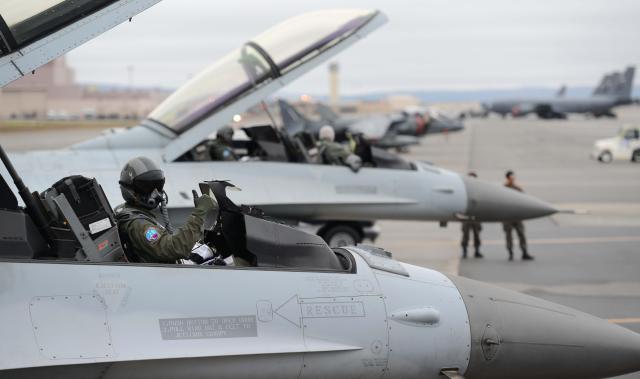
The fresh concerns emerged after the government last week handpicked the roughly 8.3 million-square-meter military airport in the southwestern region as the location for the cluster, despite some opposition over the region's lack of infrastructure.
The project is part of the government's push to strengthen the country's semiconductor competitiveness while promoting balanced regional growth.
Officials argue that the military air base is suitable because its large, already leveled tract could shorten construction time, while its proximity to the city and transport infrastructure would help attract workers and support logistics.
To secure the land before a replacement military airport is completed in nearby Muan, Cheong Wa Dae has suggested temporarily dispersing the aircraft and training missions currently based in Gwangju to other Air Force installations.
Presidential policy chief Kim Yong-beom said the government could move ahead with using the site without waiting for the new airport if it reaches an agreement with the Air Force on relocating current operations.
But military officials and lawmakers say the proposal would involve far more than simply moving aircraft.
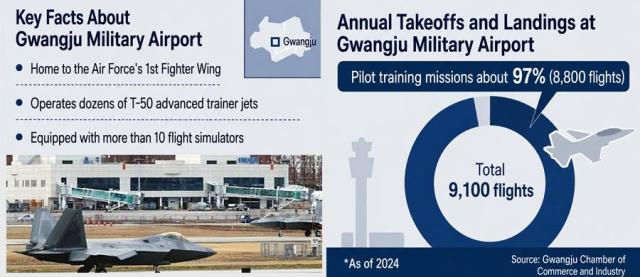
Of about 9,100 takeoffs conducted at the base last year, roughly 8,800 were training flights. The base also has more than 10 flight simulators, along with classrooms, maintenance facilities and specialized equipment needed for pilot training.
Bases in Yecheon and Wonju, which also operate T-50-family aircraft, have been mentioned as possible locations. However, they would need enough space for additional aircraft, maintenance facilities, personnel and military families.
Rep. Yoo Yong-won of the main opposition People Power Party (PPP) said relocating the training infrastructure would take at least 18 months and cost tens of billions of won.
He said many Air Force bases are already operating near capacity as they prepare facilities for the deployment of the KF-21 fighter jet or temporarily accommodate aircraft from bases undergoing construction.
"The issue is not simply moving several aircraft, but relocating the entire pilot training system," Yoo said.
He also raised concerns about the impact on roughly 10,000 service members, civilian employees and family members based in Gwangju, who could be required to move temporarily before relocating again to Muan.
Asked at a regular briefing Monday whether the Air Force had enough capacity to disperse Gwangju's training operations to other bases, a Defense Ministry spokesperson said the ministry would work with the Air Force to prevent any disruption.
"We will work closely with the Air Force to develop measures that support the government's policy of strengthening the competitiveness of the semiconductor industry while ensuring there are no problems with military readiness or training," the spokesperson said.
Responding to a follow-up question about training facilities and consultations with the United States, the spokesperson stressed that no relocation plan had been finalized.
"Nothing has been decided at this point," the spokesperson said. "We will review various options and consult with the Air Force and the U.S. side while supporting national policy and minimizing any gap in military readiness and security."
Another option reportedly under consideration is to begin building one or two semiconductor fabrication plants on land previously prepared for the relocation of an ammunition depot while the airfield remains in operation.
Yoo said that plan would also be difficult because the land is only several hundred meters from the runway and lies within an aviation safety zone. The height restrictions could prevent the use of tower cranes needed for construction.
Jeong Kyung-woon, a research fellow at the Korea Association of Military Studies, also said the fighter wings mentioned as possible alternatives are already optimized for their existing missions and were unlikely to have been designed to absorb an additional training system of this scale.
"It is difficult to imagine that another air base has enough spare capacity to accommodate all of this at once," Jung said. "Even relocating only the advanced flight training system would require considerable time, along with new accommodation, family housing and support facilities."
Jung also noted that any changes involving bases designated for joint use with U.S. forces would require coordination with Washington and could have to follow U.S. military procedures as well as South Korean requirements.
"Trying to fit Gwangju's existing system into other bases without first building replacement facilities would create significant operational and logistical problems," he said.

Copyright ⓒ Aju Press All rights reserved.
