
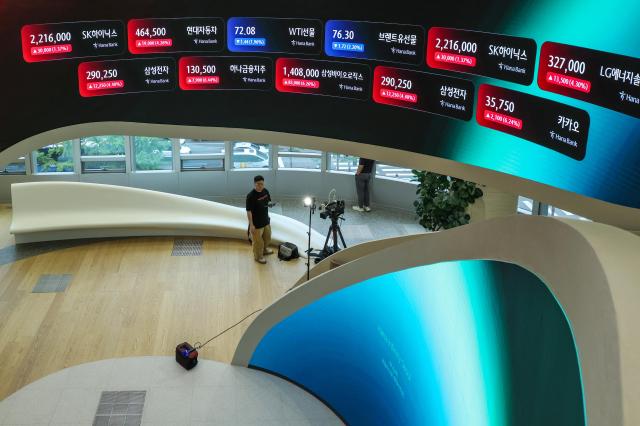
SEOUL, July 14 (AJP) -South Korean stocks has entered a technical bear market on Tuesday after the benchmark KOSPI fell nearly 30 percent from its June peak above the 9,000 mark, as a brutal selloff in semiconductor shares deepened on renewed concerns that the artificial intelligence boom may be nearing an earnings peak.
The benchmark KOSPI plunged 8.95 percent to close at 6,806.93, its lowest level in 48 trading sessions and the fourth-largest one-day point decline on record. The tech-heavy KOSDAQ lost 4.55 percent to 799.36.
The selloff followed Monday's record collapse in SK hynix shares and spread overnight to Wall Street, where SK hynix's Nasdaq-listed American depositary receipts slid another 9.3 percent after their spectacular debut last Friday.
The weakness rippled across the broader U.S. semiconductor sector, with Micron Technology falling 4.3 percent, Intel losing more than 6 percent, Sandisk tumbling 12.6 percent, while Nvidia, AMD and Marvell Technology also retreated as investors reassessed lofty AI valuations.
The combined decline erased much of the optimism surrounding SK hynix's landmark U.S. listing, which had been expected to broaden the company's global investor base and reinforce Korea's position at the center of the AI memory supply chain.
Instead, investors shifted their focus from the historic capital raising to slowing earnings momentum.
SK hynix's Korean shares crashed 15.37 percent to 1.845 million won on Monday, marking the steepest one-day decline in the company's history after having already retreated sharply from their record high. The ADRs closed at $152.35 overnight, extending the correction after Friday's Nasdaq debut.
Samsung Electronics also slid 10.7 percent in Seoul, leaving the country's two semiconductor bellwethers down roughly 32 percent and 38 percent, respectively, from their recent peaks.
The correction officially pushed the KOSPI into what market convention defines as a technical bear market, with the index falling about 28 percent from its intraday high of 9,385.59 reached on June 19 to Tuesday's intraday low near 6,780.
Trading was halted for 20 minutes after the Korea Exchange activated a market-wide circuit breaker at 1:28 p.m., the 13th such suspension in history. More strikingly, seven circuit breakers have now been triggered this year alone, reflecting unprecedented volatility fueled by concentrated semiconductor bets and the proliferation of single-stock leveraged exchange-traded funds.
The unwind has been particularly painful for retail investors who had crowded into leveraged products tracking Samsung Electronics and SK hynix during this year's AI-driven rally.
All 14 leveraged ETFs linked to the two companies fell to record lows.
KODEX SK hynix Leverage ETF has now lost more than 66 percent from its late-June peak, while TIGER Samsung Electronics Leverage ETF has shed nearly 60 percent from its June high.
Online investment communities were flooded with posts from individual investors reporting losses reaching hundreds of millions of won, with many lamenting that leveraged ETFs had become "gambling rather than investing."
Market strategists said the correction reflects a combination of profit-taking after one of the world's strongest equity rallies, mounting concerns that semiconductor earnings may have peaked, and external shocks including renewed geopolitical tensions in the Middle East that lifted oil prices and global bond yields.
Analysts also noted that the Korean market has become unusually dependent on a handful of AI-related stocks.
According to Eugene Investment & Securities, Samsung Electronics and SK hynix accounted for more than 78 percent of the KOSPI's gains during the first half of the year.
As a result, the correction in those two names has translated into market-wide volatility far exceeding that seen in Japan or Taiwan, where chip shares have also weakened but broader indexes have remained relatively resilient.
Adding to investor caution are growing doubts over second-quarter earnings.
Korea Investment & Securities recently lowered its operating profit forecasts for SK hynix by incorporating the impact of long-term supply agreements, trimming this year's and next year's earnings estimates by 9 percent and 11 percent, respectively. It now expects second-quarter operating profit to come in about 8 percent below market consensus.
The ADR listing itself may also have contributed to the reversal.
While SK hynix's U.S. shares initially surged after listing, analysts said much of the optimism had already been priced into the Seoul-listed shares before the debut, prompting investors to lock in profits once the long-anticipated event had passed.
Despite the sharp correction, strategists stopped short of calling for a prolonged bear market.
Many argued that valuation has become considerably more attractive after the rapid decline, although a sustained recovery will depend on whether upcoming earnings from major global chipmakers can restore confidence in AI demand.

Copyright ⓒ Aju Press All rights reserved.
