Inflow into the bond market following South Korea’s inclusion in the World Government Bond Index (WGBI) offered a marginal relief to the Korean won, according to the Bank of Korea.
Foreign investment in South Korean securities posted a net outflow of $30.72 billion in June. Equity funds recorded a net outflow of $32.37 billion, while bond funds posted a net inflow of $1.65 billion.
The equity outflow widened from $31.83 billion in May and marked the largest monthly withdrawal so far this year.
The central bank attributed the outflow to weaker investor sentiment amid concerns over global artificial intelligence investment and foreign investors’ rebalancing of their Korean equity holdings following an extended market rally.
The benchmark KOSPI fell 11.8 percent to 7,476 on July 10 from 8,476 at the end of May.
Foreign funds continued to flow into bonds despite the maturity of government debt, supported by the gradual increase in South Korean bonds’ weighting in the WGBI.
The weighting rose to 0.67 percent in June from 0.46 percent in May and 0.22 percent in April, when the country’s phased inclusion began.
During the first six months of the year, foreign equity investment posted a cumulative net outflow of $110.21 billion, while bond investment recorded a net inflow of $9.28 billion.
Total foreign investment in Korean securities consequently registered a net outflow of $100.93 billion during the period.
The heavy equity outflows added downward pressure on the won in June, although the currency rebounded sharply this month.
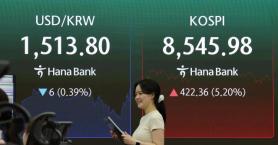
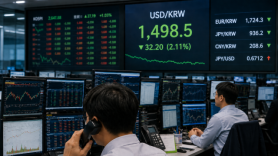
The won closed at 1,549.4 per dollar at the end of June, weakening from 1,507.9 at the end of May, before strengthening to 1,501.4 on July 10.
Foreign selling of Korean shares and continued uncertainty in the Middle East drove the exchange rate higher last month, the BOK said.
The won began recovering in July as weaker-than-expected U.S. employment indicators reduced the extent of the dollar’s gains.
Compared with the end of May, the won had strengthened 0.4 percent against the dollar as of July 10, outperforming most major emerging-market currencies over the same period.
Exchange-rate volatility, however, increased in June.
The won’s average daily trading range widened to 7.6 won from 6.6 won in May, while its average daily fluctuation rate rose to 0.50 percent from 0.45 percent.
In global markets, the dollar and major government bond yields rose as the Federal Reserve’s June policy meeting was interpreted as hawkish, strengthening expectations for further U.S. rate increases this year.
The dollar index advanced 2.0 percent to 101.0 on July 10 from 98.9 at the end of May.
The yield on the 10-year U.S. Treasury rose 12 basis points to 4.56 percent from 4.44 percent over the same period.
South Korea’s 10-year government bond yield climbed 17 basis points to 4.24 percent, while the three-year yield edged up to 3.77 percent from 3.73 percent.
The three-year currency swap rate rose 6 basis points to 3.36 percent, tracking the increase in government bond yields.
The three-month won-dollar swap rate, meanwhile, fell 7 basis points to minus 0.99 percent as institutional investors’ demand for foreign-currency funding for overseas investment increased.
Despite the foreign fund outflows, South Korean banks’ external foreign-currency borrowing conditions remained broadly stable.
The premium on medium- and long-term overseas borrowing fell to 37 basis points in June from 44 basis points in May.
The five-year credit default swap premium on South Korea’s foreign exchange stabilization bonds also declined to 23 basis points from 25 basis points.

Copyright ⓒ Aju Press All rights reserved.