
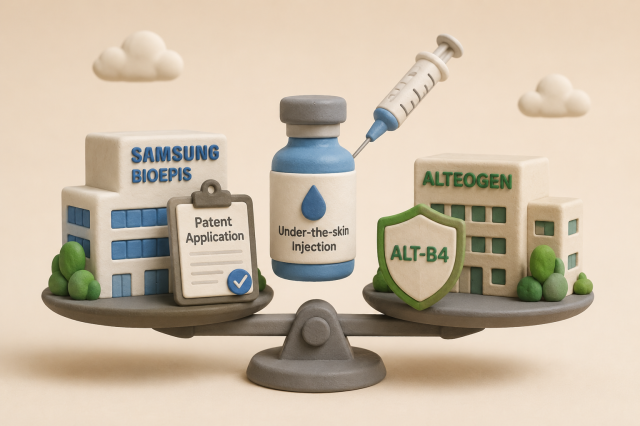
The move raised concerns that Samsung Bioepis could challenge Alteogen with a competing technology that converts intravenous drugs into subcutaneous injections.
Both companies, however, dismissed the concerns, saying the market reaction was excessive and the technologies are not direct competitors.
Samsung Bioepis said its latest patent application covers purification technology for hyaluronidase, an enzyme used in under-the-skin drug delivery.
However, speculation that Samsung Bioepis is developing a similar treatment technology sent Alteogen shares sharply lower. The KOSDAQ-listed biotech stock plunged 11.69 percent on Tuesday to close at 279,500 won. After a slight rebound the following day, shares fell again on Thursday, dropping 3.12 percent in early trading.
Investors worried that the patent application signaled Samsung Bioepis' entry into the subcutaneous drug delivery market, where Alteogen has built a strong position with its ALT-B4 technology, which enables medicines typically given by intravenous (IV) injections to be administered through quick under-the-skin injections.
Samsung Bioepis, however, said investors had misunderstood the patent, saying it is intended to support the manufacturing process for hyaluronidase rather than the development of a subcutaneous (SC) drug delivery platform.
"The patent application is still pending," a Samsung Bioepis official said. "No decision has been made on which products the technology may be applied to."
It further elaborated that it has not started clinical trials using the technology or applied for regulatory approval.
Instead, Samsung Bioepis said it is currently focused on developing an affordable version of Keytruda, a top-selling cancer drug from Merck. The company aims to complete a global Phase 3 trial this year and launch the product after Keytruda's South Korean patent expires in 2028.
Meanwhile, Alteogen sought to ease investor concerns, saying Samsung Bioepis' patent relates to manufacturing processes rather than the key technology behind Alteogen's drug delivery platform.
It said ALT-B4 is protected by its own patent and is fundamentally different from Samsung Bioepis' manufacturing technology.
Alteogen said Keytruda Qurex will continue to be protected by U.S. patents until 2043. It also said products using other hyaluronidase technologies are unlikely to be approved as biosimilars to Keytruda Qurex under current regulations.
The latest dispute seems to reflect how closely investors are watching developments in under-the-skin drug delivery, one of the pharmaceutical industry's fastest-growing areas.
Alteogen generates revenue by licensing its ALT-B4 technology to global pharmaceutical companies, making concerns over potential competitors especially sensitive for investors.

Copyright ⓒ Aju Press All rights reserved.
