
That identical message from the U.S. Treasury Department applied to both the South Korean won and Japanese yen in its latest semiannual currency report to Congress, even as it kept both countries on its monitoring list.
Treasury said recent depreciation pressures were not in line with South Korea's strong economic fundamentals and reiterated that foreign-exchange intervention should be reserved only for episodes of excessive volatility or disorderly market conditions.
Yet the two Asian currencies are now telling markedly different stories.
Despite both remaining weaker than their economic fundamentals would suggest, the won has staged a sharp rebound while the yen continues to languish near multi-decade lows, creating one of the widest divergences between the two currencies in years.
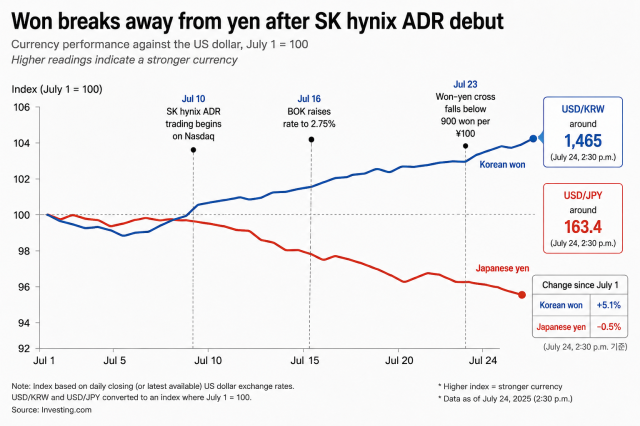
The U.S. dollar traded around 1,465 won and ¥163.4 on Friday. The won has strengthened more than 5 percent this month, while the yen has slipped about 0.5 percent. For the year, the won is still down roughly 1.9 percent against the dollar, but the yen has fallen more than 4 percent.
The key difference lies not in monetary policy but in capital flows.
ADR windfall changes the equation
The catalyst was SK hynix's record $26.5 billion American depositary receipt offering on Nasdaq, one of the largest overseas equity offerings ever by an Asian company.
The won briefly weakened into the 1,470 range in offshore non-deliverable forward trading after Houthi attacks on Saudi vessels renewed concerns over Middle East shipping risks. The move proved short-lived as expectations resurfaced that a sizeable portion of SK hynix's dollar proceeds would eventually be converted into won.
The company plans to use part of the funds to finance domestic projects, including its Yongin semiconductor cluster and advanced chip-packaging facility in Cheongju.
Construction costs, wages and local procurement will ultimately require won funding, creating what analysts see as a sizeable new source of dollar supply.
"The actual dollar-supply effect could continue through August or September," said Kwon Ah-min, an FX analyst at NH Investment & Securities.
Kwon expects conversions to begin gradually rather than all at once, as SK hynix will retain part of the proceeds in dollars to pay overseas equipment suppliers such as ASML.
That suggests the ADR proceeds are more likely to cap rebounds in the dollar-won exchange rate than trigger a one-way appreciation of the Korean currency.
Stronger domestic backdrop
The capital-flow effect has coincided with improving domestic fundamentals.
The Bank of Korea resumed monetary tightening this month, raising its benchmark interest rate for the first time since January 2023. South Korea's economy has also continued to outperform expectations, while foreign investors have returned aggressively to local equities.
Overseas investors purchased a net 2.136 trillion won ($1.46 billion) of Kospi shares on July 23 alone, adding another source of dollar inflows.
Park Sang-hyun, an economist at iM Securities, said the combination of stronger economic data, higher interest rates and sustained foreign equity purchases could give the won a firmer foundation than in recent months.
"There is now considerably greater scope for the exchange rate to decline on a sustained basis," Park said.
If expectations for further won appreciation become entrenched, exporters and shipbuilders could accelerate dollar sales and forward hedging, reinforcing downward pressure on the dollar-won rate.
Breaking away from the yen
The stronger won has produced an increasingly unusual divergence from the Japanese yen, which has historically moved closely alongside Korea's currency because both economies share export-driven industrial structures.
The won-yen cross fell below 900 won per ¥100 on July 23 for the first time in roughly 20 months as the Korean currency appreciated while the yen remained trapped near ¥163 per dollar.
Over the longer run, however, he believes the traditional correlation between the two currencies is likely to re-emerge once the temporary supply effect fades.
That would again make the yen's direction an important determinant of the won.
Not everyone is convinced
Some economists caution that markets may be overestimating the immediate impact of the ADR proceeds.
"Companies are strategic actors as well," said Baek Seok-hyun, an economist at Shinhan Bank's S&T Center.
He argued that SK hynix has little incentive to convert large amounts of dollars before the funds are actually needed because its domestic investment programme will unfold over several years.
If conversions are spread across a longer period, additional dollar supply could be largely absorbed by import demand and continued overseas investment by Korean households.
Another offsetting factor could emerge if foreign shareholders reduce their holdings of Seoul-listed SK hynix shares, convert the proceeds into dollars and shift their exposure into the newly listed U.S. ADRs.
Bank of Korea officials said they are closely monitoring how the ADR proceeds could affect foreign-exchange supply and demand.
For now, the inflows appear sufficient to restrain any renewed rise in the dollar-won rate through the third quarter.
Beyond September, however, the won's trajectory is likely to depend less on one-off corporate flows and more on broader market drivers — the Bank of Korea's policy path, foreign demand for Korean equities, corporate dollar selling, outbound investment by Korean residents and, perhaps most importantly, whether the long-standing relationship between the won and the yen ultimately reasserts itself.

Copyright ⓒ Aju Press All rights reserved.