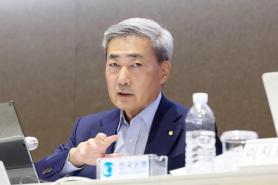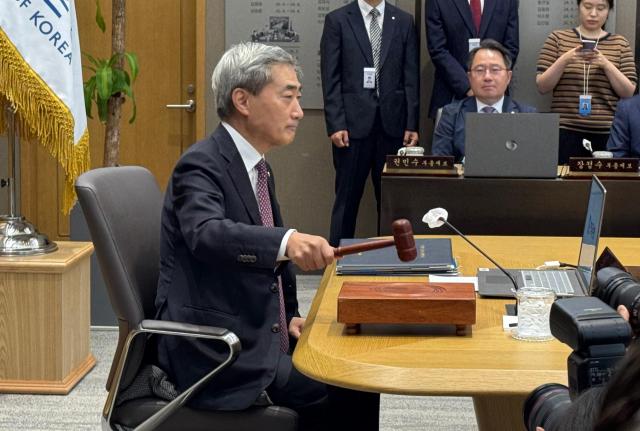
SEOUL, July 29 (AJP) -Bank of Korea Governor Shin Hyun-song on Wednesday said maintaining a rate-hike bias was the most appropriate way to contain inflation, while stressing that the timing and pace of any further tightening would depend on incoming data and economic conditions.
Shin made the remarks at a National Assembly Finance, Economy, Planning and Budget Committee meeting after Democratic Party lawmaker Yoon Hu-deok asked whether the central bank planned to raise rates once or twice more this year.
He said the scale and timing of further action would depend on incoming data and economic conditions, offering no estimate of the terminal rate.
The BOK raised its benchmark rate by 25 basis points to 2.75 percent on July 16 and said in its parliamentary report that it needed to maintain a tightening stance while monitoring inflation, growth and financial-stability risks.
Shin said the central bank was placing greater emphasis on core inflation, which is less directly affected by movements in international oil prices than headline inflation.
He said solid economic activity and improving income conditions were adding demand-side pressure, making the recovery in domestic demand an increasingly important driver of inflation.
Headline inflation rose from 2.0 percent in January and February to 3.2 percent in June, while inflation excluding food and energy climbed to 2.5 percent.
The BOK’s inflation diffusion index, which measures how broadly price increases are spreading, has approached its highest level since 2010 excluding the pandemic period.
The central bank said accumulated import costs, exchange-rate effects and stronger domestic demand were likely to keep inflation above its 2 percent target for a considerable period.
The BOK also said this year’s economic growth was likely to significantly exceed its May projection of 2.6 percent as global investment in artificial intelligence continued to support semiconductor exports and capital spending.
South Korea’s economy expanded 3.8 percent from a year earlier in the first half, with second-quarter gross domestic product growing 0.6 percent from the previous quarter and 3.7 percent year on year.
The central bank cautioned, however, that the benefits of the semiconductor boom remained concentrated in a limited number of industries and income groups, constraining its spillover into the broader economy.
Rising home prices in the Seoul metropolitan area and increased borrowing for property and equity investment were also cited as financial-stability risks supporting continued tightening.
Seoul apartment prices recently rose 0.27 percent in a week, equivalent to an annualized rate of 15.1 percent, while financial-sector household lending increased by between 8 trillion won and 9 trillion won in both May and June.
The BOK also warned that equity demand had become concentrated in a small number of AI-related industries, with foreign selling and increased leverage amplifying market volatility.
The central bank’s assessment broadly pointed in the same direction as those of other economic authorities, although their emphasis differed on inflation and household debt.
Deputy Prime Minister and Finance Minister Koo Yoon-cheol said the government would seek to keep second-half inflation below 3 percent through measures aimed at easing energy and food costs and curbing market manipulation.
The positions were not directly contradictory, but the finance ministry placed greater weight on supply measures and near-term headline inflation, while the BOK focused on persistent core-price pressure driven partly by domestic demand.
Financial Services Commission Chairman Lee Eog-weon said household debt had fallen to 85.3 percent of GDP in the first quarter from 98.7 percent in 2021 and that slower mortgage growth following the June 27 measures had reduced its influence on the property market.
The BOK, by contrast, highlighted the recent monthly increase in lending, rising metropolitan-area housing prices and the expansion of unsecured borrowing used for equity investment, suggesting greater concern about newly accumulating leverage.
At 2:30 p.m., the won was trading at 1,444 per dollar, up 18.5 won from the previous session’s daytime close of 1,462.5.
The KOSPI was down 7.25 percent at around 5,589 at the same time after a sell-side program-trading sidecar and a market-wide circuit breaker were triggered.
Circuit breakers were activated in both the KOSPI and KOSDAQ markets for a second consecutive session for the first time since the systems were introduced.
Copyright ⓒ Aju Press All rights reserved.