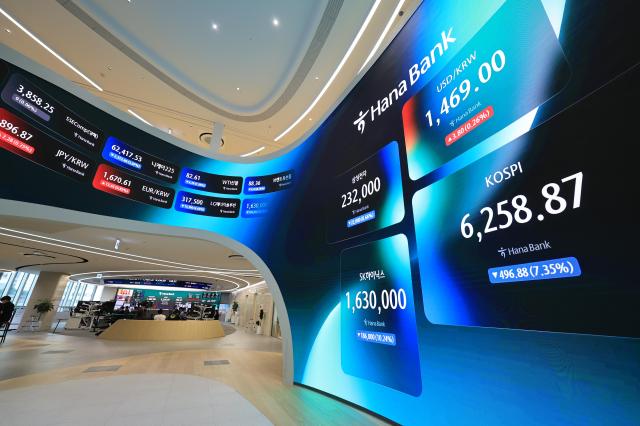
The index opened higher and appeared likely to climb back above 6,000 points, but fell in afternoon trading as concerns over semiconductor demand, renewed tensions in the Middle East and a weak overnight session on Wall Street weighed on investor sentiment. The government announced a set of new stricter rules to limit leveraged single-stock ETFs, but concerns about chip stocks and global risks remained the bigger focus for traders.
Foreign investors purchased a net 1.33 trillion won ($960 million), while institutions bought a net 66.3 billion won, cushioning the market after Tuesday's panic-driven plunge. Retail investors, however, turned net sellers, unloading 1.42 trillion won after two consecutive sessions of bargain buying.
Despite posting record quarterly earnings, Samsung Electronics failed to lift market sentiment. Its shares slipped 0.72 percent to 207,000 won, while SK hynix tumbled 5.64 percent.
Defense stocks bucked the broader market after the U.S. resumed airstrikes against Iran for the first time in about a week. Hanwha Aerospace jumped 6.79 percent to 865,000 won, while Korea Aerospace Industries gained 2.72 percent.
LG Energy Solution climbed 6.49 percent to 320,000 won, Samsung Biologics rose 3.25 percent to 1,527,000 won, HD Hyundai Heavy Industries advanced 3.23 percent to 448,000 won and KB Financial added 4.56 percent to 167,400 won. But SK Square fell 6.00 percent to 799,000 won and Samsung Electro-Mechanics slid 14.58 percent to 879,000 won.
On the junior KOSDAQ, battery materials makers outperformed despite the broader weakness. EcoPro, a battery materials producer, rose 4.75 percent to 70,600 won, while affiliate EcoPro BM, a cathode materials maker, gained 4.21 percent to 96,500 won.
Biopharmaceutical company Alteogen slipped 1.06 percent to 279,500 won, robotics developer Rainbow Robotics fell 9.14 percent to 373,000 won, semiconductor equipment maker Jusung Engineering tumbled 15.33 percent to 98,300 won, chip testing equipment maker Leeno Industrial dropped 5.15 percent to 55,200 won, biopharmaceutical company HLB fell 4.16 percent to 29,950 won, and chip equipment supplier Wonik IPS declined 8.29 percent to 76,300 won.
But the South Korean currency strengthened with the dollar trading at 1,439.5 won from 1,446.7 won in the previous session.
Analysts said recent market indicators suggest selling pressure from foreign investors may be beginning to ease. Since May, cumulative net short futures positions, which had swelled to nearly 22 trillion won, have been cut by more than half, while net selling in the cash market has also moderated.
BNK Investment & Securities said the KOSPI has already reached its first technical downside target after plunging nearly 40 percent over the past month, raising the possibility of a technical rebound. However, it said any recovery could remain limited unless buying momentum strengthens after the index broke below its upward trendline.
The brokerage attributed the recent selloff to global investors reducing exposure to technology stocks, continued foreign selling and fund outflows from semiconductor-focused equity funds after chip shares lost momentum in late June.
Whether foreign buying continues will depend not only on corporate earnings and valuations but also on broader global risk sentiment including the risk of renewed unwinding in yen-funded carry trades. Sustained overseas inflows would be an early sign that selling pressure is fading and confidence is gradually returning to the market.
Regional markets offered little additional direction, reflecting continued caution over the global economic outlook and spending on AI-related technologies.
Japan's Nikkei 225 rebounded 0.71 percent on bargain hunting after recent losses, while Hong Kong's Hang Seng Index edged up 0.21 percent. China's Shanghai Composite slipped 0.62 percent as persistent concerns over the property sector and slowing domestic demand weighed on sentiment.
Investors also looked to upcoming earnings from major U.S. technology companies for signs of whether heavy AI investment would continue to drive semiconductor demand.

Copyright ⓒ Aju Press All rights reserved.