
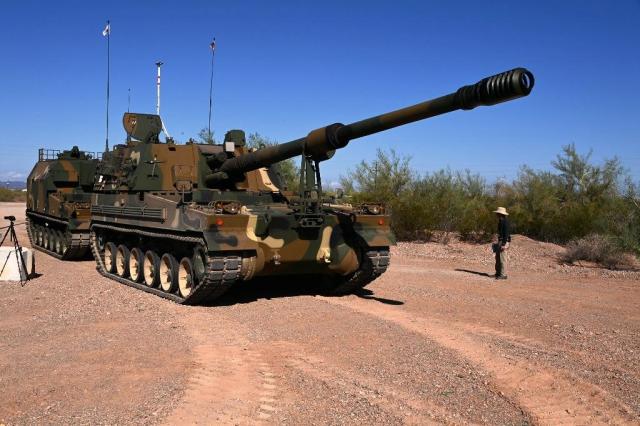
The company reported second-quarter operating profit of 1.37 trillion won ($951 million), up 59 percent from a year earlier, on consolidated sales of 9.29 trillion won, which rose 47 percent.
The results were driven by steady deliveries from its land systems business in domestic and overseas markets, alongside strong contributions from affiliates Hanwha Ocean and Hanwha Systems.
Hanwha Aerospace's land systems division generated 2.11 trillion won in sales and 533 billion won in operating profit, up 19 percent and 2 percent, respectively. Domestic revenue benefited from increased production of key weapons systems including the Chunho wheeled anti-aircraft gun system and Chungum anti-tank guided missile, while exports to Poland, Egypt and the Middle East proceeded as scheduled.
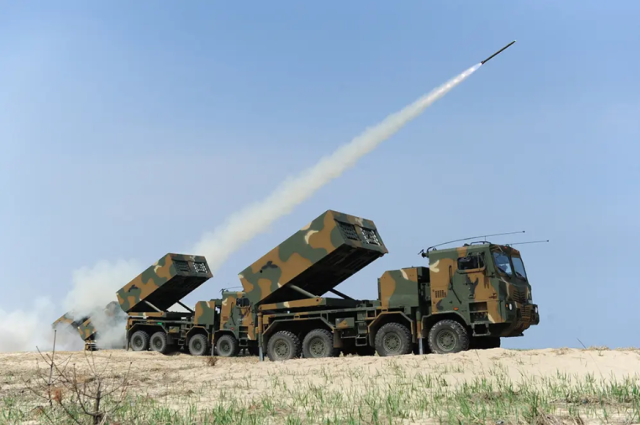
The division's order backlog expanded to 38.3 trillion won at the end of June after securing additional export contracts, including a 940 billion won K9 self-propelled howitzer deal with Finland in April and an additional Chunmoo multiple rocket launcher contract with Estonia in May.
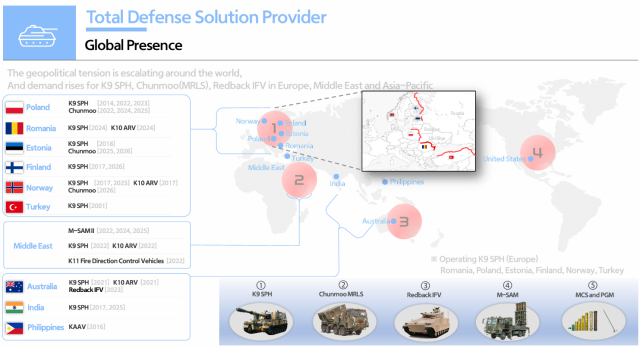
"The third K9 execution contract is based on localization, and we are currently in detailed discussions," a company official said. "We expect to reach a conclusion as early as this year."
The company also said construction has begun on its Chunmoo missile joint venture in Poland, with the factory scheduled for completion in 2029 and production to begin in 2030.
In the United States, Hanwha Aerospace said it is awaiting the selection of a preferred bidder for the U.S. Army's next-generation self-propelled howitzer program, which could be announced around August following delays.
The company is also close to finalizing the location of a planned U.S. ammunition manufacturing facility as part of its localization strategy.
"We are at the stage just before finalizing the site for localization investment," the official said. "We hope to reach a conclusion in the second half and lead it to a contract."
Hanwha Aerospace pointed to its localization projects—including the Chunmoo missile venture in Poland, K9 and Redback production in Australia, and industrial cooperation in Egypt—as examples of adapting to customers' procurement requirements.
In the Middle East, executives said heightened geopolitical tensions continue to support demand for air-defense systems, although contract procedures could take longer amid regional uncertainty. They added that stronger demand for air-defense systems is complementing rather than replacing demand for traditional land systems.
The aerospace division posted 760 billion won in sales and 37 billion won in operating profit, with revenue rising 17 percent from a year earlier as increased military programs helped the business return to profitability.
The company also highlighted aircraft engines as its next strategic growth area.
Earlier this month, Hanwha Aerospace and the Agency for Defense Development unveiled two domestically developed unmanned-aircraft engine prototypes—a 5,500-pound-class turbofan for stealth UAVs and a 1,400-horsepower turboprop for medium-altitude reconnaissance drones—and began ground testing.
The program marks a technological shift from missile propulsion systems, which operate for minutes, to aircraft engines designed to run reliably for thousands of hours. Hanwha Aerospace said it intends to leverage the project to participate in future government programs developing indigenous 10,000-pound-class turbofan engines and other advanced aircraft propulsion systems.
Shares of Hanwha Aerospace closed 6.0 percent higher at 917,000 won on Friday.

Copyright ⓒ Aju Press All rights reserved.
