Summer is usually a sleepy season for stocks. Not this year. In Seoul, July was sheer chaos.
The KOSPI plunged 22.19 percent from June's close, wiping out nearly a quarter of the roughly 100 percent rally it had built in the first half.
The KOSDAQ dropped 21.44 percent, accounting for almost its entire 22.23 percent decline for the year after barely moving through June. By mid-month, sidecars and circuit breakers had become almost routine.
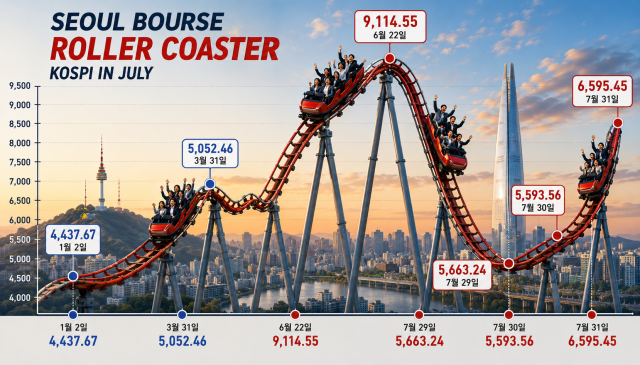
The KOSPI ended 2025 at 4,214 and had doubled to 8,476 by the end of June on the AI memory boom. It extended the rally to a record closing high of 9,114.55 on June 22 before momentum began to fade.
The real collapse came in the final week of July. The KOSPI tumbled 10.84 percent to 6,023.66 on July 28, triggering a circuit breaker, then another the following day — the first back-to-back market-wide circuit breakers in the exchange's history.
The index hit an intraday low of 5,593.6 on July 30, down about 34 percent from the end of June and nearly 39 percent below its June 22 peak. A stunning 17.91 percent rebound on July 31 lifted it to 6,595.5, leaving the benchmark still up 56.51 percent for the year despite one of the sharpest corrections in its history.
Samsung Electronics nearly halved, falling from 374,500 won on June 19 to 189,200 won on July 29.
SK hynix suffered an even steeper rout, plunging 58 percent from its June 25 peak of 2,987,000 won to 1,246,000 won on July 29 before rebounding 29.95 percent in a single session to 1,718,000 won — still about 43 percent below its peak.
These are not the numbers of an ordinary sector correction. They are the hallmarks of a market dominated by two stocks that account for nearly half the benchmark, where extreme leverage turned concentration into a powder keg.
Foreign Money Ran, Then Ran Back In
Foreign investors had already been net sellers of Korean stocks all year — a cumulative 186.8 trillion won pulled out of the market through July, including 58.7 trillion won in June alone, according to Financial Supervisory Service data.
But the selling eased sharply in July itself, to 8.4 trillion won net for the month, and on the two days that mattered most, foreigners flipped hard the other way: net buying 1.55 trillion won on July 30 and 8.75 trillion won on July 31, right as the index staged its rebound.
Foreign investors still hold 40 percent of KOSPI's total market value. Whether that reversal was value-hunters stepping in or simply the last of the forced sellers finally clearing their books, the timing lines up with the bottom almost exactly.
Retail Investors Built Their Own Detonator
Domestic retail investors didn't need foreign capital to blow themselves up.
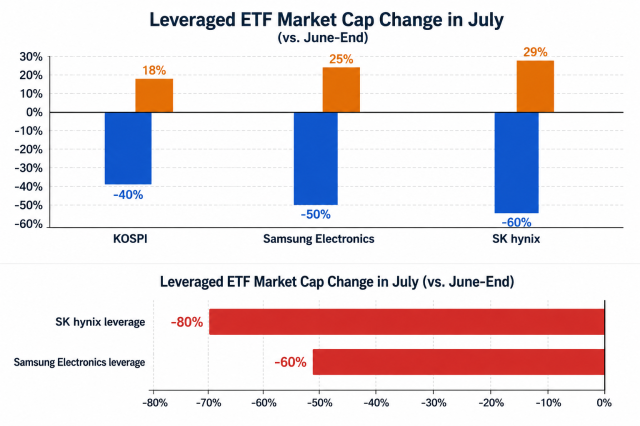
Sixteen single-stock leverage and inverse products tied to Samsung and SK hynix launched on May 27. By July 30 they had generated 525.5 trillion won in trading value — 32.3 percent of all ETF trading in the country in barely nine weeks.
The SK hynix leverage products averaged a return of negative 70.8 percent over that stretch; the Samsung leverage products averaged negative 61.4 percent. Even after the July 31 rally, holders are sitting on losses near half their capital.
The Economist noticed before Korea's own regulators fully reckoned with it, comparing the domestic market to a casino on July 23 and pricing roughly 10 billion dollars, about 14.6 trillion won, in Korean retail money already committed to single-stock leverage products — money the paper suggested would be hard for authorities to coax back out now that investors had grown attached to the format.
This month, the single most-bought overseas stock among Korean investors was the Direxion Daily Semiconductor Bull 3x ETF, at 3.33 billion dollars in net buying — nearly four times what flowed into SK hynix's own U.S.-listed ADR, the second-most-bought name.
Finance Minister Koo Yun-cheol ended up apologizing to the National Assembly on July 29 for how the leveraged products were approved in the first place. "The country has turned into a casino," lawmaker Lee Jongwook told him, calling the rollout a policy failure.
The Foreign Money Wasn't Any Smarter, Either
The domestic casino wasn't the only one that lost. Leopold Aschenbrenner, the 25-year-old former OpenAI researcher whose 2024 manifesto "Situational Awareness" argued AI progress demanded a massive buildout of chips and power, ran a hedge fund by the same name that had grown to roughly 45 billion dollars by early July on concentrated, heavily leveraged bets including SK hynix.
When Korean chip stocks slid, his position went down with them. Reported leverage near four times turned the drawdown into margin calls he couldn't meet, and on July 30 — the same day foreign money started flowing back into KOSPI — his fund sold the bulk of, and by some accounts all of, its public equity book in a single block trade to Ken Griffin's Citadel, shrinking from 45 billion dollars to roughly 10 billion in days.
When the Chairman Had to Buy the Dip Himself
As Samsung's stock swung from a record high to a two-year low and back inside six weeks, the company's own leadership decided the market needed proof that they believed in it more than the market did. Roh Tae-moon, Samsung Electronics' CEO and head of its device experience division, bought 3,045 shares at 230,000 won apiece on July 30, according to the disclosure filing — a purchase worth 700.35 million won that brought his total holding to 124,280 shares.
Samsung's senior executives have done this before: when the stock was stuck in a trading range through 2024, several bought shares in succession as a show of what Korean corporate language calls "responsible management."
The timing this time was pointed. Samsung had touched an intraday record of 374,500 won on June 19, then fallen as low as 207,000 won the day before Roh's purchase, as KOSPI slid under the 6,000 mark. The stock closed that same session at 262,500 won, up on the day, as Wall Street's semiconductor names recovered overnight.
SK Group chairman Chey Tae-won moved the same way. He personally bought 3,620 common shares of SK hynix on the open market — a purchase worth roughly 4.79 billion won at the day's closing price of 1,322,000 won, and the largest amount he could buy without triggering the advance-disclosure requirement that kicks in above 5 billion won. It was the first time Chey had bought SK hynix stock in his own name.
Market watchers read it as exactly what it looked like: the chairman putting his own money on the table to signal confidence while chip stocks were being torn apart.
Put all three groups side by side and the shape of the summer becomes clear.
A 25-year-old Silicon Valley fund manager, tens of thousands of Korean retail accounts trading leveraged ETFs on their phones, and the actual chairmen running Samsung and SK Group all had money riding on the same two stocks in the same six weeks.
Chips have stopped being an industrial policy in Korea. They've become a shared national exposure that runs from the presidential office to a chairman writing a personal check to defend his own company's stock price.
The Bottom Line
Korea's chip republic earned its valuation the hard way — Samsung and SK hynix are genuinely behind the AI memory buildout, and the underlying demand isn't in question.
But this summer proved that concentration and leverage are a standing invitation for exactly this kind of violence, and it's no longer a risk confined to one type of investor.
Retail accounts, a foreign hedge fund, and the men running the companies themselves all got caught in the same six weeks of volatility. Regulators have already tightened the leveraged-ETF rules after the fact. The question the chip republic still hasn't answered is whether it can keep cashing in on two stocks' fortunes without the whole country — from individual traders to the corner office — being taken hostage to their next bad week.
*The author is the managing editor of AJP
Copyright ⓒ Aju Press All rights reserved.