
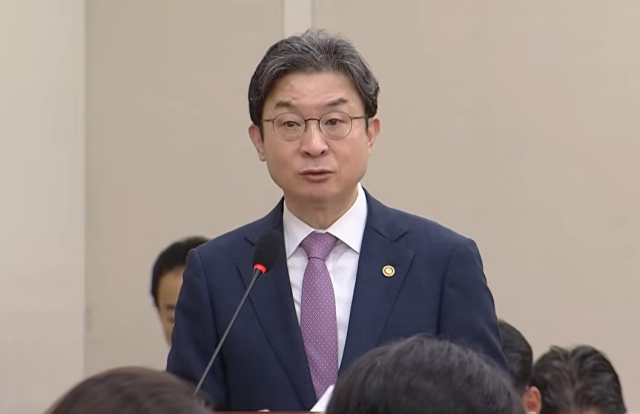
According to financial authorities on Sunday, the Financial Services Commission (FSC) is drafting amendments to the Financial Investment Services and Capital Markets Act, the country's primary law governing capital markets and investment products, to establish a legal basis for swift market-stabilization measures during periods of extreme volatility.
The proposed changes would allow regulators to lower the current two-times leverage ratio of single-stock leveraged ETFs when needed. Existing rules require investor approval before any change can be made, limiting the authorities' ability to respond swiftly when markets come under stress.
Authorities are drawing on Hong Kong's newly introduced variable leverage ratio framework, which allows leverage to be adjusted within a predetermined range according to market conditions. FSC Chairman Lee Eog-weon said lowering leverage could help reduce volatility, adding that investor protection and legal safeguards would be taken into account when drafting the legislation.
Beyond leverage adjustments, officials are considering further steps to curb speculative trading. These include capping investment in single-stock leveraged ETFs at around 20 percent of an individual's investment portfolio, requiring investors to complete simulated trading before buying the products, raising the current 30 million won ($21,600) minimum cash deposit requirement, and allowing temporary trading restrictions or suspensions during periods of severe market stress.
For now, any changes to leverage ratios are not expected to take effect immediately. In the meantime, regulators will first assess the impact of measures introduced on July 31 before deciding whether additional restrictions are necessary.
Early indications suggest the existing measures are already having an impact. On July 31, the first day the higher minimum cash deposit requirement took effect, turnover in single-stock leveraged ETFs fell to about 3 trillion won from roughly 12.4 trillion won a day earlier.
The impact is also spilling over into the broader ETF market. The Korea Exchange has told asset managers that reviews of new ETF listing applications may take longer than usual this month. While new applications are still being accepted, delays in the review process could postpone the launch of new ETF products.
Meanwhile, global investment bank Morgan Stanley struck a more bullish tone on South Korea despite another sharp market decline. With the KOSPI down about 5 percent at 6,264.89 on Monday afternoon, the investment bank upgraded South Korean equities to "Overweight," arguing that the recent unwinding of leveraged positions had eased valuation pressures and created an attractive entry point for investors seeking exposure to the artificial intelligence (AI) trade and the semiconductor supercycle. It said the KOSPI could eventually reach 9,000, implying about 36 percent upside from current levels.
The dramatic market swings also drew political attention. Jeong Jeom-sig of the conservative People Power Party (PPP) on Sunday called for a parliamentary investigation into the recent stock market turmoil, arguing that the KOSPI's 16.17 percent two-day plunge followed immediately by a 17.91 percent one-day rebound reflected abnormal market conditions and called for a thorough investigation.
"The stock market has been turned into something resembling a casino," he said. "We propose a parliamentary investigation to determine what caused the recent market turmoil."

Copyright ⓒ Aju Press All rights reserved.
