
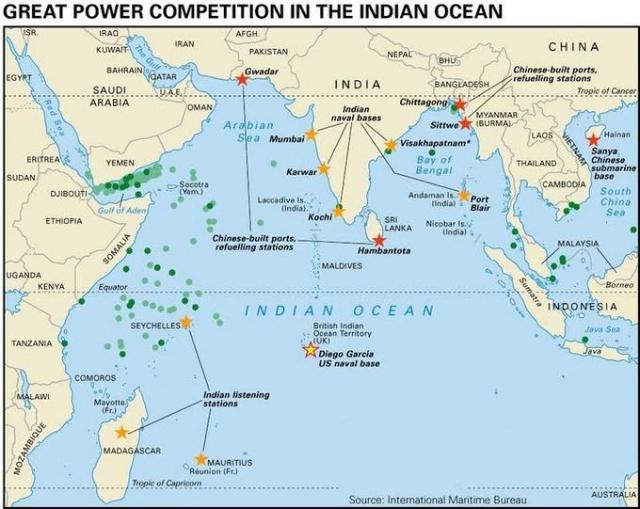
India’s peninsular geography provides a long coastline extending toward the Persian Gulf in West Asia and Southeast Asia in the east. This geography provided an impetus to explore the vast waters surrounding the Indian Peninsula because it offered easy access to the maritime domain.
THE INDIAN PENINSULA
India’s maritime tradition is among the world’s oldest, with unparalleled continuity since the Neolithic Age [9th millennium BCE]. Golbai Sasan, a Neolithic site on the east coast of India in Odisha state, has provided invaluable archaeological evidence of shipbuilding activities and seafaring forays.
During the Sindhu-Saraswati era [3300–1300 BCE], India had developed a mature seafaring tradition based on maritime trade. The ancient port of Lothal in Gujarat, constructed around 2300 BCE, is an outstanding example of maritime infrastructure. It had docks, tidal locks and jetties for ships. Sophisticated trade networks and infrastructure linked India with contemporary civilizations in Mesopotamia, Egypt and China.
Vedic-era texts and archaeological evidence suggest early boatbuilding activities for coastal fishing and commerce. The Rig Veda mentions Sataritara, or a galley with a hundred oars. This seafaring tradition helped develop cartography and the study of monsoon-based sailing, using stars for navigation.
This rich maritime tradition was consolidated during the Mauryan Empire (324–187 BCE), which institutionalized maritime administration by setting up a Department of Waterways and Navigation, headed by the Navadhyaksha (Superintendent of Ships), who regulated shipbuilding, sea trade and port operations. Ancient India’s greatest strategic thinker, Kautilya, wrote a whole chapter in the Arthashastra dedicated to maritime affairs, underlining their strategic importance.
In the post-Mauryan period, Roman records show extensive trade with ports in southern India. Around 30 inscriptions in Tamil-Brahmi, Sanskrit and Prakrit have been identified inside rock-cut tombs in Egypt’s Valley of the Kings in Luxor, dating from the 1st to the 3rd centuries CE. Indian merchants left graffiti as evidence. Hoards of Roman gold coins have also been discovered at various sites in southern India.
The Delhi Sultanate, established by Muslim invaders, maintained limited naval forces for riverine warfare and coastal operations rather than large-scale oceanic campaigns. The Mughal rulers also maintained a navy primarily for security and support of the territorial military. The focus of the empire’s expansion remained inward.
During the 13th century CE, India’s maritime power and commerce reached a peak under the Pala Empire in eastern India and the Chola Empire in southern India. Under the Chola dynasty [9th–13th century CE], large fleets sailed to Sri Lanka, the Maldives and parts of Southeast Asia, including ports in the Srivijaya Empire in Indonesia, spreading Indian religion and cultural influence across Southeast Asia.
The advent of the Europeans led to the marginalization of India’s maritime control and commerce. Despite British colonial rule, India retained its shipbuilding tradition and continued to build ships. By the 19th century CE, the British had monopolized seaborne commerce, controlling key ports such as Bombay (Mumbai) and Calcutta (Kolkata). India became a source of manpower and material. The Royal Indian Marine [1892 CE] and the Royal Indian Navy [1934 CE] developed with Indian sailors manning both naval and merchant ships.
Upon gaining independence in 1947, India inherited a meagre 33 ships and 538 naval officers to protect a coastline of 7,517 km, 1,280 islands and 14,500 km of potentially navigable waterways. India’s geographical location places it close to major Sea Lanes of Communication (SLOCs) in the Indian Ocean. With limited maritime capabilities, India avoided entanglement in the bipolar world order and promoted the concept of the Indian Ocean as a Zone of Peace. After independence, India gave priority to coastal defence and the integration of the Princely States.
Burdened with land wars in 1948, 1962 and 1965, India was forced to divert resources to the Army and Air Force at the expense of the Navy. India gradually began rebuilding its maritime sector and shipbuilding industry. As India’s economy grew, more resources were provided to the Navy and to the development of ports, vital for maritime commerce and national security.
By the 1990s, the Indian Navy was deployed for UN peacekeeping operations, evacuations of Indian nationals during the war in Iraq and anti-piracy operations in the Arabian Sea. The Navy’s blue-water capabilities expanded to support maritime security and international seaborne commerce, with the aim of securing the maritime commons.
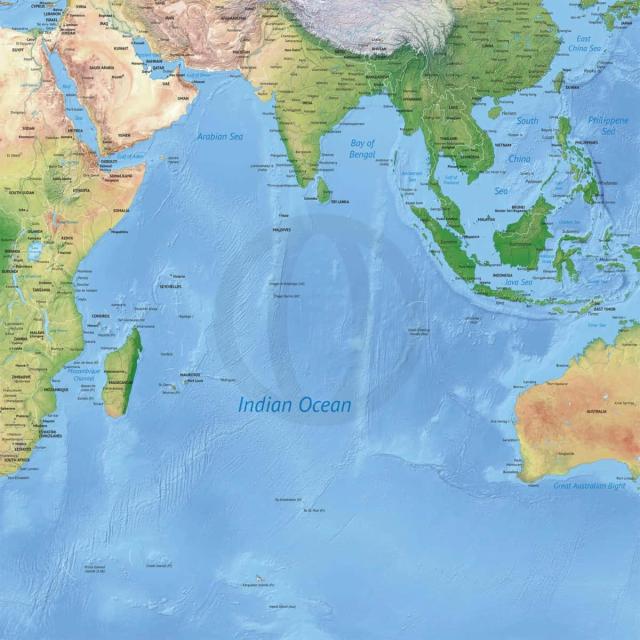
Currently, the maritime arena faces a wide array of challenges — climate change, cyclones, sea-level rise and human-security threats such as illegal migration, trafficking, piracy, illegal fishing, pollution and seabed mining.
The strategic importance of the maritime domain has driven India’s maritime strategy, providing security for around 90 percent of India’s trade by volume. The ongoing war in Iran has highlighted the weaponization of international shipping channels, particularly the Strait of Hormuz, in violation of the United Nations Convention on the Law of the Sea [UNCLOS].
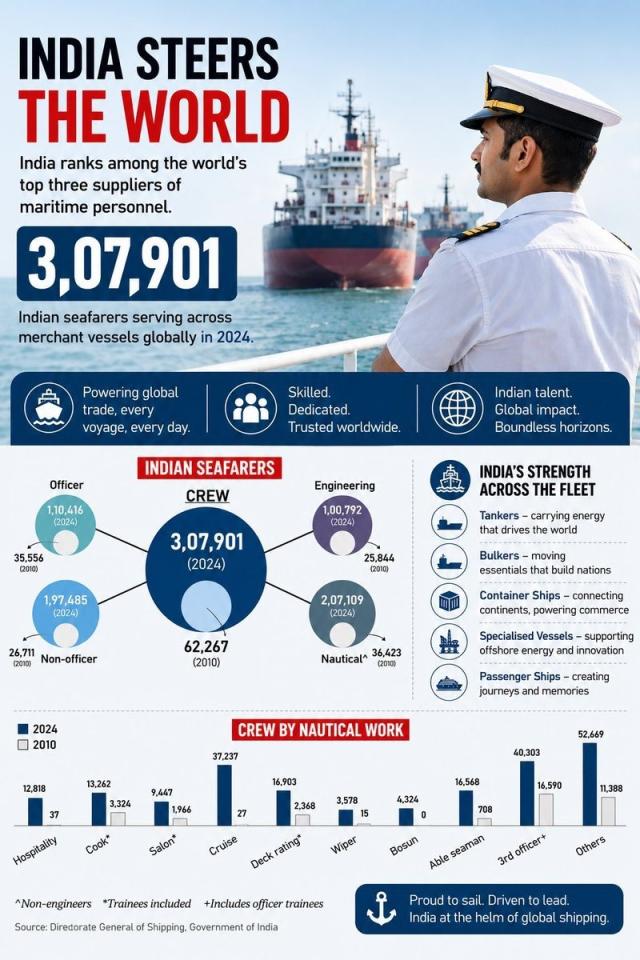
Almost one-third of sailors in the global shipping industry are Indians. Some have lost their lives in indiscriminate attacks on ships transiting the Strait of Hormuz and Bab el-Mandeb. Providing security to international shipping will require diplomacy and dialogue, as well as a more powerful Navy, to help shape a more cooperative geopolitical order.
India’s indigenous shipbuilding capabilities have been ramped up. India’s maritime strategy is focused on the Indian Ocean Region (IOR), which is critical for global trade flows — two-thirds of the world’s oil shipments, one-third of its bulk cargo and half of its container traffic. Forty nations lie along its littoral and account for nearly 40 percent of the world’s population.
Despite the importance of the maritime commons, there are limited security structures that can police this space. Naval ships are constrained in their ability to act against offending or rogue merchant vessels.
In 2015, India adopted the SAGAR doctrine [Security and Growth for All in the Region]. This strategy seeks to enhance India’s role as a net security provider in the Indian Ocean Region and a first responder in humanitarian and disaster-related assistance.
India has since moved from SAGAR to MAHASAGAR [Mutual and Holistic Advancement for Security and Growth Across Regions], extending its maritime approach beyond regional security into economic diplomacy, technological connectivity, environmental sustainability and maritime domain awareness.
MAHASAGAR aims to support technological connectivity in the Indo-Pacific region through joint naval exercises, data sharing and the peaceful settlement of maritime disputes. Supporting these policy moves is SAGARMALA, a port-led development initiative aimed at modernizing and building ports and shifting toward more efficient coastal and waterway transport networks to spur industrial growth, job creation and sustainable coastal development.
To enable international and regional cooperation to secure the maritime commons, India organized the 2016 International Fleet Review, in which 48 navies participated, and the biennial MILAN exercises, which drew 47 nations in 2024, to build cooperation and interoperability.
The IOR is monitored by the Information Fusion Centre [IFC], while naval operations across several maritime theatres have helped combat piracy, provide safe passage to international cargo ships and support humanitarian operations.
Twenty-eight partner nations and international organizations have joined India in tracking maritime traffic, piracy and illegal activities in the IOR.
This strategic shift bolsters maritime security through the Indian Navy’s growing blue-water deployments. Joint exercises with different navies, such as the Malabar exercises with QUAD partners Australia, Japan and the United States, are conducted periodically.
The Indian Navy has spearheaded maritime diplomacy through capacity building, joint exercises, plurilateral conferences, Humanitarian Assistance and Disaster Relief (HADR), and Search and Rescue (SAR) activities.
Big-power competition is increasing in the IOR, requiring greater vigilance over maritime security. To avoid conflict, India has advocated “a free, open, secure and safe Indian Ocean” as a shared goal for securing the maritime commons, as envisaged under UNCLOS.
Despite military strikes, commercial navigation through the Strait of Hormuz remains closed. Iran has weaponized its geography to disrupt one of the world’s most important energy chokepoints, keeping global energy markets under constant pressure and prolonging a worldwide economic shock.
Post-Iran war, global power equations will shift decisively toward the maritime domain. An interconnected world depends on maritime routes, energy corridors, digital infrastructure and financial systems. Nations will also increasingly seek to control digital nodes, cable landing stations, undersea cable routes, data centres and satellite networks.
India’s comprehensive plan to strengthen its maritime sector was long overdue. India’s vast coastline and strategic location in the IOR create vulnerabilities and expose it to maritime security threats. India’s maritime reforms and modernization drive mark a pivotal step toward achieving Maritime India Vision 2030 and aligning with Sustainable Development Goals 9 and 14.
India has tasked its Navy, through Operation Sankalp, with providing escorts for merchant vessels, conducting maritime surveillance across the Arabian Sea and Gulf of Aden, and protecting sea lanes of communication vital to India’s economy and energy security.
India will have to undertake autonomous actions and, wherever possible, synchronize its efforts to secure SLOCs. Operation Sankalp is focused on protecting Indian shipping, preserving freedom of navigation for India’s supply lines and avoiding direct regional involvement. India’s policy of strategic autonomy precludes joining formal coalitions while keeping diplomatic channels active with individual countries in the conflict region.
To upgrade its capacity to secure the maritime commons, India is addressing infrastructure gaps, sustainability challenges and workforce inequities while building a truly blue-water Navy with nuclear deterrence capabilities.
India aims to become a global maritime hub and a leading maritime power over the next two to three decades, enabling it to play a significant role in ensuring the security of the maritime commons.
*The author, a retired diplomat, served as Secretary in the Ministry of External Affairs; earlier he served as India’s High Commissioner to Bangladesh and Ambassador to Thailand.

**Editor's note: The views expressed in this contribution are solely those of the author and do not necessarily reflect the views of AJP or Aju Media Group.
Copyright ⓒ Aju Press All rights reserved.
