SEOUL, August 12 (AJP) - Who says money can't buy happiness?
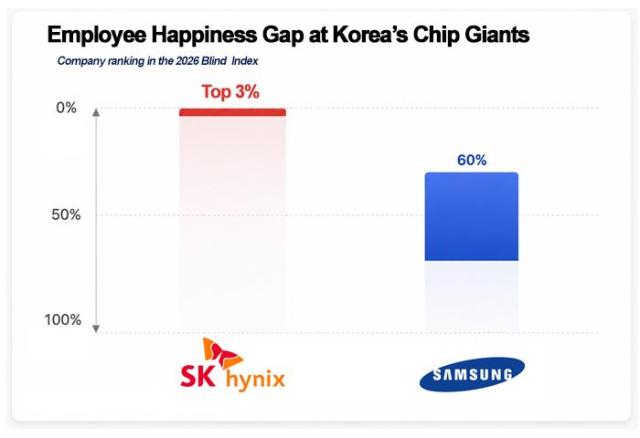
SK hynix ranked among the top 3 percent of South Korean companies for employee happiness while archrival Samsung Electronics placed around the top 60 percent, according to a workplace survey released Wednesday, underscoring how the AI memory boom is translating into starkly different perceptions of reward inside Korea's two biggest chipmakers.
The findings came from the latest Blind Index, compiled by workplace platform Blind using a methodology jointly developed with the Korea Labor Institute. The survey covered 34,372 South Korean employees between July and December last year and does not reflect this year's earnings and bonus windfall.
The divergence is notable as the two chipmakers compete for talent as fiercely as they do for leadership in artificial intelligence memory.
Money may be part of the answer.
SK hynix allocates 10 percent of annual operating profit to its profit-sharing, or PS, program after removing a previous payout cap. Based on this year's projected earnings, employees could receive around 700 million won ($486,000) each on average, although actual payouts vary by rank and individual performance.
Samsung Electronics has moved closer to that model this year after labor and management agreed to introduce a separate bonus for its Device Solutions chip division on top of its existing Overall Performance Incentive, or OPI, scheme.
Samsung has traditionally calculated OPI based on economic value added, with payouts capped at 50 percent of annual salary.
The new DS bonus instead draws from 10.5 percent of agreed business performance and carries no payout ceiling. Under current profit assumptions, employees in Samsung's highly profitable memory business could receive close to 600 million won in combined incentives, while payouts elsewhere could be far smaller depending on business performance.
The difference is not only how much employees receive, but how they receive it.
SK hynix pays 80 percent of its PS award in cash in the year it is earned, with the remaining 20 percent deferred over the following two years. Employees can also elect to receive part of their bonus in company shares.
Samsung's new semiconductor bonus, by contrast, will be paid entirely in Samsung Electronics shares after tax. One-third can be sold immediately, another third after one year and the remainder after two years.
The scheme is set to run through 2035 and is subject to annual operating-profit thresholds, marking Samsung's attempt to tie semiconductor compensation more directly to the profits generated by its chip business.
Public reviews on Blind also point to a gap between the companies. SK hynix currently carries an overall employee rating of 3.0 out of 5, compared with Samsung Electronics' 2.8. SK hynix scores 3.3 for compensation and benefits and 2.9 for corporate culture, while Samsung scores 3.0 and 2.7, respectively.
One person familiar with Samsung's workplace culture attributed part of the lower employee sentiment to what the source described as an intensely performance-driven environment, which has also exposed widening disparities between highly profitable chip operations and weaker businesses during the semiconductor boom.
"Samsung Electronics is highly goal-oriented, with individual performance often prioritized over collaboration," the source told AJP. "There are also internal systems through which employees can anonymously report their colleagues, which can create an atmosphere where people find it difficult to fully trust those they work with."
Blind's publicly available Samsung Index points to broader concerns over workplace culture. Samsung ranks relatively low on measures including employees' sense of meaning and importance in their work, workplace bonds, work-life balance and psychological safety, according to the platform.
The gap does not mean sentiment at SK hynix is uniformly positive.
Recent verified employee reviews on Blind praise compensation and benefits but also cite heavy workloads and dissatisfaction with management and labor negotiations, suggesting even some of the industry's richest bonuses have limits in determining workplace happiness.
Across corporate South Korea, employee sentiment deteriorated more broadly. Only 33 percent of companies surveyed received happiness scores of 50 or higher, down from 47 percent a year earlier, according to Blind.
The deterioration has not translated into greater employee mobility. The proportion of workers who attempted to change jobs over the past year fell despite lower happiness scores, suggesting a weaker labor market is keeping more dissatisfied workers where they are.
SK hynix ranked among the top 3 percent of South Korean companies for employee happiness while archrival Samsung Electronics placed around the top 60 percent, according to a workplace survey released Wednesday, reflecting how generous reward in cash instead of stock option influenced employees in rating their contentment with their employers.
The findings came from the latest Blind Index, compiled by workplace platform Blind using a methodology jointly developed with the Korea Labor Institute. The survey covered 34,372 South Korean employees between July and December last year.
The divergence is notable as the two chipmakers compete for talent and leadership in artificial intelligence memory.
Public reviews on Blind also point to a modest gap between the companies. SK hynix currently carries an overall employee rating of 3.0 out of 5, compared with Samsung Electronics' 2.8. SK hynix scores 3.3 for compensation and benefits and 2.9 for corporate culture, while Samsung scores 3.0 and 2.7, respectively.
One person familiar with Samsung's workplace culture attributed part of the lower employee sentiment to what the source described as an intensely performance-driven environment that resulted in a yawning chasm between profit-making chip and non-chip operations during the chip boom.
Blind's publicly available Samsung Index offers some support for broader concerns over workplace culture. Samsung ranks relatively low on measures including the perceived meaning and importance of employees' work, workplace bonds, work-life balance and psychological safety, according to the platform.
The gap comes despite mixed sentiment at SK hynix itself. Recent verified employee reviews on Blind praise compensation and benefits, while others cite heavy workloads and dissatisfaction with management and labor negotiations, suggesting the survey ranking does not translate into uniformly positive employee sentiment.'
SK hynix employees are moving to form a new unified union spanning production and technical-office workers as they seek greater bargaining power in a dispute over management's proposed changes to the bonus system.
More than 3,500 workers joined the preparatory group within three days of its launch, equivalent to about 10 percent of the company's workforce.
Across corporate South Korea, workplace happiness deteriorated more broadly. Only 33 percent of companies surveyed received happiness scores of 50 or higher, down from 47 percent a year earlier, according to Blind.
The decline, however, has not translated into greater employee mobility. The proportion of workers who attempted to change jobs over the past year fell despite lower happiness scores, suggesting a weaker labor market may be keeping dissatisfied employees in place.

Copyright ⓒ Aju Press All rights reserved.