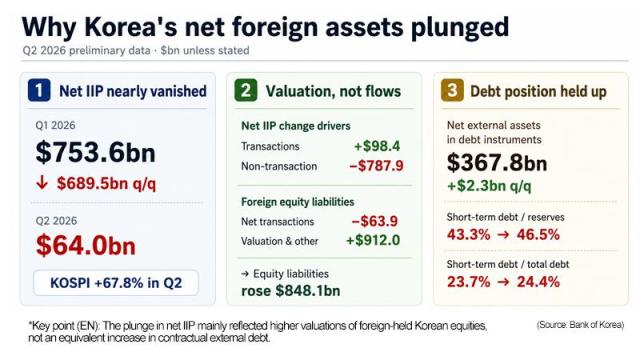
The country's net international investment position or net IIP fell by $689.5 billion from $753.6 billion at the end of March, according to preliminary data released by the Bank of Korea on Thursday.
"What matters, ultimately, is why it fell," the BOK said in a separate explanatory memo, saying that an increase in equity liabilities caused by higher stock valuations is different from an increase in debt, which must be repaid.
South Korea's external financial assets rose $201.7 billion to $3.08 trillion, while external financial liabilities jumped by $891.2 billion to $3.02 trillion.
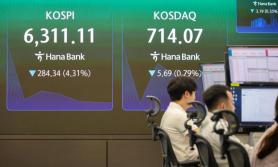
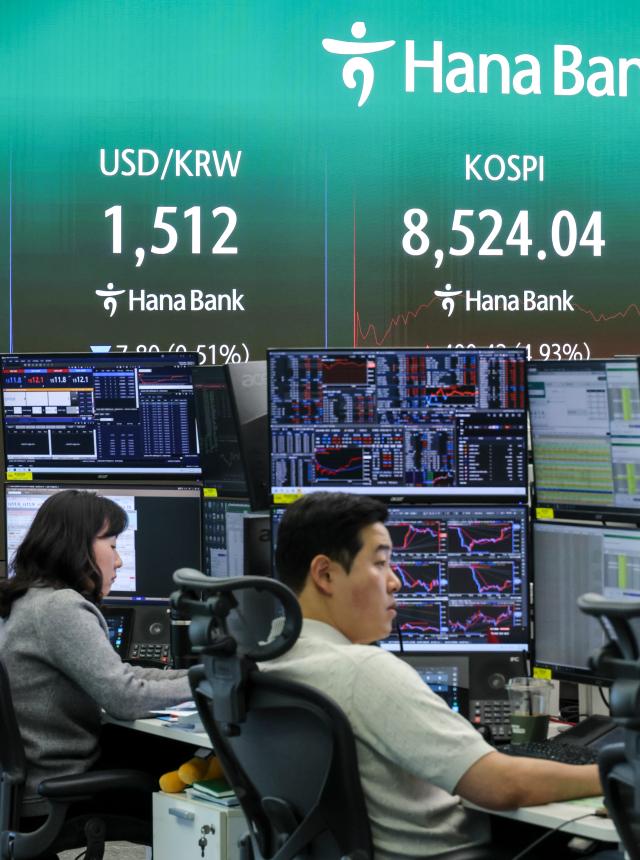
The KOSPI surged 67.8 percent in the second quarter to 8,476.5 from 5,052.5, sharply lifting the market value of Korean shares already held by overseas investors.
Actual transactions moved in the opposite direction from the headline net IIP, adding $98.4 billion to South Korea's net position while price, exchange-rate and other non-transaction effects reduced it by $787.9 billion.
Foreign portfolio-investment liabilities increased $859.3 billion during the quarter, with equity securities accounting for $848.1 billion of the increase.
Foreign investors, however, were net sellers of $63.9 billion of Korean equities, while valuation and other non-transaction effects added $912.0 billion to the value of their remaining holdings.
The increase in South Korea's external financial liabilities therefore reflected higher valuations of foreign-held shares rather than a comparable influx of new foreign investment.
The BOK linked the unusual pattern partly to semiconductor-led export strength, which supported current-account surpluses and overseas asset accumulation while boosting earnings expectations and domestic share prices.
Transaction effects associated with current-account surpluses added $191.0 billion to South Korea's net foreign assets in the first half, but the central bank said gains in foreign-held Korean equities outweighed that contribution.
External financial liabilities in the IIP include foreign ownership of domestic equities and direct-investment stakes as well as bonds, loans and other debt instruments.
A rise in the price of foreign-held Korean shares can therefore reduce the net IIP without creating an equivalent increase in principal or interest that South Korean borrowers are required to repay.
That distinction was visible in South Korea's net external assets in debt instruments, which rose $2.3 billion to $367.8 billion in the second quarter, marking the first increase in three quarters.
External assets in debt instruments increased $40.7 billion to $1.1806 trillion, while external debt rose $38.4 billion to $812.8 billion.
Short-term external debt nevertheless increased $15.0 billion to $198.5 billion, pushing its ratio to reserve assets to 46.5 percent from 43.3 percent and its share of total external debt to 24.4 percent from 23.7 percent.
The BOK said part of the increase reflected won deposits and unsettled balances generated by foreign equity sales, with the rise in short-term external debt exceeding the increase in reserve assets during the quarter.
The central bank cited Nokia-era Finland, ASML in the Netherlands and TSMC in Taiwan as previous cases in which soaring valuations of dominant exporters with high foreign ownership drove down national net foreign-asset positions.
South Korea's equity market is also highly concentrated, with Samsung Electronics common shares accounting for an average 28.24 percent of main-board capitalization in June and SK hynix for 24.96 percent, or a combined 53.2 percent, according to the Korea Financial Investment Association.
The BOK said such valuation-driven drops were associated with unusually sharp stock gains and that Korea's net IIP could increase again if domestic share-price gains moderate while current-account surpluses continue.
AJP Takeaways:
• Bank of Korea preliminary data show South Korea's net IIP fell by $689.5 billion to $64.0 billion in the second quarter, with valuation changes driving the bulk of the decline.
• Foreign investors sold a net $63.9 billion of South Korean equities even as valuation and other non-transaction effects added $912.0 billion to the value of their remaining holdings.
• South Korea's net external assets in debt instruments increased $2.3 billion to $367.8 billion, distinguishing the collapse in headline net IIP from the country's contractual external debt position.
• Samsung Electronics and SK hynix accounted for a combined 53.2 percent of main-board capitalization on a June-average basis, increasing the effect of chip-share valuations on South Korea's international balance sheet.

Copyright ⓒ Aju Press All rights reserved.