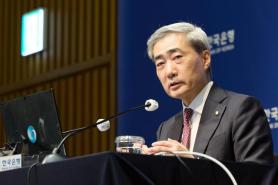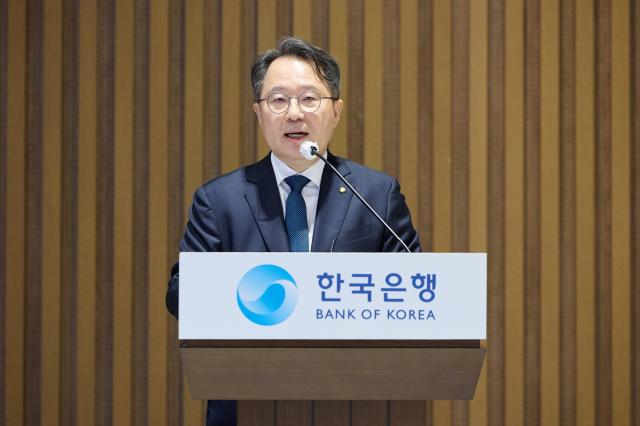
Kwon said semiconductor strength had lifted growth beyond earlier expectations, while inflation remained above the central bank's target and financial imbalances centered on household debt and housing prices persisted.
Exchange-rate volatility and geopolitical and trade risks meant policy decisions would need to remain "cautious and flexible," he said.
His remarks stop short of establishing Kwon as a monetary-policy hawk. But the risks he chose to emphasize are largely those that could constrain how quickly the BOK changes course after restarting rate increases last month.
The central bank raised its benchmark rate by 25 basis points to 2.75 percent on July 16, its first increase in three-and-a-half years, citing stronger export- and investment-led growth, above-target inflation and persistent financial-stability risks. All seven board members backed the move.
Kwon will have a say in what comes next almost immediately.
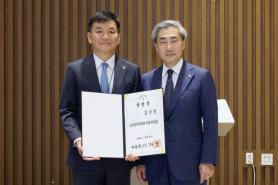
He began a three-year term Friday after being appointed to succeed Ryoo Sangdai, and the senior deputy governor serves ex officio on the BOK's seven-member Monetary Policy Board. His term runs through Aug. 20, 2029.
His elevation was not a surprise appointment.
Kwon and fellow deputy governor Park Jong-woo had both been cited as leading internal contenders for the post before the decision, while several former BOK executives were also discussed as possible candidates.
More revealing than the internal promotion itself may be the expertise the BOK has added to its top leadership.
Park built much of his career in monetary policy and financial markets, while Kwon's record is concentrated in foreign exchange, reserve management and international finance.
Kwon joined the BOK in 1995 and later worked in foreign-currency operations, the New York office and the Reserve Management Group before heading the International Department's foreign-exchange market team. He subsequently oversaw investment strategy and government-bond portfolios and became head of the Reserve Management Group in 2023.
Since becoming a deputy governor in May 2024, he has overseen international finance and cooperation, including responses to heightened FX-market volatility and work with the BIS, World Bank, G20 and EMEAP. That background was visible throughout Friday's address.
Kwon pledged to strengthen market analysis and open-market operations, help settle Korea's 24-hour FX trading system and advance won internationalization while ensuring greater market openness does not undermine financial stability.
The agenda puts him broadly in step with Shin rather than positioning him as a counterweight to the governor.
Kwon explicitly endorsed four priorities set out by Shin when he took office in April: cautious and flexible monetary policy, a stronger financial-stability role, won internationalization and payment-system innovation, and a greater contribution to structural reform.
Shin himself made financial stability a central theme of his inaugural agenda, arguing that uncertainty over inflation and growth required flexibility in monetary policy while the central bank broadened its approach to financial risks. He also put won internationalization and payment-system reform among his priorities.
The overlap suggests the two officials may differ less over which risks matter than over how they assess them.
Shin, an academic economist who spent years at Oxford, Princeton and the Bank for International Settlements, approaches policy through the lens of macro-finance, global liquidity and the links between financial institutions and markets.
Kwon brings the experience of a market practitioner who has managed reserves and dealt directly with foreign-currency liquidity and market volatility.
That combination could broaden the BOK leadership's perspective when exchange-rate movements complicate interest-rate decisions — with Shin assessing the wider macro-financial transmission and Kwon potentially adding a closer reading of currency supply and demand, liquidity and market functioning.
That remains an inference from Kwon's career rather than an established voting record.
His appointment also does not necessarily make the board more hawkish. Ryoo, his predecessor, had himself favored a rate increase in May before the board unanimously tightened policy in July.
What Kwon did make clear Friday was that stronger growth alone does not remove the constraints facing policymakers: inflation remains above target, household and property risks persist and the exchange rate remains part of the calculation.
His first test comes on Aug. 27, less than a week into the job, when he casts his first vote on interest rates. The decision should provide the first concrete indication of how Kwon translates a career spent managing Korea's exposure to global markets into monetary policy.
AJP Takeaways:
- Kwon's promotion was within expectations: He and Park Jongwoo had already been cited among leading internal candidates, making the appointment less a surprise than a choice between different areas of expertise.
- His first message leaned toward risk management: Kwon highlighted above-target inflation, household debt, housing prices and FX volatility while calling for "cautious and flexible" policy.
- Kwon looks more complement than counterweight to Shin: The two share a focus on financial stability and won internationalization, but Kwon adds deeper hands-on experience in FX and reserve markets.
- Aug. 27 will offer the first real policy signal: Kwon's first rate vote will show whether that market background translates into a distinct weighting of currency and financial-stability risks.
Copyright ⓒ Aju Press All rights reserved.