SEOUL, August 27 (AJP) -The Bank of Korea (BOK) sharply raised its 2026 growth forecast to 3.3 percent on Thursday, citing a stronger-than-expected semiconductor boom, hours after delivering a second consecutive interest-rate increase to contain persistent inflation pressure.
The central bank lifted this year's growth outlook by 0.7 percentage point from its May estimate of 2.6 percent. It also raised its 2027 projection to 2.9 percent from 2.1 percent.
The 2026 projection would mark South Korea's strongest annual growth since 2021.
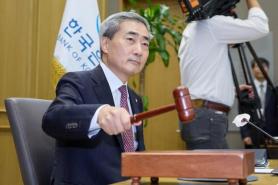
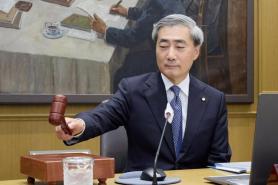
The upgrades reinforced the BOK's case for keeping monetary policy restrictive after the Monetary Policy Board raised the benchmark rate by 25 basis points to 3.00 percent in a 6-1 decision earlier Thursday.
Headline consumer inflation forecasts were unchanged at 2.7 percent for this year and 2.3 percent for next year.
Underlying inflation, however, was revised higher. Core inflation is now expected at 2.5 percent in both 2026 and 2027, compared with the previous projections of 2.4 percent and 2.3 percent.
The BOK said accumulated cost shocks were continuing to feed through into prices. Improving income conditions and stronger domestic demand were also gradually increasing demand-side pressure.
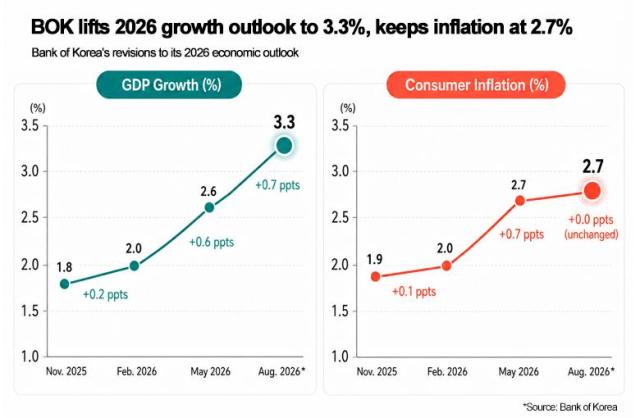
The BOK estimated that stronger-than-expected semiconductor activity added 0.35 percentage point to the revision. Chip export volumes and prices exceeded earlier expectations, while exports of AI-related products expanded.
Revisions to previously released economic data contributed another 0.20 percentage point.
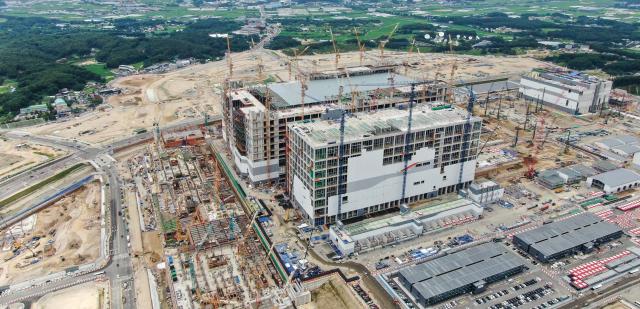
Faster investment linked to three major projects added 0.10 percentage point, while a smaller-than-expected impact from Middle East disruptions added another 0.10 point. Other factors partly offset those gains.
The improvement is concentrated largely in exports and investment.
Goods exports are now forecast to expand 9.7 percent this year, nearly double the 4.9 percent projected in May. Facilities investment is expected to grow 6.8 percent, up from the previous estimate of 4.4 percent.
Private consumption is projected to increase 2.1 percent, only slightly above the May forecast of 2.0 percent. The construction investment outlook was lowered to 0.2 percent from 0.6 percent.
The export boom is also expected to produce a record external surplus.
The BOK raised its 2026 current-account surplus forecast to $450.0 billion from $250.0 billion in May. That would far exceed the previous record of $123.1 billion posted last year.
The central bank said strong global AI investment was supporting semiconductor demand. Supply constraints were also lifting chip prices and widening the goods surplus.
The BOK expects the semiconductor cycle to remain strong into next year but said the outlook carries considerable uncertainty from the pace of AI investment and developments in the Middle East.
Its baseline scenario assumes global AI infrastructure investment will continue to expand and semiconductor exports will maintain strong growth. Production capacity is also expected to increase gradually.
Middle East supply disruptions are expected to ease as traffic through the Strait of Hormuz partially recovers and crude supplies increase through alternative routes.
The BOK assumes Brent crude will average $86 a barrel this year and fall to $74 a barrel next year, substantially below its May assumptions.
The central bank said stronger semiconductor exports and investment could provide additional upside to growth. A broader spillover of the IT boom into other sectors would also support the economy.
A pullback in AI investment, renewed Middle East tensions and heavier U.S. trade and tariff pressure were cited as major downside risks.
The revised outlook came after the BOK earlier Thursday lifted its policy rate to 3.00 percent, its second consecutive 25-basis-point increase.
Six of the seven board members supported the move. Hwang Kun-il favored keeping the rate at 2.75 percent.
The board's six-month conditional rate projections also shifted higher. Of 21 probability-weighted dots, 10 were placed at 3.25 percent and six at 3.50 percent, while five remained at 3.00 percent.
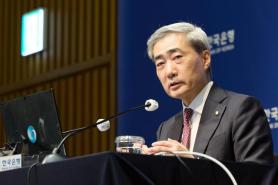
Gov. Shin Hyun-song nevertheless signaled that further tightening is likely to proceed more gradually after the back-to-back moves.
He said the median projection of 3.25 percent was broadly consistent with about one additional increase over the four policy meetings during the coming six months.
Shin stressed that the projections were conditional rather than a commitment. The BOK will first assess the impact of the July and August increases before deciding the timing of its next move.
The policy statement also shifted away from July's explicit language calling for a continued rate-hike stance.
The BOK instead said the timing and pace of further increases would depend on inflation, growth and financial-stability conditions.
Shin said policymakers would closely monitor August and September inflation figures, preliminary second-quarter nominal GDP and business sentiment ahead of the next rate decision.
The BOK also continues to see financial-stability risks from rising housing prices and household debt as a reason to maintain a restrictive policy stance.
Shin said the two preemptive increases should help contain inflation through their effects on domestic demand, the exchange rate and import prices.
The central bank said it would continue to monitor inflation and growth alongside housing prices, household debt and broader financial conditions when deciding the timing and pace of further tightening.
AJP Takeaways:
- The BOK raised its 2026 growth forecast by 0.7 percentage point to 3.3 percent after lifting the benchmark rate to 3.00 percent.
- A stronger semiconductor boom accounted for 0.35 percentage point of the growth upgrade, while the goods export growth forecast was nearly doubled to 9.7 percent.
- Headline inflation forecasts were unchanged, but core inflation was raised to 2.5 percent for both 2026 and 2027 as demand-side pressure strengthens.
- The BOK expects a record $450 billion current-account surplus, while Shin signaled that further rate increases are likely to proceed more gradually.
Copyright ⓒ Aju Press All rights reserved.